- All Posts
- /
- 5 Best ActiveCampaign Alternatives in 2026
-
 Chris Hexton
-
Updated:Posted:
On this page
ActiveCampaign is used by 180,000+ businesses in 170 countries. It includes a built-in CRM, 900+ integrations, and starts at $15/mo. For SMBs wanting email automation and pipeline management, it’s a default choice.
But its per-contact pricing charges for every address regardless of engagement. B2C businesses and B2B PLG teams with large inactive lists pay a steep penalty.
The platform is also built for marketers, not engineers. It has no native data warehouse integration and limited developer APIs. Engineering teams consistently find it difficult to integrate with product infrastructure.
This guide covers the 5 best ActiveCampaign alternatives for 2026. Each is evaluated on its own merits, with an honest comparison of where it outperforms ActiveCampaign.
What are the best ActiveCampaign alternatives?
The top 5 ActiveCampaign alternatives are Customer.io, Braze, HubSpot, Loops, and Vero.
Customer.io is the strongest alternative for product-led SaaS teams. It’s event-driven, developer-friendly, and supports WhatsApp. It still charges per profile and includes a CDP layer that creates overlap with Segment or RudderStack.
Braze suits organizations that need enterprise-grade AI personalization. It offers RCS and LINE channels backed by a $593M ARR public company. It requires full sales engagement before any evaluation.
HubSpot covers CRM plus inbound marketing in one platform. It has a broader free tier and faster-developing AI capabilities than ActiveCampaign. Its per-contact pricing creates the same structural problem.
Loops is the simplest option for early-stage SaaS teams. It’s email-only with no CRM overhead or per-contact pricing commitment.
Vero (our platform) charges only for active profiles. It connects directly to data warehouses via SQL. It’s designed to work alongside CDPs rather than replacing them.
Top ActiveCampaign alternatives — Comparison table
| Platform | Starting Price | Channels | Best For | Key Differentiator | Free Trial |
|---|---|---|---|---|---|
| Customer.io | $100/mo | Email · Push · In-app · SMS · WhatsApp | SaaS and B2B product teams wanting behavioral messaging | 9,000+ brands · built-in CDP · WhatsApp | Yes (14 days) |
| Braze | Custom (enterprise) | Email · SMS/RCS · WhatsApp · Push · In-app · LINE | Enterprise brands with dedicated marketing ops | $593M ARR public company · BrazeAI Decisioning | Demo required |
| HubSpot | Free / $15/mo+ | Email · SMS · Push · In-app · Ads | Teams wanting CRM + inbound marketing from one vendor | 228K customers · 1,500+ integrations · Breeze AI | Yes (Free plan) |
| Loops | Usage-based | Email only | Early-stage SaaS wanting simple email | Purpose-built for SaaS · No complexity overhead | Yes (No credit card) |
| Vero | $49/mo (annual) | Email · Push · In-app · SMS · Webhooks | Mid-market PLG and B2C SaaS with warehouse data | Active-profile pricing + direct warehouse SQL | Yes (14 days) |
Customer.io: Best ActiveCampaign alternative for product-led SaaS teams
ActiveCampaign is a tool that marketers configure and own. For companies whose messaging is driven by product behavior, that model creates constant friction. Campaign logic ends up disconnected from actual product data.
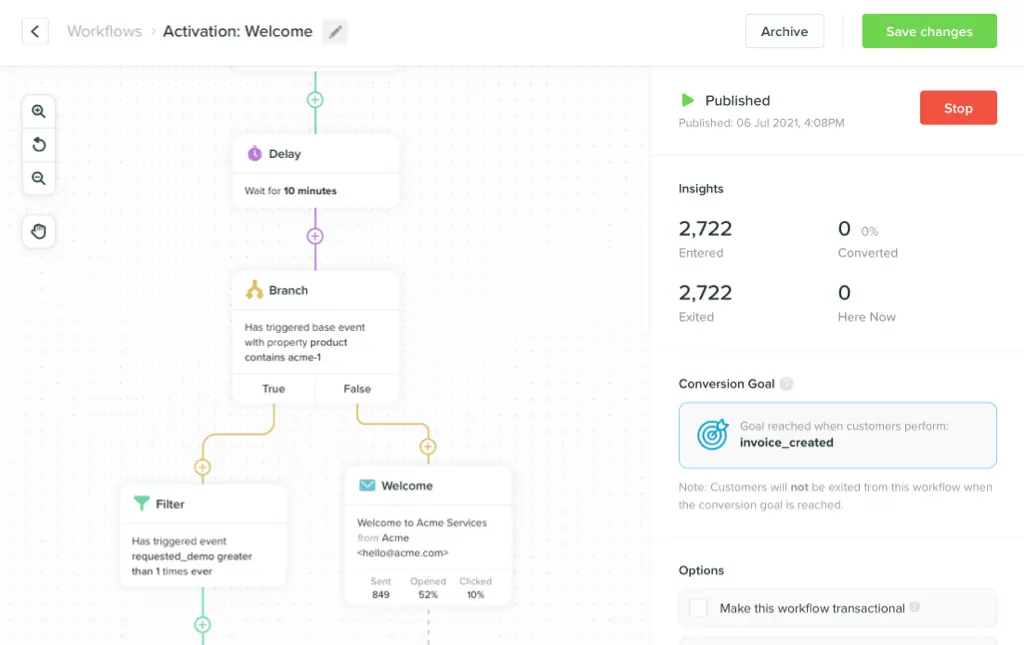
Customer.io is built around event-driven messaging. Its architecture supports onboarding sequences, activation nudges, and re-engagement flows triggered by real user behavior. The API-first design lets engineering teams integrate it cleanly.
The platform serves 9,000+ brands globally and processes billions of messages daily. WhatsApp support — which ActiveCampaign lacks — is included alongside email, push, in-app, and SMS.
The trade-offs are real. Per-profile pricing still counts all contacts, including inactive ones. The built-in CDP creates overlap spend for teams already running Segment or RudderStack.
Key features
- Event-triggered behavioral messaging: Campaigns driven by real-time product events — onboarding, activation, abandonment, lifecycle, retention
- Visual workflow builder: Drag-and-drop journey automation without engineering involvement for each change
- Built-in CDP layer: Data unification and activation; less dependent on external CDPs than Vero, but creates overlap if you already own one
- Omnichannel delivery: Email, push, in-app, SMS, WhatsApp
- A/B testing and cohort analysis: Test subject lines, content, timing, and channels
- Data pipelines: APIs, webhooks, and reverse ETL for connecting product data
- Custom objects: Enhanced personalization using complex data models
- Design Studio: No-code message creation for marketing teams
Pricing
| Plan | Price | Notes |
|---|---|---|
| Essentials | $100/mo | 5,000 profiles · 1M emails/mo · 2 object types |
| Premium | $1,000/mo | Custom volume · 10 object types · Dedicated support |
| Enterprise | Custom | Priority support · Dedicated CSM · Dedicated hardware |
| Startup program | Free 12 months | Startups raising under $10M |
Pros & cons
Pros:
- Purpose-built for behavioral, event-driven messaging — a significant step up from ActiveCampaign’s automation model for product teams
- WhatsApp channel support that ActiveCampaign doesn’t offer
- 9,000+ brands and billions of daily messages signal proven infrastructure
- Developer-friendly API and data pipeline architecture
- Startup program provides free access for early-stage companies
Cons:
- Per-profile pricing still charges for inactive contacts — same structural problem as ActiveCampaign for B2C and PLG businesses
- Built-in CDP creates overlap spend for teams already using Segment, RudderStack, or Hightouch
- $100/mo entry price is higher than ActiveCampaign’s $15/mo or Vero’s $49/mo
- No built-in CRM for teams that actually need deal pipeline management
Customers
Notion, Pipedrive, StuDocu, Kraft Heinz, Zara USA, Schneider Electric. 4.4/5 on G2 with 709 reviews.
Customer.io gave our team the ability to build complex behavioral flows that would have been impossible to maintain in ActiveCampaign. – Customer.io customer
Braze: Best ActiveCampaign alternative for enterprise teams at scale
ActiveCampaign serves 180,000+ businesses, mostly SMBs. Its product is calibrated for accessible pricing and marketer-friendly UX. For organizations with dedicated marketing ops teams, it becomes a limitation.
Braze is the most recognized customer engagement platform at enterprise scale. It’s a $593M ARR public company (Nasdaq: BRZE) with 2,300+ customers across 195 countries. BrazeAI Decisioning Studio delivers 1:1 personalization using predictive, generative, and agentic intelligence.
Channels include WhatsApp, RCS, and LINE alongside email, SMS, push, and in-app. Braze Currents streams real-time data to warehouses — a gap ActiveCampaign doesn’t address.
The trade-off: no public pricing, mandatory sales engagement, and annual contracts. If the issue is data integration or engineering friction, this is the wrong direction.
Key features
- BrazeAI™: Predictive, generative, and agentic intelligence across all channels — send time optimization, content generation, intelligent journey branching
- BrazeAI Decisioning Studio™: 1:1 personalization at scale, not rule-based segmentation
- Braze Data Platform: Data unification, activation, and real-time streaming (Currents) to warehouses
- Full channel coverage: Email, SMS/RCS, WhatsApp, Mobile push, Web push, In-app messaging, LINE
- Journey orchestration: Multi-channel automation with real-time behavioral triggers
- Full analytics and attribution suite: Revenue attribution, campaign performance, cohort analysis
- 15 offices across 5 continents: 195-country global infrastructure
Pricing
Custom (contact sales). Usage-based on MAUs and message volume. Enterprise annual contracts standard. No published tiers.
Pros & cons
Pros:
- Most recognized CEP brand globally — reduces internal procurement friction at enterprise
- BrazeAI suite is the deepest AI personalization capability in the category
- Channel breadth (WhatsApp, RCS, LINE) exceeds ActiveCampaign and most alternatives
- $593M ARR public company signals long-term product investment and stability
- Currents provides real-time data streaming to warehouses that ActiveCampaign entirely lacks
Cons:
- No published pricing; requires full sales engagement before any evaluation
- Enterprise contracts mean 12-month+ commitments and significant upfront cost
- Implementation overhead — not suitable for lean or SMB teams
- Overkill for businesses that don’t need enterprise-grade AI personalization or 195-country infrastructure
- Per-MAU pricing doesn’t offer the active-profile advantage of platforms like Vero
Customers
Burger King, Grubhub, NBA, HBO Max, Paramount, KFC, Skyscanner, PureGym, NASCAR, OkCupid. 4.5/5 on G2 with 1,412 reviews.
Braze let us move from batch-and-blast to genuinely 1:1 messaging at a scale our previous platform couldn’t touch. – Braze customer
HubSpot: Best ActiveCampaign alternative for inbound marketing teams
ActiveCampaign and HubSpot both include CRM and marketing automation. Both target SMBs and mid-market businesses. Both charge on a per-contact basis.
The philosophies differ in one key way. ActiveCampaign was built around email automation and lead nurturing sequences. HubSpot was built around inbound — content, SEO, lead capture, and nurture as a connected system.
HubSpot’s Marketing Hub includes landing pages, forms, and native ad management. Its free tier provides real utility before any paid commitment. Breeze AI is advancing content generation and personalization rapidly.
The shared limitation: per-contact pricing is equally punishing for B2C and PLG businesses. Professional starts at $800/mo — a steep jump from the $15/mo Starter. Neither platform has native data warehouse integration.
Key features
- Full CRM platform: Marketing, Sales, Service, Operations, and Commerce hubs — one platform across the entire customer lifecycle
- HubSpot AI / Breeze: Content generation, send time optimization, predictive lead scoring, conversational chatbots
- Inbound marketing suite: Landing pages, forms, SEO tools, lead capture
- Native ad management: Facebook, Google, LinkedIn from within HubSpot
- Visual workflow builder: Email sequences, lifecycle automation, lead nurturing
- 1,500+ app integrations: Broadest ecosystem in this comparison
- SMS, push, and in-app messaging: Marketing Hub Professional and above
- Reporting and attribution dashboards: Full-funnel analytics
Pricing
| Plan | Price | Notes |
|---|---|---|
| Free | $0 | Limited CRM + email marketing; real utility for small teams |
| Starter | From $15/mo | 1,000 contacts · Basic automation |
| Professional | From $800/mo | Advanced automation · A/B testing · SMS · Push |
| Enterprise | From $3,600/mo | Full AI suite · Advanced reporting · Custom objects |
Contact-based pricing; scales with list size.
Pros & cons
Pros:
- Full CRM + inbound marketing in one platform — stronger content and SEO tooling than ActiveCampaign
- Free tier provides genuine utility for teams evaluating before committing
- 1,500+ integrations — widest ecosystem in this comparison
- Breeze AI is accelerating content generation and personalization capabilities
- 228K customers and strong brand recognition reduces buying committee friction
Cons:
- Per-contact pricing is as punishing for B2C and PLG teams as ActiveCampaign
- Not built for product-triggered behavioral messaging — better for inbound/CRM-led journeys
- No native data warehouse integration — not designed for product behavioral data at scale
- Scales steeply: $800/mo for Professional is a significant jump from the $15/mo Starter
- Engineering teams consistently cite HubSpot as difficult to integrate with product infrastructure
Customers
228,000+ businesses across 135 countries. 4.4/5 on G2 with 12,000+ reviews.
HubSpot gave us our inbound engine and our CRM in one place — the handoff between marketing and sales became a non-issue. – HubSpot customer
Loops: Best ActiveCampaign alternative for early-stage SaaS teams
ActiveCampaign’s feature breadth has a cost. Configuration overhead, per-contact pricing, and a platform designed for generalist SMBs add up. For early-stage SaaS founders, most of it is wasted spend.
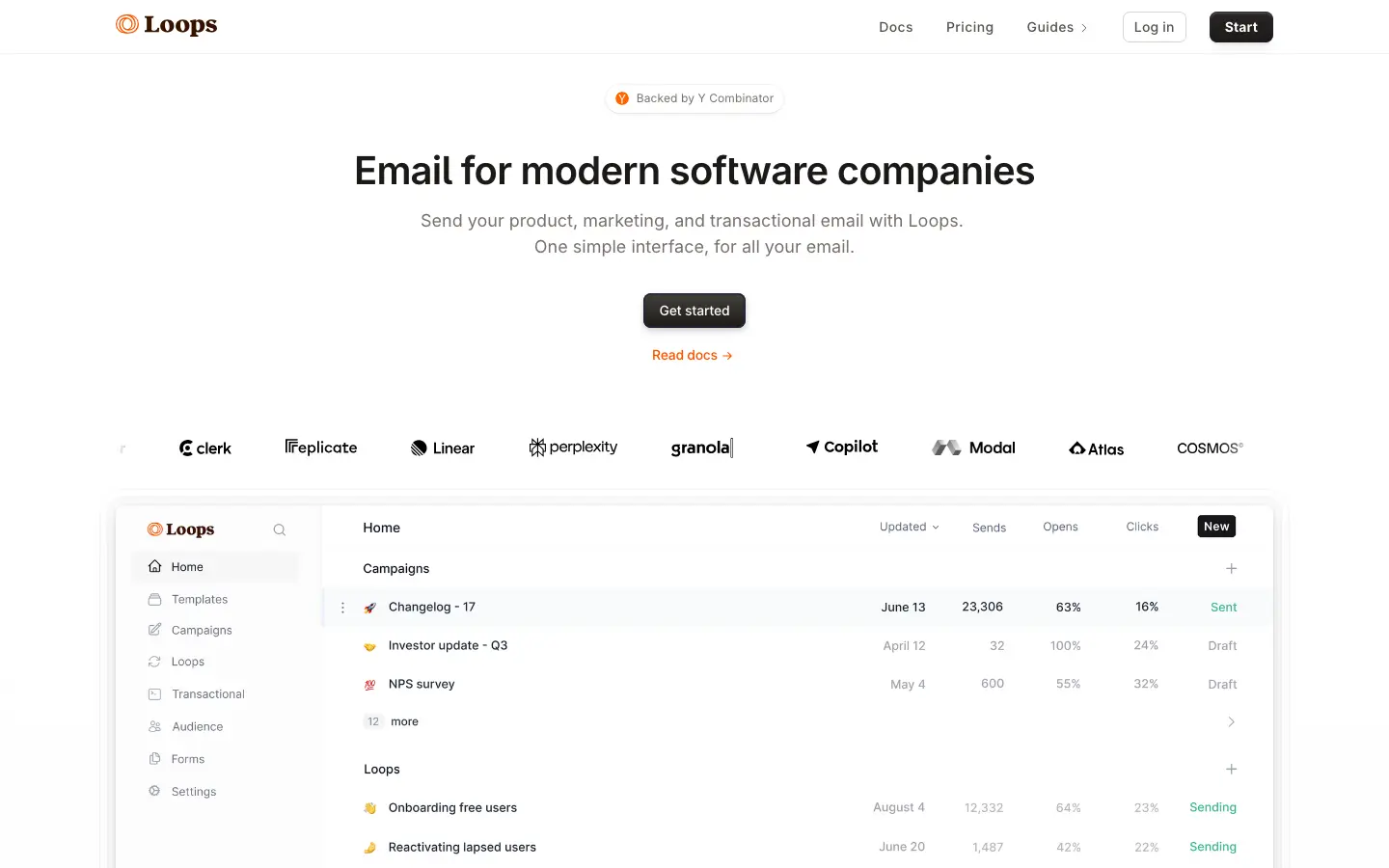
Loops is email for SaaS, nothing more. Transactional and marketing email come from one platform with templates designed for SaaS onboarding patterns. There’s no CRM, no push, no in-app channel.
The limitation is also the value. Loops works well until your messaging needs outgrow email-only. At that stage, a simpler tool at lower cost beats paying for unused features.
Key features
- Transactional and marketing email from one platform: No split between providers or accounts
- SaaS-specific templates: Onboarding, activation, churn prevention, newsletters — designed for common SaaS patterns
- Event-triggered automation: Behavioral triggers based on product activity
- Simple audience segmentation: Filter by user properties and event history
- Clean, minimal interface: Built for founders and small teams, not marketing operations specialists
- API and integration support: Standard data ingestion for SaaS stacks
- Usage-based pricing: No credit card required to start
Pricing
Usage-based with public tiers. No credit card required. Free to start.
Pros & cons
Pros:
- Purpose-built for SaaS — templates, language, and defaults match common product patterns
- No complexity overhead — can be operational in hours, not days
- Usage-based pricing with a free start removes cost barriers for early-stage teams
- No CRM overhead for teams that don’t need deal pipeline management alongside email
Cons:
- Email only — no push, in-app, SMS, or webhooks
- No data warehouse integration or connected audience segmentation
- Not suitable for companies with complex product data or multi-channel messaging needs
- Not a long-term platform for companies with maturing behavioral messaging requirements
Customers
Early-stage SaaS companies and product-led growth teams.
Loops got us to good product emails in an afternoon. We weren’t ready for the complexity of anything heavier. – Loops customer
Vero: Best ActiveCampaign alternative for B2C and product-led software companies
Disclosure: Vero is our platform. We’ve included it here for a specific type of ActiveCampaign customer — product-led and B2C software companies needing behavioral messaging tied to warehouse data. We’ve been honest about where it does and doesn’t fit.
ActiveCampaign’s per-contact pricing charges for your full database. A B2C business with 200,000 total users and 40,000 actives pays for 200,000. That mismatch is baked in — no configuration change fixes it.
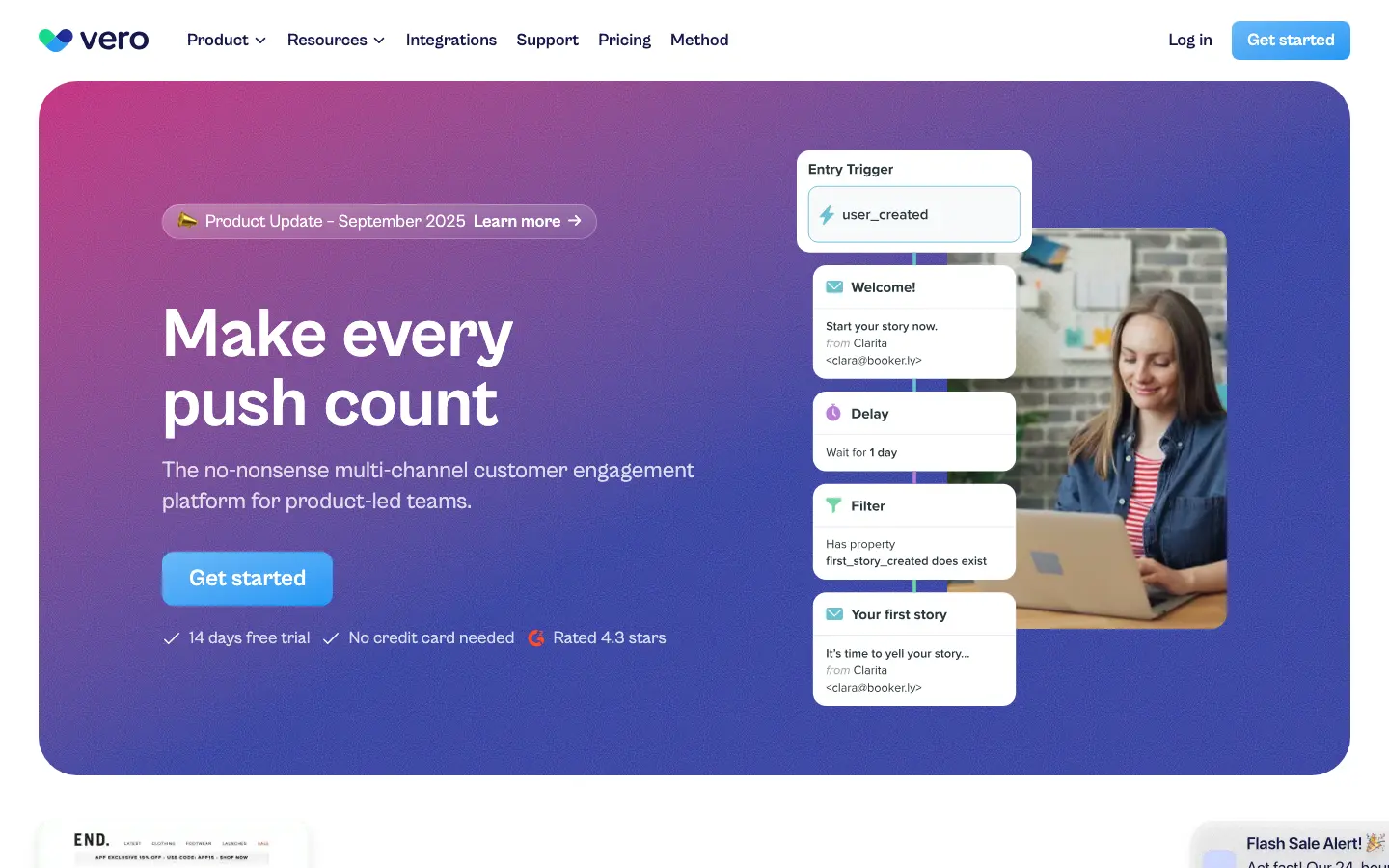
Vero charges only for active profiles. That same business pays for 40,000. For product-led growth companies, that’s often a 60–80% cost reduction at comparable scale.
The second issue is data. ActiveCampaign has no native data warehouse integration. Teams with data in Snowflake, BigQuery, or Redshift need a separate sync layer to use it in campaigns.
Vero’s Connected Audiences connects directly to warehouse databases via SQL. You use your warehouse data for segmentation without storing a copy inside Vero. The platform pairs with CDPs rather than duplicating them.
We needed something that scales with our send volumes, not our user counts. – Lawrence Scotland, Sr. Director, Dribbble
Key features
- Active-profile pricing: Charges only for users active in the billing period — not total database size; structural cost advantage for B2C and PLG businesses
- Connected Audiences / Data Warehouse integration: Direct SQL access to Snowflake, BigQuery, Redshift, PostgreSQL, MySQL, SQL Server — no API sync layer, no data duplication
- Best-of-breed CDP fit: Works alongside Segment, RudderStack, Hightouch, Census; no CDP spend overlap
- Event-triggered behavioral messaging: Onboarding, activation, abandonment, lifecycle, retention — all driven by product behavior
- Visual journey builder: Multi-channel workflow automation operable by marketing teams without engineering involvement
- Multi-channel delivery: Email, iOS/Android push, in-app messaging, SMS, webhooks coordinated in a single workflow
- Developer-credible infrastructure: Full API, developer guide, 12 years of production scale — 5B+ messages/year at 99.99% uptime
Pricing
| Plan | Price | Includes |
|---|---|---|
| Starter | $49/mo (annual) or $54/mo | 5,000 active profiles · 10,000 emails/mo · 20,000 push/mo · 160,000 events/mo · Unlimited seats |
| Professional | Custom | Scales all dimensions · SMS · Unlimited seats · Fair use overage policy |
14-day free trial, no credit card required.
Pros & cons
Pros:
- Active-profile pricing is a structural cost advantage over ActiveCampaign’s per-contact model for B2C and PLG businesses
- Direct warehouse SQL integration removes the need for a sync layer to get product data into the messaging tool
- Lower entry price ($49/mo annual) than CustomerIO ($100/mo) with a more favorable pricing model at scale
- 12-year track record with proven infrastructure — 5B+ messages/year, 99.99% uptime
- Best-of-breed stack positioning works for teams already invested in Segment, RudderStack, or Hightouch
Cons:
- No WhatsApp channel yet (in development) — Customer.io and Braze have this
- Smaller customer base and brand recognition than ActiveCampaign’s 180,000+
- No built-in CRM — not the right choice for teams that need deal pipeline alongside messaging
- SMS channel is newer and less mature than email and push
Customers
Dribbble, Unsplash, Pipedrive, Stockpile, and 50+ companies globally. 4.3/5 on G2.
It didn’t make sense to be paying for everything when we don’t need all that stuff. – Vincent Turner, CEO, Uno
Frequently asked questions
Why would I look for an ActiveCampaign alternative?
The most common reasons fall into a few categories.
Pricing model: ActiveCampaign charges per contact regardless of engagement. This compounds costs for B2C and B2B PLG companies with large inactive lists.
Data integration: There’s no native warehouse integration. Product-first companies need a sync layer to use Snowflake or BigQuery data in campaigns.
Developer friction: Engineering teams consistently find ActiveCampaign hard to integrate. This creates friction when the platform becomes a constant backend concern.
Channel needs: As companies mature, ActiveCampaign’s email-first origins show in push and in-app maturity.
Does ActiveCampaign charge for inactive subscribers?
Yes. Pricing is based on total contact count — all records, regardless of engagement. A business with 50,000 contacts pays the same rate whether 5,000 are active or all 50,000 are.
For B2C and PLG companies with heavily inactive databases, this creates persistent overpayment. Vero’s active-profile model is the most direct structural alternative.
Which ActiveCampaign alternative is best if I already have a data warehouse?
Vero. ActiveCampaign has no native warehouse integration — connecting Snowflake, BigQuery, or Redshift requires a custom sync pipeline or reverse ETL middleware.
Vero’s Connected Audiences connects directly via SQL. You use existing data for segmentation and personalization without storing a copy inside the platform.
Which ActiveCampaign alternative is best if I need CRM included?
HubSpot. It has broader inbound marketing capabilities — SEO tools, landing pages, and native ad management. Breeze AI is advancing content generation faster than ActiveCampaign.
The trade-off: Professional starts at $800/mo with the same per-contact pricing structure. Neither HubSpot nor ActiveCampaign suits B2C or PLG businesses penalized by contact-based billing.
Which alternative is best for a B2C business with a large subscriber list?
Vero. The active-profile model charges only for users active in the billing period. A business with 300,000 total subscribers and 50,000 actives pays for 50,000 — not 300,000.
This is the most material pricing difference in the category for B2C businesses. ActiveCampaign, Customer.io, and HubSpot all charge on total contact count.
How does Vero compare to ActiveCampaign for PLG SaaS?
Vero is built specifically for product-led software companies; ActiveCampaign is not. Vero’s active-profile pricing charges for engaged users — favorable for PLG’s large free-user / small paying-user ratio. It also connects directly to data warehouses via SQL.
ActiveCampaign’s CRM layer adds complexity that pure PLG companies don’t need. Its per-contact pricing is a persistent cost penalty at scale.
How difficult is it to migrate from ActiveCampaign?
ActiveCampaign exports contacts, automation data, and campaign history in standard formats. Most platforms support CSV imports and API/webhook ingestion for event data.
The main work is recreating automation logic. Vero’s support team manages migration onboarding and can typically get teams live in days. Braze requires the most time due to enterprise implementation overhead.
Conclusion: Choosing your ActiveCampaign alternative
ActiveCampaign serves SMBs and mid-market businesses that want email automation plus CRM from one vendor. For that buyer, it remains a defensible choice.
For product-led and B2C software companies with large inactive segments and warehouse data, Vero is the clearest alternative. Active-profile pricing, direct warehouse SQL, and best-of-breed CDP compatibility removes the cost penalty and data sync overhead at once.
For teams that have grown into enterprise messaging requirements — complex personalization, WhatsApp and RCS channels — Braze is the next step up.
For SaaS product teams that need behavioral event-driven messaging rather than CRM-led automation, Customer.io is the most direct step up — developer-friendly and trusted by 9,000+ brands.
For teams that want CRM and inbound marketing more deeply integrated than ActiveCampaign offers, HubSpot is the natural comparison — broader tooling and a rapidly improving AI layer.
For early-stage SaaS companies that just need clean product email, Loops is purpose-built and operable in hours.
Want to see how Vero’s active-profile pricing compares to what you’re paying ActiveCampaign today? Start a free trial — no credit card required, no sales call needed.