- All Posts
- /
- 5 Best Braze Alternatives in 2026
-
 Chris Hexton
-
Updated:Posted:
On this page
Braze is a $593M ARR public company with 2,300+ customers across 195 countries. It’s backed by $175M in funding, built for enterprise scale, and used by Burger King, HBO Max, and the NBA. If that sounds like your organization, Braze is probably on your shortlist for good reason.
But for most product-led software companies, mid-market SaaS businesses, and mobile app teams, Braze’s pricing model creates a problem before any feature conversation starts. Braze doesn’t publish pricing — every quote requires a sales process — and typical annual contracts start in the tens of thousands of dollars. Implementation projects are measured in weeks. Teams without dedicated marketing engineers often find themselves underusing the platform they’re paying heavily for.
This guide covers the 5 best Braze alternatives for 2026. Each platform is evaluated on its own merits with an honest look at where it outperforms Braze and where it falls short.
What are the best Braze alternatives?
The top 5 Braze alternatives are Vero, Customer.io, Iterable, OneSignal, and CleverTap.
Vero is the most practical option for mid-market product-led teams — transparent pricing starting at $49/mo, direct data warehouse integration without API overhead, and support teams across North America, Europe, and Australia. Customers typically save 30—50% versus Braze. Customer.io matches Braze’s channel breadth (including WhatsApp) with public pricing starting at $100/mo and a 12-month free startup program. Iterable is the closest feature-for-feature Braze competitor with $343M in funding, purpose-built for experience-focused brands that need Braze-level capabilities at a lower contract threshold.
OneSignal is the strongest alternative for mobile and push-first teams — 4.7/5 on G2 with 1,155 reviews, 2M+ businesses on the platform, and a free tier with real utility. CleverTap leads for mobile-first international brands, particularly in Southeast Asia, India, and MENA, with a pricing floor around $72/mo and a 30-day free trial.
Top Braze alternatives — Comparison table
| Platform | Starting Price | Channels | Best For | Key Differentiator | Free Trial |
|---|---|---|---|---|---|
| Vero | $49/mo (annual) | Email · Push · In-app · SMS · Webhooks | Mid-market PLG, B2C SaaS, mobile apps | Data warehouse-native segmentation + active-profile pricing | Yes (14 days) |
| Customer.io | $100/mo | Email · Push · In-app · SMS · WhatsApp | SaaS teams wanting transparent pricing + CDP | Built-in CDP + 12-month free startup program | Yes (14 days) |
| Iterable | Custom | Email · Push · In-app · SMS | Mid-market and enterprise wanting Braze-like features | $343M funded · Iterable Nova AI suite | Demo required |
| OneSignal | Free / $19/mo | Push · Email · SMS · In-app | Mobile and push-first app teams | 4.7/5 G2 · 2M+ businesses · free tier with real utility | Yes (Free plan) |
| CleverTap | ~$72/mo | Email · Push · SMS · In-app · WhatsApp · RCS | Mobile-first international brands | Dominant in SEA/India/MENA · CleverAI + IntelliNODE | Yes (30 days) |
Vero: Best Braze alternative for mid-market product-led teams
Braze’s enterprise model assumes you have a dedicated marketing engineer, a lengthy implementation runway, and a contract budget in the tens of thousands. Vero starts at $49/mo, publishes its pricing, requires no sales call to get started, and gets teams live without a multi-week implementation project.
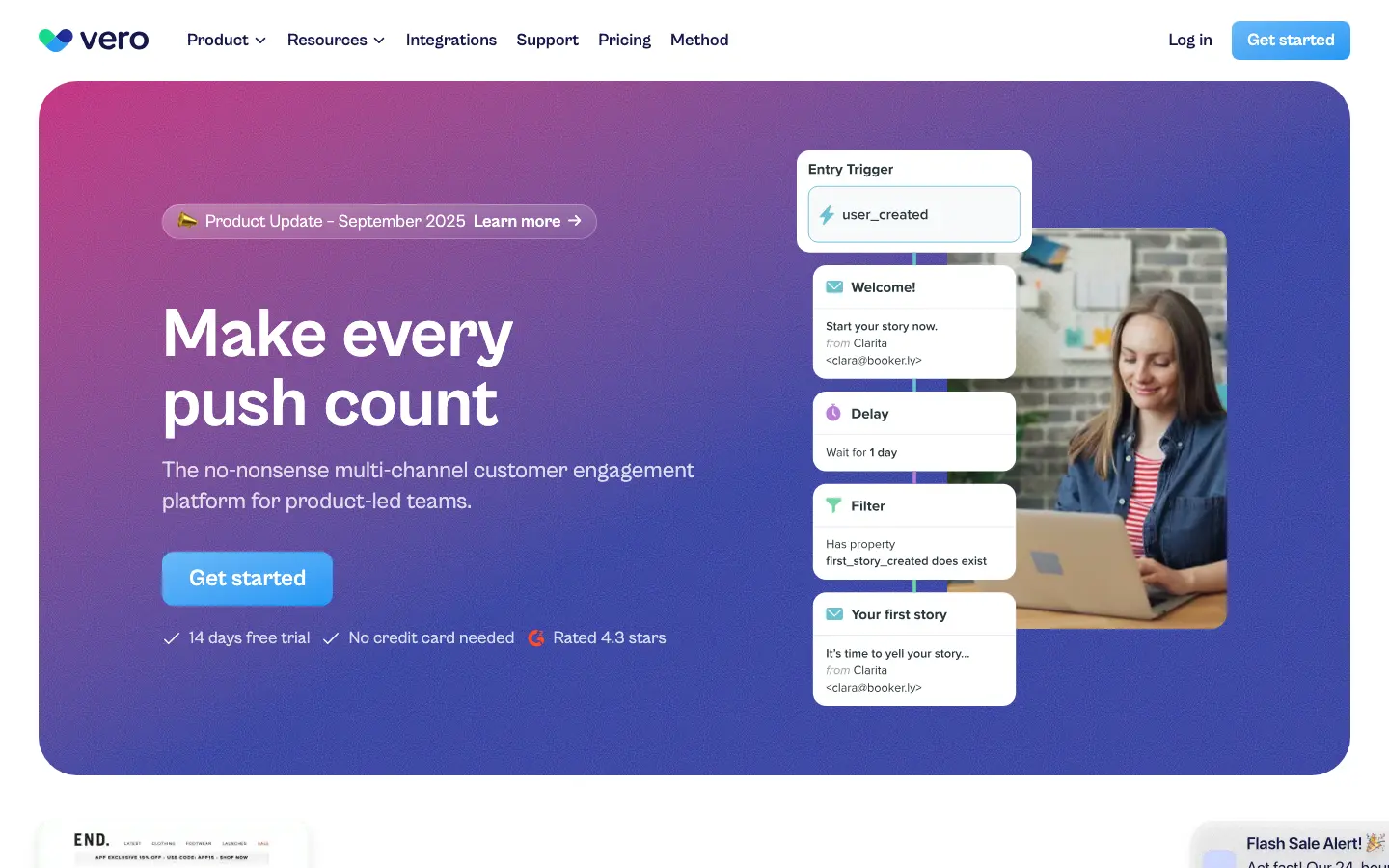
The structural difference between Vero and Braze isn’t just price — it’s who the platform is built for. Braze is built for brands with large marketing operations teams. Vero is built for the product and engineering teams that are most frustrated when marketing picks a tool they can’t integrate cleanly. The result: developer-reliable infrastructure with an interface product and marketing teams can operate without an engineer on every change.
Two capabilities set Vero apart from every other platform on this list. Connected Audiences lets teams query their Snowflake, BigQuery, Redshift, PostgreSQL, or SQL Server data directly — no API integrations, no data duplication, no sync latency. And Vero’s active-profile pricing charges only for users who are actually active, not your entire database — a structural cost advantage for B2C and B2B PLG businesses with large inactive lists.
It didn’t make sense to be paying for everything when we don’t need all that stuff.
— Vincent Turner, CEO, Uno
Key features
- Connected Audiences / Data Warehouse integration: Direct SQL connections to Snowflake, BigQuery, Redshift, PostgreSQL, MySQL, and SQL Server — use any warehouse data for segmentation without storing it in Vero
- Active-profile pricing: Charges only for users with activity in the billing period — not your total subscriber count; meaningful cost savings for B2C and PLG businesses
- Best-of-breed CDP fit: Designed to pair with Segment, RudderStack, Hightouch, or Census — no duplicative CDP spend; no "buy our CDP to use our messaging" lock-in
- Event-triggered behavioral messaging: Send messages based on what users do (or don’t do) in the product; onboarding, activation, abandoned flows, lifecycle
- Visual journey builder: Build and maintain multi-channel automated workflows without engineering involvement
- Behavioral segmentation: High-specificity segmentation based on event history, profile attributes, and warehouse data
- Multi-channel delivery: Email, iOS/Android push, in-app messaging, SMS, and webhooks coordinated within a single workflow
- Support across North America, Europe, and Australia: 24/5 email support with a team known for responsiveness — no enterprise contract required to access it
Pricing
All plans include unlimited team members. 14-day free trial, no credit card required.
| Plan | Price | Includes |
|---|---|---|
| Starter | $49/mo (annual) or $54/mo | 5,000 active profiles · 10,000 emails/mo · 20,000 push/mo · 160,000 events/mo |
| Professional | Custom | Scales all dimensions · SMS · Fair use overage policy with notifications |
Customers switching from Braze typically save 30-50% on total platform cost, including reduced spend on separate CDP tooling.
Pros & cons
Pros:
- Transparent pricing with a 14-day free trial — no sales process to evaluate the platform
- Active-profile pricing saves significant cost for B2C and PLG teams with large inactive lists
- Data warehouse integration (Connected Audiences) eliminates the CDC/API sync layer required with most other platforms
- Best-of-breed stack positioning means no forced CDP spend — Vero pairs cleanly with tools you already own
- Developer-credible platform with a 12-year track record, 5B+ messages/year, 99.99% uptime
Cons:
- Smaller feature surface than Braze — no equivalent to BrazeAI Decisioning Studio or Currents at scale
- No WhatsApp channel yet (in development)
- 50+ customer case studies vs Braze’s 2,300+ customer brand recognition
- SMS is newer and less mature than email and push
Customers
Vero serves Dribbble, Unsplash, Pipedrive, Stockpile, and 50+ companies globally. It holds a 4.3/5 G2 rating and has delivered 5B+ messages annually with 99.99% uptime since 2012.
We needed something that scales with our send volumes, not our user counts.
— Lawrence Scotland, Sr. Director, Dribbble
Customer.io: Best Braze alternative for teams wanting transparent pricing and CDP features
Braze’s pricing is entirely opaque — there’s no public pricing page, no self-serve trial, and no way to evaluate cost without a sales conversation. Customer.io publishes its pricing, starts at $100/mo, and offers a 14-day free trial and a 12-month free program for early-stage startups.
Customer.io is the closest equivalent to Braze for teams that want enterprise-grade channel breadth (including WhatsApp) without the enterprise contract overhead. It supports email, push, in-app, SMS, and WhatsApp from a single platform, processes billions of messages and webhooks daily, and has 9,000+ brands on the platform — three times Braze’s customer count.
The key trade-off versus Vero: Customer.io has built its own CDP layer, which is useful if you don’t already have a CDP but creates duplicative spend if you do. It also charges per total profile, not just active users — which can make it significantly more expensive than Vero for B2C teams with large inactive lists.
Key features
- Omnichannel messaging: email, push, in-app, SMS, WhatsApp
- Visual workflow builder with advanced branching and delay logic
- Built-in CDP with custom objects for deep personalization
- Data pipelines with APIs, webhooks, and reverse ETL
- A/B testing and cohort analysis
- Ad audience synchronization (Facebook, Google)
- Dedicated hardware and CSM on Enterprise tier
- Startup program: 12 months free for companies raising under $10M
Pricing
| Plan | Price | Notes |
|---|---|---|
| Essentials | $100/mo | 5,000 profiles · 1M emails/mo · 2 custom object types |
| Premium | $1,000/mo | Custom volume · 10 object types · Dedicated support |
| Enterprise | Custom | Priority support · Dedicated CSM · Dedicated hardware |
14-day free trial available.
Pros & cons
Pros:
- Published pricing with a free trial: no sales process for evaluation
- WhatsApp channel support that Braze offers and Vero doesn’t yet
- Built-in CDP for teams that don’t already have one
- 9,000+ customers and strong brand recognition; Notion, Pipedrive among named customers
- Startup program provides 12 months free: significant for early-stage teams
Cons:
- Per-total-profile pricing disadvantages B2C and PLG businesses with large inactive lists
- Built-in CDP creates duplicative spend for teams already using Segment or RudderStack
- $100/mo entry is higher than Vero’s $49/mo (annual)
- No direct data warehouse integration comparable to Vero’s Connected Audiences
Customers
Customer.io serves 9,000+ brands globally including Notion, Pipedrive, StuDocu, Kraft Heinz, and Zara USA. It holds a 4.4/5 G2 rating with 709 verified reviews.
Customer.io lets our marketing team move fast without waiting on engineering for every campaign change.
— Customer.io customer
Iterable: Best Braze alternative for mid-market teams wanting Braze-level capabilities
Iterable is the most direct feature-for-feature Braze competitor on this list. $343M raised, $240M ARR, a $2B valuation, and an AI suite (Iterable Nova) built to match Braze’s investment in predictive and generative intelligence. If your team evaluated Braze and wants equivalent capability at a lower entry contract, Iterable is the primary alternative.
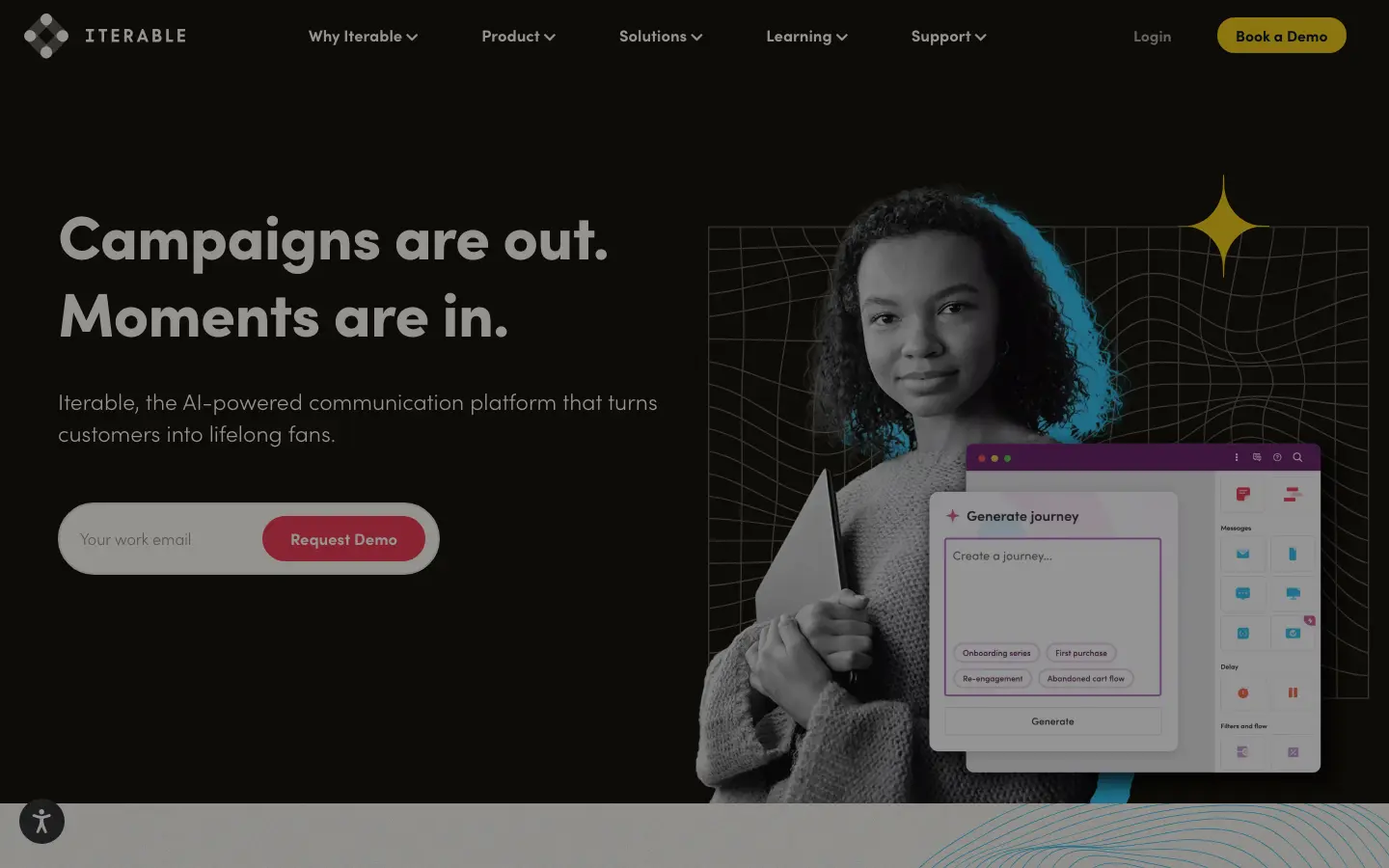
The practical difference between Iterable and Braze is scale orientation. Braze is built for the largest enterprise brands with dedicated marketing operations teams. Iterable is built for experience-focused mid-market and upper-mid-market companies (Asana, Square, Redfin, Morning Brew) that need sophisticated journey orchestration without the enterprise overhead that comes with being a $593M ARR public company.
The honest trade-off: Iterable still requires a sales process and custom pricing. There’s no self-serve evaluation, no public pricing page, and contracts are annual. It’s not a drop-in replacement for teams looking to escape enterprise sales cycles. It’s the right choice when you genuinely need Braze-tier feature depth at a lower total cost.
Key features
- Iterable Nova. AI-powered suite: send time optimization, brand affinity scoring, predictive goals
- Cross-channel journey orchestration. Email, mobile push, web push, in-app, SMS
- Activate Data. Data activation across your existing tech stack
- Engage 1:1. Behavioral lifecycle messaging with deep personalization
- Optimize Strategy: A/B testing, analytics, and reporting
- Iterable AI Suite: predictive modeling without a data science team
Pricing
Custom pricing, annual contracts. Demo required. No published tiers.
Pros & cons
Pros:
- Closest feature parity to Braze with 857 employees and $343M in funding behind ongoing product investment
- Iterable Nova AI suite is a genuine capability investment matching Braze’s AI direction
- Strong mid-market customer base: Asana, Square, Redfin, Fender, Priceline, Morning Brew
- 4.5/5 on G2 with 691 reviews: comparable rating to Braze’s 4.5/5 with 1,412 reviews
Cons:
- No public pricing or self-serve trial: requires full sales engagement before evaluation
- Annual contracts standard; not suitable for teams that want flexibility
- Per-subscriber pricing model (not active-profile) disadvantages B2C and PLG businesses
- G2 reviewers flag reporting features as an area needing improvement
Customers
Iterable serves Asana, Square, Redfin, Priceline, Fabletics, Fender, NHL, Morning Brew, Box, and Wolt. It holds a 4.5/5 G2 rating with 691 verified reviews.
Iterable gives us the personalization depth we needed at a scale that didn’t require Braze’s contract size.
— Iterable customer
OneSignal: Best Braze alternative for mobile and push-first teams
Braze started as "Appboy", a mobile push notification tool: before expanding into a full CEP. OneSignal is still primarily a push platform, and for teams where mobile push is the core channel, that focused heritage translates into deeper SDK coverage, better mobile documentation, and more mature mobile-specific capabilities than any other tool on this list.
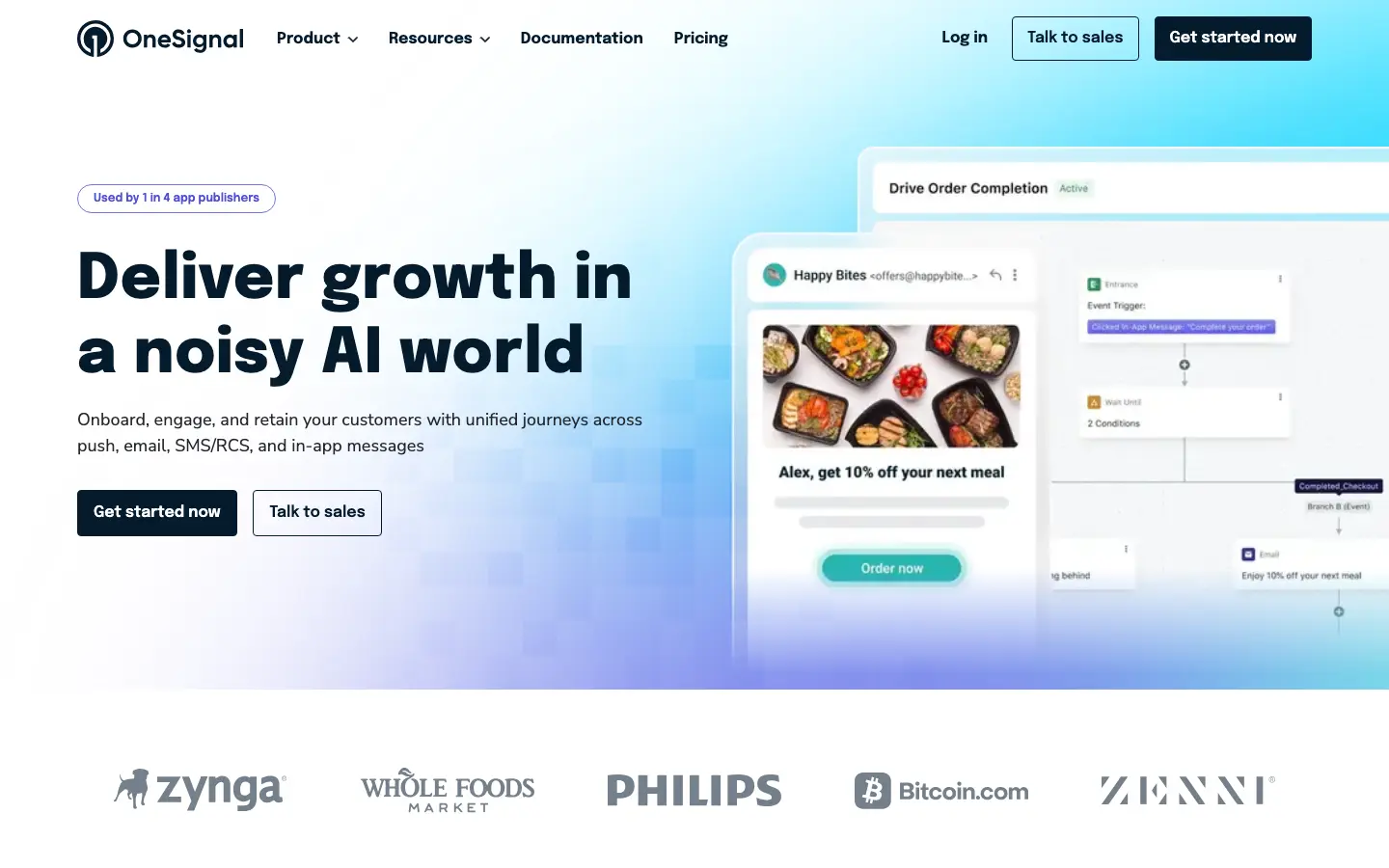
The numbers back the positioning: 1 in 4 app publishers use OneSignal. 2M+ businesses. 12B+ messages per day. 4.7/5 on G2 with 1,155 reviews: the highest G2 rating in this comparison by a meaningful margin. And it’s the only platform here that offers a genuinely useful free plan (unlimited mobile push, 10K emails/month) with no credit card required.
OneSignal’s limitation is also its strength: it’s built around push. Email, SMS, and journey depth are secondary capabilities. Teams that need sophisticated behavioral email automation, data warehouse integration, or lifecycle campaign complexity will find the platform’s ceiling lower than Braze or Vero.
Key features
- Mobile push notifications: Android, iOS, Flutter, React Native, Expo, Unity SDK coverage
- Web push notifications
- Email and SMS as secondary channels
- In-app messaging and Live Activities (iOS)
- Journey orchestration and personalization
- REST APIs, webhooks, and event streams
- Analytics and lifecycle measurement
- SDKs across every major mobile development framework
Pricing
| Plan | Price | Notes |
|---|---|---|
| Free | $0 | Unlimited mobile push · 10K emails/mo · 1 active journey · 6 segments |
| Growth | From $19/mo | 20K emails included · Mobile push $0.012/MAU · Web push $0.004/subscriber |
| Professional | Custom | 20 journeys · Advanced analytics · CSV exports |
| Enterprise | Custom | Frequency capping · Dedicated success manager · SLA |
Pros & cons
Pros:
- 4.7/5 G2 rating with 1,155 reviews: highest customer satisfaction score in this comparison
- Free plan provides genuine value: unlimited mobile push and 10K emails/month with no credit card
- Deepest mobile SDK coverage in the category: Flutter, React Native, Expo, Unity all supported
- 2M+ businesses provides scale for network-effect product improvements
- Starting at $19/mo vs Braze’s enterprise-only pricing
Cons:
- Push-first heritage: email and SMS are secondary capabilities, not core strengths
- Journey orchestration and behavioral email less mature than Braze, Vero, or CustomerIO
- No native data warehouse integration
- Growth plan per-MAU pricing for push can become expensive at scale for high-engagement apps
Customers
OneSignal serves Zenni Optical, Zynga, Whole Foods, Philips, DHL, Royal Caribbean, Porsche, and Bitcoin.com. It holds a 4.7/5 G2 rating with 1,155 verified reviews.
OneSignal is incredibly easy to integrate and the push delivery rates are excellent — we were live in a day.
— OneSignal customer
CleverTap: Best Braze alternative for mobile-first international brands
Braze has a strong US and European presence and competes most aggressively in those markets. CleverTap is the dominant customer engagement platform across Southeast Asia, India, and MENA: and for brands with significant user bases in those regions, the localization depth, data residency options, and regional support coverage are hard to replicate elsewhere.
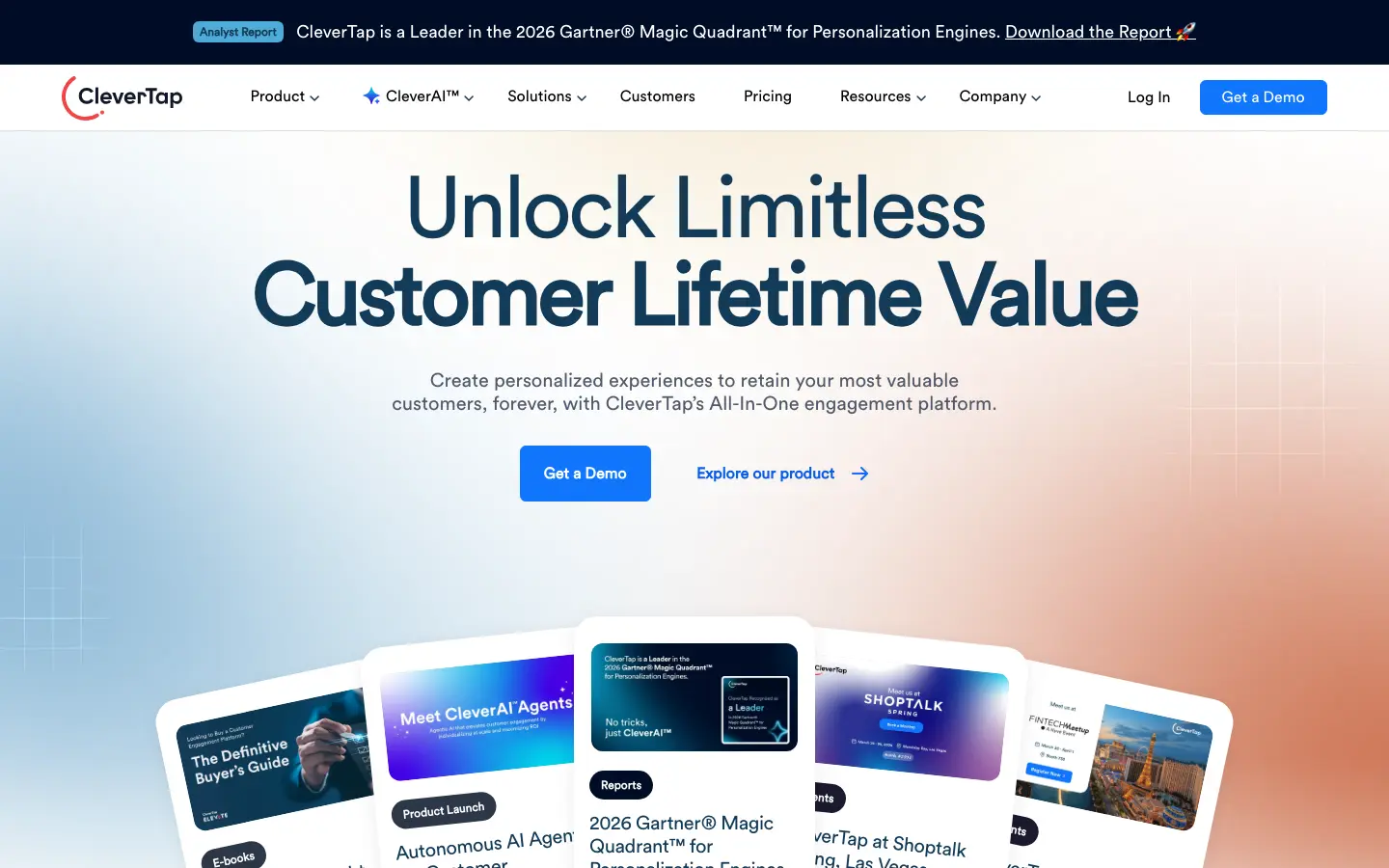
Founded in 2013 in Mumbai, CleverTap serves 2,000+ brands worldwide with a channel set that includes email, mobile push, SMS, in-app, web push, WhatsApp, and RCS. Its AI suite (CleverAI + IntelliNODE) is built directly into journey orchestration — IntelliNODE analyzes user behavior in real time and routes each user to the journey path most likely to produce a conversion, without manual A/B test setup.
For teams outside Southeast Asia and India, CleverTap is still worth evaluating — particularly if WhatsApp, RCS, or deep loyalty/promo mechanics are requirements. The starting price (~$72/mo for 5,000 MAU) with a 30-day free trial makes it accessible for evaluation without a sales commitment.
Key features
- CleverAI: AI-powered intelligence layer across all campaign types
- IntelliNODE: real-time AI journey branching based on live behavioral signals
- Predictive segmentation: without manual model configuration
- Product recommendations engine
- RFM analysis and lifecycle optimization
- WhatsApp, RCS, and SMS Direct as first-class channels
- Visual editor for in-app experiences
- Promos and Loyalty management module
- 10-year data retention (Cutting Edge tier)
- SFTP data imports and regional data residency options
Pricing
| Plan | Notes |
|---|---|
| Essentials | From ~$72/mo (5,000 MAU); scales to 100K+ MAU |
| Advanced | Custom: adds hyper-personalization, automated segmentation, Facebook/Google Ads integration |
| Cutting Edge | Custom: adds CleverAI suite, IntelliNODE, predictive segmentation, product recommendations |
Add-on modules available: Advanced Email, WhatsApp, RCS, SMS Direct, Product Experiences, Visual Editor, Loyalty. 30-day free trial.
Pros & cons
Pros:
- Dominant CEP in Southeast Asia, India, and MENA: unmatched regional infrastructure and support
- WhatsApp, RCS, and SMS Direct as first-class channels — stronger than Braze in this specific area for some markets
- CleverAI + IntelliNODE AI suite built directly into journey orchestration (not an add-on)
- Loyalty and promo module for brands that need retention mechanics beyond standard messaging
- 30-day free trial and accessible starting price (~$72/mo)
Cons:
- Less developer-friendly than Vero or Braze; not built for engineering-influenced buying decisions
- No direct data warehouse integration comparable to Vero’s Connected Audiences
- All-in-one positioning means limited best-of-breed CDP compatibility
- Primary strength is mobile; pure web and SaaS-first companies may find weaker fit
Customers
CleverTap serves 2,000+ brands worldwide. It has a strong presence in consumer apps, fintech, and e-commerce across Asia and emerging markets.
CleverTap’s regional infrastructure and WhatsApp support made it the right fit for our Southeast Asian user base.
— CleverTap customer
Frequently asked questions
Why would I look for a Braze alternative instead of Braze itself?
Braze is purpose-built for enterprise organizations with dedicated marketing operations teams and significant annual budgets. The platform requires a sales process before any pricing discussion, implementation projects often run weeks, and typical contracts start well above what most mid-market software companies budget for a messaging platform.
If your team is in the 50—1,000 employee range, runs a product-led or B2C model, or wants to evaluate a platform without a procurement cycle, a Braze alternative will likely give you more value at a lower cost — and get you live faster.
How much does Braze cost compared to alternatives?
Braze does not publish pricing. Based on market data and customer reports, annual contracts typically start in the range of $60,000—$120,000+ per year for mid-market customers, with enterprise contracts substantially higher. By comparison, Vero starts at $49/mo (annual), CustomerIO starts at $100/mo, and OneSignal has a free tier with a paid plan from $19/mo.
Which Braze alternative has the best data warehouse integration?
Vero is the strongest option here. Connected Audiences provides direct SQL access to Snowflake, BigQuery, Redshift, PostgreSQL, MySQL, and SQL Server — no API sync layer, no data duplication in Vero, no ETL pipeline required. You write your audience query in SQL and Vero uses it directly. Braze offers Currents for data streaming out to warehouses, but importing warehouse data into Braze still requires separate integration work.
Which Braze alternative is best for B2C or product-led growth businesses?
Vero. The active-profile pricing model is the key differentiator: Vero charges only for users who are active in the billing period. B2C businesses typically have large databases with a small percentage of active users at any given time — most CEPs, including Braze, CustomerIO, and Iterable, charge based on total subscribers or MAUs regardless of engagement. Dribbble specifically chose Vero because they needed pricing that scales with send volumes rather than user counts.
Which Braze alternative is best for mobile push?
OneSignal. 1 in 4 app publishers already use it. The SDK coverage spans Android, iOS, Flutter, React Native, Expo, and Unity — the deepest in the category. It has a 4.7/5 G2 rating with 1,155 reviews, a useful free tier, and Growth plans starting at $19/mo. For push-primary use cases, OneSignal beats Braze on both accessibility and community, even if Braze’s overall platform is broader.
Does switching from Braze require a lengthy migration?
It depends on the platform. Vero’s support team specifically positions around getting teams live without "lengthy implementation projects" — its hands-on support model and direct warehouse integration are designed to reduce migration overhead. CustomerIO also offers a 14-day free trial and self-serve setup. Iterable is closer to Braze in implementation complexity. OneSignal and CleverTap are generally faster to implement for their primary use cases.
Which alternative is best if I already have a CDP (Segment, RudderStack, Hightouch)?
Vero. It’s the only platform on this list that deliberately doesn’t include a built-in CDP — and that’s a feature, not a gap. Competitors like CustomerIO and Braze have built CDP layers that create duplicative spend if you already own a CDP. Vero pairs directly with Segment, RudderStack, Hightouch, and Census without overlap, which reduces total stack cost and avoids the data governance complexity of maintaining two CDPs.
Conclusion: Choosing your Braze alternative
Braze is the enterprise standard for a reason — $593M ARR, 2,300+ customers, and a feature set built for marketing operations teams at scale. But for most mid-market product-led teams, it’s more platform than the problem requires, at more cost than the budget allows.
For mid-market B2C and product-led SaaS teams, Vero is the strongest alternative. Active-profile pricing eliminates the cost penalty for large inactive lists, Connected Audiences integrates directly with the data warehouse you already own, and the platform has been delivering 5B+ messages/year at 99.99% uptime since 2012 — without an enterprise contract. Teams switching from Braze typically save 30—50%.
For teams that want Braze’s channel breadth (including WhatsApp) with transparent pricing, Customer.io provides the closest equivalent at $100/mo with a 14-day free trial. The built-in CDP is useful if you don’t already have one; if you do, Vero’s best-of-breed positioning makes more sense.
For teams that genuinely need Braze-tier feature depth — predictive AI, sophisticated journey orchestration, multi-brand workspaces — Iterable is the right comparison. It requires a sales process and annual contract, but at a lower threshold than Braze for most organizations.
For mobile-first and push-heavy teams, OneSignal is the clearest win — highest G2 score in the category, deepest SDK coverage, free tier that works, and Growth plans from $19/mo.
For international brands with significant Southeast Asia, India, or MENA user bases, CleverTap covers channels (WhatsApp, RCS) and provides regional infrastructure that no Western-headquartered competitor matches at a comparable price.
Ready to see how Vero compares to Braze for your stack? Start a 14-day free trial — no credit card required, no sales call needed.