- All Posts
- /
- 5 Best Customer.io Alternatives in 2026
-
 Chris Hexton
-
Updated:Posted:
On this page
Customer.io has built a strong position in the mid-market engagement space. 9,000+ brands, transparent pricing starting at $100/mo, a 14-day free trial, and a channel set that includes WhatsApp — things most enterprise competitors won’t offer without a sales call. The platform has grown organically to become a genuine alternative to Braze for teams that want capability without a six-figure contract.
But Customer.io’s model creates friction for specific buyer types. Its per-profile pricing counts every subscriber regardless of activity — a structural problem for B2C businesses and B2B PLG teams whose databases have large inactive segments. The platform has also built out a CDP layer to compete with Segment and RudderStack, which is useful if you don’t already own a CDP, but generates duplicative spend if you do. And at $100/mo for the Essentials plan, it’s above the entry price of several capable alternatives.
This guide covers the 5 best Customer.io alternatives for 2026 — each evaluated on its own merits, with an honest comparison of where it outperforms Customer.io and where it doesn’t.
What are the best Customer.io alternatives?
The top 5 Customer.io alternatives are Vero, Braze, HubSpot, Knock, and Loops.
Vero is the most direct substitute for B2C and PLG teams frustrated by Customer.io’s per-profile pricing. It charges only for active users, integrates directly with data warehouses via SQL without duplicating data, and pairs cleanly with existing CDPs rather than replacing them. Customers typically save 30-50% versus comparable Customer.io plans. Braze is the right move for teams that have outgrown Customer.io and need enterprise-grade AI personalization, RCS and LINE channels, or the credibility of a $593M ARR public company behind their messaging infrastructure.
HubSpot is the alternative for teams that want CRM and marketing automation from a single vendor — it brings Customer.io’s lifecycle messaging depth into the same platform as pipeline management, deal tracking, and sales tooling. Knock is built for engineering teams that want notification infrastructure in code — version-controlled templates, CLI integration, CI/CD workflows — rather than a marketing platform operated by a non-technical team. Loops is the simplest option for early-stage SaaS companies that need transactional and marketing email from one place without the overhead of a full CEP.
Top Customer.io alternatives — Comparison table
| Platform | Starting Price | Channels | Best For | Key Differentiator | Free Trial |
|---|---|---|---|---|---|
| Vero | $49/mo (annual) | Email · Push · In-app · SMS · Webhooks | Mid-market PLG, B2C SaaS, mobile apps | Active-profile pricing + direct warehouse SQL | Yes (14 days) |
| Braze | Custom (enterprise) | Email · SMS/RCS · WhatsApp · Push · In-app · LINE | Enterprise brands with dedicated marketing ops | $593M ARR public company · BrazeAI Decisioning | Demo required |
| HubSpot | Free / $15/mo+ | Email · SMS · Push · In-app · Ads | Teams wanting CRM + marketing from one vendor | 228K customers · 1,500+ integrations · Breeze AI | Yes (Free plan) |
| Knock | Free / $250/mo | Email · Push · SMS · In-app · Slack · Teams | Engineering-led teams building notification infra | Version-controlled templates · CLI · CI/CD | Yes (Free plan) |
| Loops | Usage-based | Email only | Early-stage SaaS wanting simple email | Purpose-built for SaaS · No complexity overhead | Yes (No credit card) |
Vero: Best Customer.io alternative for B2C and product-led teams
Customer.io charges $100/mo for 5,000 profiles — and every profile counts toward that total, active or not. For a B2C business with 100,000 total subscribers and 15,000 actives, you’re paying for 100,000. Vero charges only for users with activity in the billing period, which for the same business means paying for 15,000.
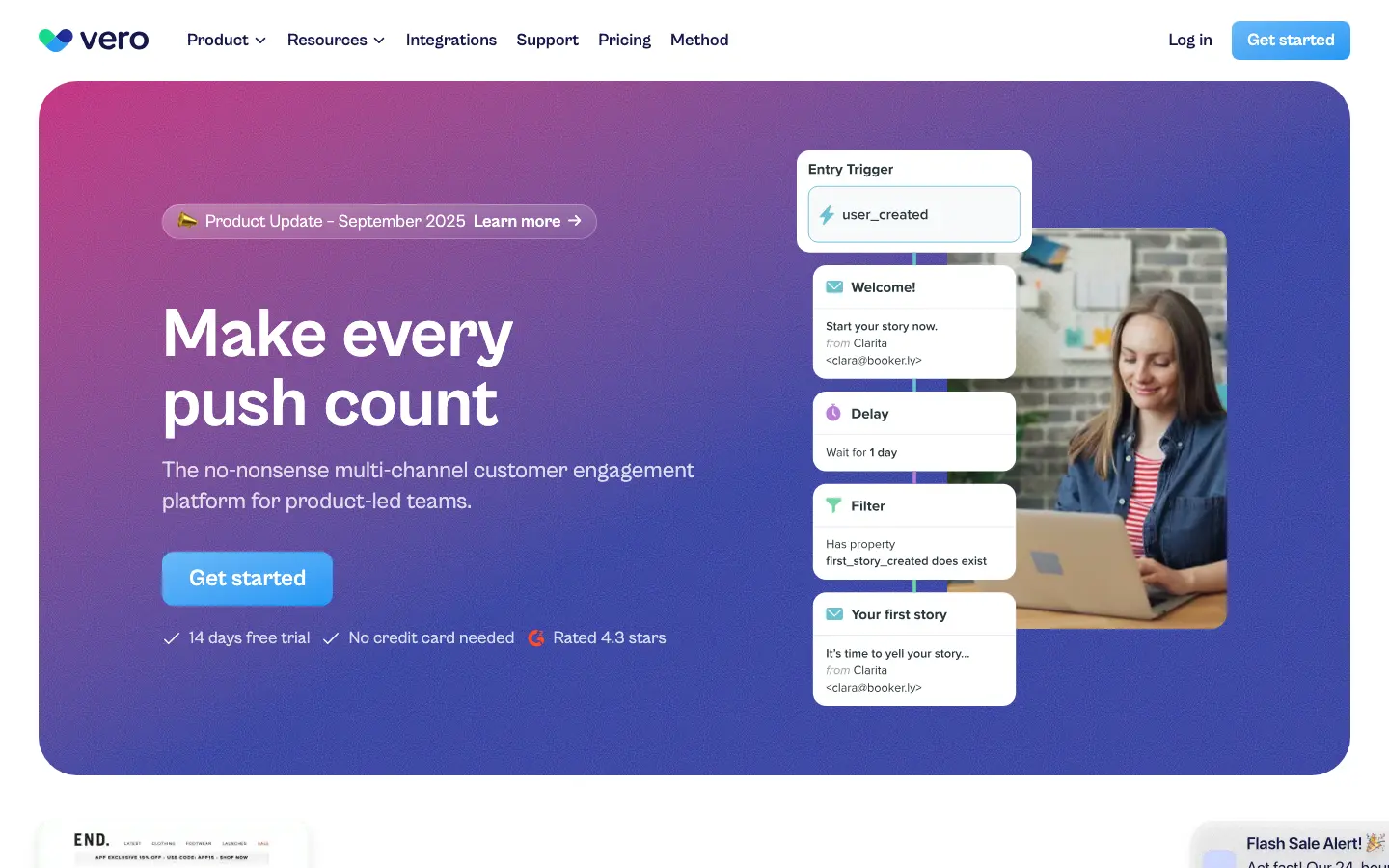
That pricing difference compounds for any company following a product-led growth model — large top-of-funnel, smaller engaged core, valuable data in a warehouse rather than in the messaging tool. Customer.io has built a CDP to compete with Segment and RudderStack, which creates duplicative cost and governance complexity for teams that already own a CDP. Vero deliberately skips the CDP layer: it connects directly to Snowflake, BigQuery, Redshift, PostgreSQL, MySQL, and SQL Server via SQL, letting you use warehouse data for segmentation and personalization without storing a copy in Vero.
The product overlap with Customer.io is real: event-triggered behavioral messaging, visual journey builder, behavioral segmentation, A/B testing, multi-channel delivery. Where Vero wins is the architectural fit for B2C and PLG buying patterns — pricing aligned with the active-user model, warehouse-native data access, and a platform that pairs with CDPs rather than competing with them.
We needed something that scales with our send volumes, not our user counts.
— Lawrence Scotland, Sr. Director, Dribbble
Key features
- Active-profile pricing: Charges only for users active in the billing period — not total database size; material cost advantage for B2C and PLG businesses
- Connected Audiences / Data Warehouse integration: Direct SQL access to Snowflake, BigQuery, Redshift, PostgreSQL, MySQL, SQL Server — no API sync layer, no data duplication
- Best-of-breed CDP fit: Works alongside Segment, RudderStack, Hightouch, Census rather than duplicating them; no CDP spend overlap
- Event-triggered behavioral messaging: Send messages based on what users do (or don’t do); onboarding, activation, abandonment, lifecycle, retention
- Visual journey builder: Multi-channel workflow automation without engineering involvement for each change
- Multi-channel delivery: Email, iOS/Android push, in-app messaging, SMS, webhooks coordinated in a single workflow
- Developer-credible infrastructure: Full API, developer guide, 12 years of production scale — 5B+ messages/year at 99.99% uptime
- Support across North America, Europe, and Australia: 24/5 email support; no enterprise contract required
Pricing
| Plan | Price | Includes |
|---|---|---|
| Starter | $49/mo (annual) or $54/mo | 5,000 active profiles · 10,000 emails/mo · 20,000 push/mo · 160,000 events/mo · Unlimited seats |
| Professional | Custom | Scales all dimensions · SMS · Unlimited seats · Fair use overage policy |
14-day free trial, no credit card required. Teams switching from Customer.io typically save 30-50%.
Pros & cons
Pros:
- Active-profile pricing is a structural cost advantage over Customer.io’s per-profile model for B2C and PLG businesses
- Direct warehouse SQL integration removes the CDP duplication problem that Customer.io’s built-in CDP creates
- Lower entry price ($49/mo annual vs Customer.io’s $100/mo)
- 12-year track record with proven infrastructure at scale — not a startup
- Best-of-breed stack positioning works for teams already invested in Segment, RudderStack, or Hightouch
Cons:
- No WhatsApp channel yet (in development) — Customer.io has this
- Smaller customer base and brand recognition than Customer.io’s 9,000+
- No built-in CDP — a gap for teams that don’t already have one
- SMS channel is newer and less mature than email and push
Customers
Dribbble, Unsplash, Pipedrive, Stockpile, and 50+ companies globally. 4.3/5 on G2.
It didn’t make sense to be paying for everything when we don’t need all that stuff.
— Vincent Turner, CEO, Uno
Braze: Best Customer.io alternative for enterprise teams at scale
Customer.io tops out at a Premium plan ($1,000/mo) before moving to custom enterprise pricing. For organizations whose messaging operations have grown beyond what a self-serve or lower-mid-market platform can support, Braze is the natural next step — and the most recognized CEP brand globally.
Braze is a $593M ARR public company (Nasdaq: BRZE) with 2,300+ customers across 195 countries, 2,000+ employees, and a channel set that includes WhatsApp, RCS, and LINE — channels Customer.io either doesn’t offer or offers more narrowly. BrazeAI Decisioning Studio provides 1:1 personalization at scale that goes beyond what most mid-market platforms offer: predictive, generative, and agentic intelligence built into journey orchestration rather than bolted on.
The honest trade-off: Braze is built for organizations with dedicated marketing operations teams, significant annual budgets, and implementation timelines measured in weeks. If Customer.io feels too small, Braze offers the enterprise infrastructure to match. If the issue is just pricing or CDP integration, it’s the wrong direction — Vero is more likely the right answer.
Key features
- BrazeAI„¢ — predictive, generative, and agentic intelligence across all channels
- BrazeAI Decisioning Studio„¢ — 1:1 personalization at scale
- Braze Data Platform — data unification, activation, and real-time streaming (Currents)
- Full channel coverage: Email, SMS/RCS, WhatsApp, Mobile push, Web push, In-app, LINE
- Journey orchestration across all channels with real-time behavioral triggers
- Full analytics, attribution, and reporting suite
- 15 offices across 5 continents; 195-country global reach
Pricing
Custom (contact sales). Usage-based on MAUs and message volume. Enterprise annual contracts standard. No published tiers.
Pros & cons
Pros:
- Most recognized CEP brand globally — reduces internal procurement friction
- BrazeAI suite is the deepest AI personalization capability in the category
- Channel breadth (WhatsApp, RCS, LINE) exceeds Customer.io and most alternatives
- $593M ARR and public company status signals long-term product investment
- Currents provides real-time data streaming to warehouses at enterprise volume
Cons:
- No published pricing; requires full sales engagement before any evaluation
- Enterprise contracts mean 12-month+ commitments and significant upfront cost
- Implementation overhead — not suitable for lean teams wanting quick time to value
- Per-MAU pricing model doesn’t offer the active-profile advantage Vero does
Customers
Burger King, Grubhub, NBA, HBO Max, Paramount, KFC, Skyscanner, PureGym, NASCAR, OkCupid. 4.5/5 on G2 with 1,412 reviews.
Braze gave us the scale and the AI capabilities to move from batch-and-blast to genuinely 1:1 messaging at enterprise volume.
— Braze customer
HubSpot: Best Customer.io alternative for teams that want CRM included
Customer.io is a messaging and engagement platform. It doesn’t include a CRM, deal pipeline, or sales tooling. For many product-led teams that’s the right tradeoff — the messaging layer stays lean. But for organizations where marketing automation and sales pipeline management need to share data and ownership, running separate platforms creates friction that compounds over time.
HubSpot solves that problem. 228,000+ customers across 135 countries use it as the central platform for marketing, sales, service, and operations. The marketing hub — which competes most directly with Customer.io — includes email automation, behavioral lifecycle messaging, visual workflows, A/B testing, landing pages, forms, and an AI layer (Breeze) that’s accelerating personalization and content generation capabilities across the suite.
The cost structure is very different from Customer.io. HubSpot starts free (genuinely useful free tier), with paid tiers from $15/mo — below Customer.io’s $100/mo floor. It scales steeply into enterprise territory ($3,600+/mo) with a contact-based pricing model that penalizes B2C companies the same way Customer.io does. For teams doing CRM-led inbound marketing — not product-triggered behavioral messaging — it’s the stronger fit.
Key features
- Full CRM platform: Marketing, Sales, Service, Operations, and Commerce hubs
- Visual workflow builder for lifecycle automation and email sequences
- HubSpot AI / Breeze — content generation, smart send, and predictive lead scoring
- Landing pages, forms, and lead capture built in
- Native ad management: Facebook, Google, LinkedIn
- SMS, push, and in-app messaging (Marketing Hub Professional+)
- 1,500+ app integrations via the App Marketplace
- Comprehensive reporting and attribution dashboards across the full funnel
Pricing
| Plan | Price | Notes |
|---|---|---|
| Free | $0 | Limited CRM + email marketing; real utility for small teams |
| Starter | From $15/mo | 1,000 contacts · Basic automation |
| Professional | From $800/mo | Advanced automation · A/B testing · SMS · Push |
| Enterprise | From $3,600/mo | Full AI suite · Advanced reporting · Custom objects |
Contact-based pricing; scales with list size.
Pros & cons
Pros:
- Full CRM + marketing in one platform — eliminates the CRM/messaging data sync problem
- Free tier provides genuine value for teams evaluating before committing
- 1,500+ integrations — widest ecosystem in this comparison
- Breeze AI is rapidly improving content generation and personalization capabilities
- 228K customers and massive brand recognition reduces buying committee friction
Cons:
- Contact-based pricing is as punishing for B2C and PLG teams as Customer.io
- Not built for product-triggered behavioral messaging — better for inbound/CRM-led journeys
- No native data warehouse integration; not designed for product behavioral data at scale
- Engineering teams consistently cite HubSpot as difficult to integrate with product infrastructure
- Breadth over depth in messaging — a generalist platform, not a specialist one
Customers
HubSpot serves 228,000+ businesses across 135 countries. 4.4/5 on G2 with 12,000+ reviews.
HubSpot gave us marketing and sales from one platform — the handoffs between teams became a non-issue.
— HubSpot customer
Knock: Best Customer.io alternative for engineering-led teams
Customer.io is operated primarily by product and marketing teams. Engineers integrate it, but the day-to-day — creating campaigns, building workflows, managing templates — happens outside engineering tooling. That’s the right model for most messaging use cases. But for engineering teams building notification infrastructure directly into a product — where notification templates live in code, versioning matters, and CI/CD deployment is standard — Customer.io is the wrong abstraction level.
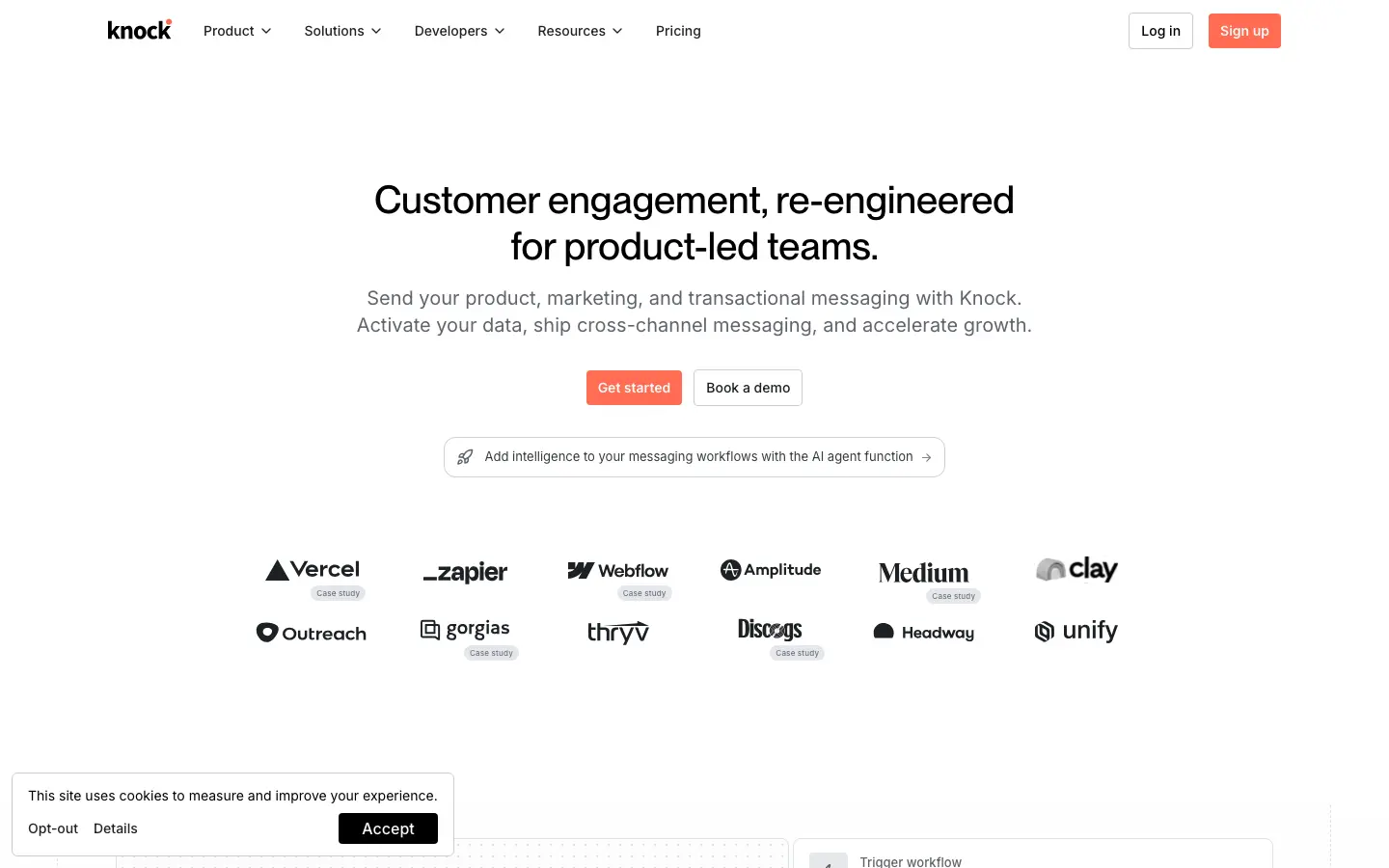
Knock is notification infrastructure for engineering teams. Templates live in version control alongside the rest of the codebase. The CLI integrates with AI IDEs like Cursor and Copilot. Deployments go through the same CI/CD pipelines as every other product change. Workflows are defined in code with branching logic, delay conditions, and user preference management — not in a drag-and-drop visual builder operated by a marketing manager.
Knock’s channel set includes Email, Push, SMS, In-app, Slack, and Microsoft Teams — the last two being B2B use cases that Customer.io doesn’t natively cover. Vercel, Webflow, Medium, Clay, and Amplitude use it. The free Developer tier provides 10K messages/month and 500 AI agent credits, with no credit card required.
Key features
- Version-controlled notification templates — live in the codebase, not in a SaaS UI
- CLI and AI IDE integration: Cursor, GitHub Copilot support
- CI/CD integration for notification template deployment
- Drag-and-drop workflow builder (for teams that want the visual layer too)
- AI agent functions for intelligent, context-aware workflows
- User preference centers and send window management
- Slack and Microsoft Teams channels — B2B use cases Customer.io doesn’t cover
- Built-in observability, logging, and debugging
- Per-customer branding and translations (Enterprise)
- Data warehouse integration (Enterprise)
- SCIM, SAML 2.0 SSO, HIPAA compliance
Pricing
| Plan | Price | Includes |
|---|---|---|
| Developer | $0 | 10K messages/mo · 500 guide active users · 500 AI agent credits |
| Starter | $250/mo | 50K messages · 2.5K guide active users · 2K AI agent credits |
| Enterprise | Custom | Flexible volume · Per-customer branding · SAML · HIPAA · Datadog observability |
Pros & cons
Pros:
- Only platform in this comparison built for version-controlled, CI/CD-deployed notification templates
- Slack and Teams channels cover B2B SaaS product notification use cases Customer.io doesn’t
- CLI + AI IDE integration (Cursor, Copilot) is ahead of the market for dev workflow
- Developer free tier with 10K messages/month — real utility, no credit card
- 4.6/5 on G2 with 107 reviews; Vercel, Webflow, Amplitude as named customers
Cons:
- Not a marketing automation platform — no behavioral lifecycle campaigns, email newsletters, or marketing analytics
- Small team (11-50 employees) means limited support resources at scale
- Non-technical marketing teams can’t operate it independently — requires engineering for most changes
- No warehouse-native audience segmentation comparable to Vero’s Connected Audiences
Customers
Vercel, Webflow, Medium, Clay, Amplitude, Gorgias, Outreach, Discogs. 4.6/5 on G2 with 107 reviews.
Knock let us treat notification templates like the rest of our codebase — versioned, reviewed, deployed. That’s exactly how it should work.
— Knock customer
Loops: Best Customer.io alternative for early-stage SaaS teams
Customer.io is built for teams with significant user bases, complex product data, and multi-channel messaging needs. That’s not where most SaaS companies start. Early-stage teams — pre-series A, under 10,000 users, small founding teams — need to send good product emails without a six-week implementation project or a $100/mo commitment before they’ve validated any messaging strategy.
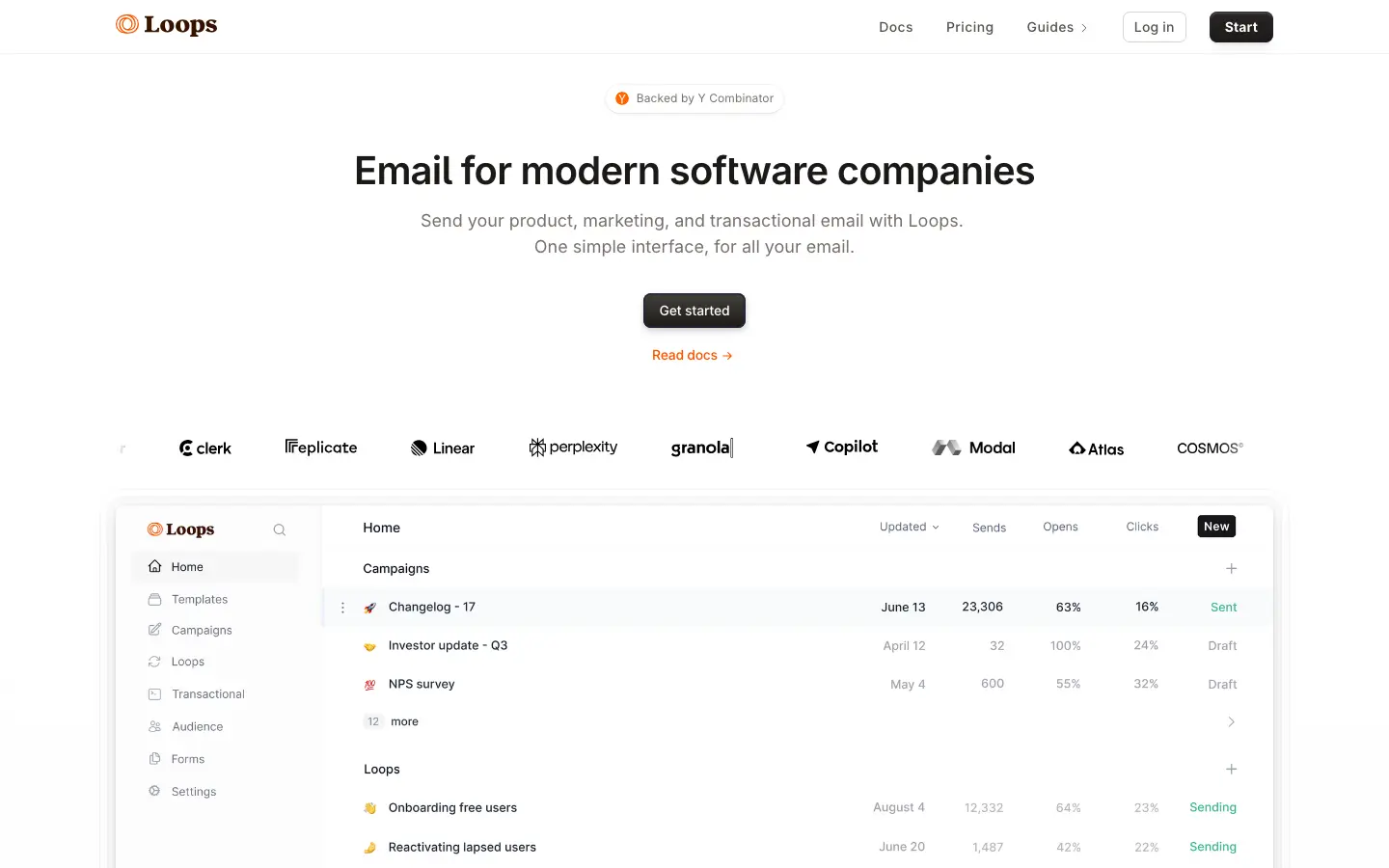
Loops is email for SaaS, nothing more. Transactional and marketing email from one platform, purpose-built templates for SaaS onboarding sequences and lifecycle emails, simple audience segmentation, and event-triggered automation that doesn’t require a dedicated marketing engineer to configure. The interface is intentionally minimal — designed for a founder or early-stage marketer to operate without training.
The limitation is the same as the value proposition: email only. No push, no in-app, no SMS, no webhooks. For teams that have outgrown email-only messaging, Loops is a stepping stone, not a destination. But for companies that haven’t yet invested in multi-channel infrastructure, paying Customer.io’s $100/mo for channels you’re not using isn’t a better answer.
Key features
- Transactional and marketing email from a single platform — no split between providers
- Pre-built SaaS email templates: onboarding, activation, churn prevention, newsletters
- Event-triggered automation based on product behavior
- Simple audience segmentation by user properties and events
- Clean, minimal interface optimized for small teams and founders
- API and integration support for standard SaaS data ingestion
- Usage-based pricing with no credit card required to start
Pricing
Usage-based with public tiers. No credit card required. Free to start.
Pros & cons
Pros:
- Purpose-built for SaaS — templates, language, and defaults match common SaaS product patterns
- No complexity overhead — can be operational in hours, not weeks
- Usage-based pricing with a free start removes the cost barrier for early-stage teams
- SaaS-specific positioning creates strong product-market fit for pre-series A companies
Cons:
- Email only — no push, in-app, SMS, webhooks, or multi-channel workflows
- No data warehouse integration or connected audience segmentation
- Limited behavioral logic depth for complex product-led growth messaging
- Not a long-term platform for companies with maturing multi-channel needs
Customers
Loops serves early-stage SaaS companies and product-led growth teams. Framer-built; modern design-forward interface.
Loops got us to good product emails without any of the complexity we weren’t ready for yet.
— Loops customer
Frequently asked questions
Why would I look for a Customer.io alternative?
The most common reasons teams evaluate Customer.io alternatives fall into three buckets. First, pricing: Customer.io’s per-profile model charges for your full subscriber database, not just active users — for B2C and PLG businesses this can mean paying for 5-10x more profiles than are actually engaged. Second, CDP overlap: Customer.io has built a CDP layer that creates duplicative spend for teams already running Segment, RudderStack, or Hightouch. Third, fit: teams that need enterprise AI and channel breadth may need Braze; teams that want simpler email may prefer Loops; engineering teams building notification infrastructure may prefer Knock.
Does Customer.io charge for inactive subscribers?
Yes. Customer.io’s Essentials plan is priced at $100/mo for up to 5,000 profiles — and "profiles" includes all contacts in your workspace, regardless of whether they’ve opened an email or triggered an event in the last 90 days. For B2C companies and B2B PLG businesses with large inactive lists, this results in significant overpayment relative to the actual value delivered. Vero’s active-profile pricing model is the main structural alternative for teams where this is a persistent budget issue.
Which Customer.io alternative is best if I already have Segment or RudderStack?
Vero. Customer.io has built a CDP layer to compete with Segment and RudderStack, which means buying Customer.io if you already have a CDP leads to paying for overlapping functionality. Vero’s design deliberately avoids this: no built-in CDP, direct SQL connections to your data warehouse, and native source integrations with Segment, RudderStack, Hightouch, and Census. You get behavioral messaging without the CDP duplication cost.
Which Customer.io alternative has the best pricing for B2C businesses?
Vero. The active-profile pricing model charges only for users who are active in the billing period. A B2C business with 200,000 total subscribers and 30,000 actives pays for 30,000 — not 200,000. This is the single most important structural pricing difference in the category for B2C businesses, and no other platform in this comparison offers it as clearly as Vero. Loops has a lower absolute price floor but is email-only, making it unsuitable for multi-channel B2C messaging.
Which alternative is best if I need CRM and marketing from one platform?
HubSpot. It’s the only platform in this comparison that combines a full CRM — deal pipeline, contact management, sales sequences — with marketing automation, lifecycle messaging, and multi-channel campaign management. Customer.io requires a separate CRM integration; HubSpot makes that integration unnecessary. The trade-off is that HubSpot’s messaging depth is shallower than Customer.io for purely behavioral, product-triggered use cases.
Can Knock replace Customer.io for a B2B SaaS product?
Partially. Knock is stronger than Customer.io for engineering use cases — in-product notifications, transactional alerts, user preference management, Slack/Teams integration for B2B workflows. But Knock is not a marketing automation platform. It can’t run a lifecycle email campaign, an onboarding drip sequence, or a re-engagement flow in the way Customer.io can. Teams that need both product notification infrastructure and behavioral marketing email typically run Knock for the former and Vero or Customer.io for the latter.
How difficult is it to migrate from Customer.io?
Customer.io exports contacts, events, and segment data in standard formats. Most platforms in this comparison support CSV imports for contacts and webhook or API ingestion for events. Vero’s support team specifically manages migration onboarding and can often get teams live in days rather than weeks. Loops is the fastest to implement of any option here — email-only means no SDK integration overhead. Knock requires the most engineering work to implement due to its code-first architecture.
Conclusion: Choosing your Customer.io alternative
Customer.io is a strong mid-market platform. The problem isn’t that it’s bad — it’s that for specific buying patterns, the structural fit isn’t there, and the cost implications of that mismatch compound over time.
For B2C and product-led SaaS teams paying for large inactive subscriber lists, Vero is the clearest switch. Active-profile pricing, direct warehouse SQL, and best-of-breed CDP compatibility removes both the cost penalty and the data duplication overhead at once. Teams typically save 30-50% and can often implement in less time than it took to evaluate Customer.io.
For teams that have outgrown Customer.io and need enterprise AI, RCS/LINE channels, and the credibility of a public company behind their infrastructure, Braze is the next step — with the understanding that you’re entering enterprise procurement territory.
For teams that want CRM and marketing from a single vendor — where sales pipeline and lifecycle email share ownership rather than being managed across separate tools — HubSpot replaces two platforms with one.
For engineering teams building notification infrastructure in code — versioned templates, CI/CD deployment, Slack/Teams integration — Knock is the right abstraction level that Customer.io was never designed for.
For early-stage SaaS teams that need good product email without multi-channel complexity or a $100/mo commitment, Loops is purpose-built for the problem and nothing else.
Ready to see how Vero compares to Customer.io for your stack? Start a free trial — no credit card required, no sales call needed.