- All Posts
- /
- SMS vs Email Marketing: Which Works Better in 2026
SMS vs Email Marketing: Which Works Better in 2026
Alternatives-
 Chris Hexton
-
Updated:Posted:
On this page
The question comes up every year: should we focus on SMS or email? It frames the two channels as competitors, when they’re really complementary. The better question is which channel fits each specific moment — and how to use both strategically.
In 2026, both channels are mature, widely used, and clearly capable of driving results. But they excel in very different contexts. This guide breaks down where each one wins — and how the best teams coordinate both.
How email marketing works in 2026
Email remains the backbone of lifecycle marketing for software products. It’s where you tell the complete story — onboarding sequences, feature announcements, re-engagement campaigns. No other channel has the same flexibility for content depth and personalization.
Behavioral email — messages triggered by specific user actions — is where email truly outperforms every alternative. A user who signs up or abandons an upgrade flow can receive a message tied to that exact moment. The precision of event-triggered email is hard to match in any other channel.
Email also scales well with content complexity. You can embed images, CTAs, dynamic content blocks, and product data. That makes it the right channel for anything requiring context, explanation, or multiple calls to action.
The flip side is that email open rates have plateaued across most industries. Inboxes are crowded, and users filter aggressively. The channel is still highly effective — but it rewards quality, relevance, and timing more than it ever did.
How SMS marketing works in 2026
SMS works on a different set of principles. The channel has near-universal open rates — most SMS messages are read within minutes of delivery. That immediacy makes it powerful for time-sensitive communication: flash sales, appointment reminders, security alerts, and re-engagement nudges.
SMS is also where you reach users who have stopped opening emails. A subscriber who hasn’t opened your last ten campaigns may still read a text. For win-back and re-engagement, SMS often outperforms email for users who have gone cold.
The constraints of SMS are real, though. You have 160 characters — no room for nuance, images, or complex calls to action. SMS should carry a single, clear message — not a story.
Compliance is also more complex with SMS than email. Opt-in requirements are stricter — typically requiring explicit double opt-in in most jurisdictions. Sending SMS without proper consent is a legal risk, not just a brand one.
SMS vs email: Head-to-head comparison
| Dimension | SMS | |
|---|---|---|
| Open rate | Moderate | Near-universal |
| Content depth | High — images, links, rich text | Low — 160 characters |
| Personalization | Advanced — behavioral, dynamic content | Limited — name and basic fields |
| Cost per message | Lower | Higher |
| Compliance complexity | Moderate | High |
| Best for | Lifecycle, behavioral, content-rich sends | Time-sensitive, re-engagement, alerts |
| Channel maturity | Very mature | Maturing rapidly |
Open rates
SMS has higher open rates than email — that’s not a debate. But open rate alone doesn’t determine which channel is right for a given message. A complex onboarding sequence needs the space email provides, even if fewer recipients open it.
What matters is the right metric for the job. A transactional SMS confirmation should be measured on delivery and read rate. A behavioral onboarding email should be measured on conversion — did the user take the next step in the product?
Cost
Email is significantly cheaper per message than SMS. At scale, the cost difference is meaningful — especially for high-volume behavioral sends. SMS should be reserved for moments where the immediacy and reach justify the higher cost.
Personalization
Email supports significantly richer personalization than SMS. You can pull in product data, behavioral history, dynamic content blocks, and conditional logic. SMS personalization is limited to name and basic data fields — the channel doesn’t support complexity.
When to use email
Email is the right choice when the message needs context. Onboarding a new user who hasn’t explored your product yet requires explanation, not urgency. A single-sentence text message won’t move them through activation the way a well-timed email sequence will.
Email is also the right channel for content-rich campaigns — product updates, newsletters, feature announcements. These messages benefit from images, structure, and the ability to link to multiple destinations. SMS can’t carry that kind of payload.
Product-triggered sequences belong in email, not SMS. The channel supports context, explanation, and multiple CTAs — everything behavioral messaging requires. That complexity is simply beyond what SMS can carry.
Use email for:
- Onboarding sequences and activation nudges
- Feature announcements and product updates
- Abandoned flow campaigns with multi-step logic
- Lifecycle messaging (trial expiration, upgrade prompts, churn prevention)
- Transactional messages requiring context (invoices, reports, summaries)
- Newsletters and content-rich sends
When to use SMS
SMS earns its place in moments where immediacy outweighs depth. A time-limited discount, a cart abandonment reminder, an appointment alert — these messages have seconds to make an impact. The 160-character limit is a feature in that context, not a constraint.
SMS is also where you recover users who have gone email-dark. If a user hasn’t opened your emails in 60 days, a short, direct SMS can restart the conversation. The key is to make it worth the interruption — give them a reason to click.
Transactional SMS — password resets, order confirmations, shipping alerts — performs well because users actively want that information. Unlike promotional SMS, transactional messages don’t require warming up a reluctant recipient. The value is immediately clear.
Use SMS for:
- Time-sensitive promotions and flash sales
- Appointment reminders and scheduling confirmations
- Shipping and order status updates
- Re-engagement campaigns for email-inactive users
- Security alerts and one-time passwords
- Short, urgent nudges tied to a specific action
The case for using both
The strongest marketing programs don’t choose between email and SMS — they use each channel for what it does best. Email handles the nurture, the education, the behavioral sequences. SMS handles the urgency, the re-engagement, and the moments where immediacy is everything.
Coordinating both from one platform matters. Separate tools create double-sending risks, conflicting messages, and gaps in suppression logic. A user who gets an abandoned cart email and a cart SMS within minutes feels spammed, not served.
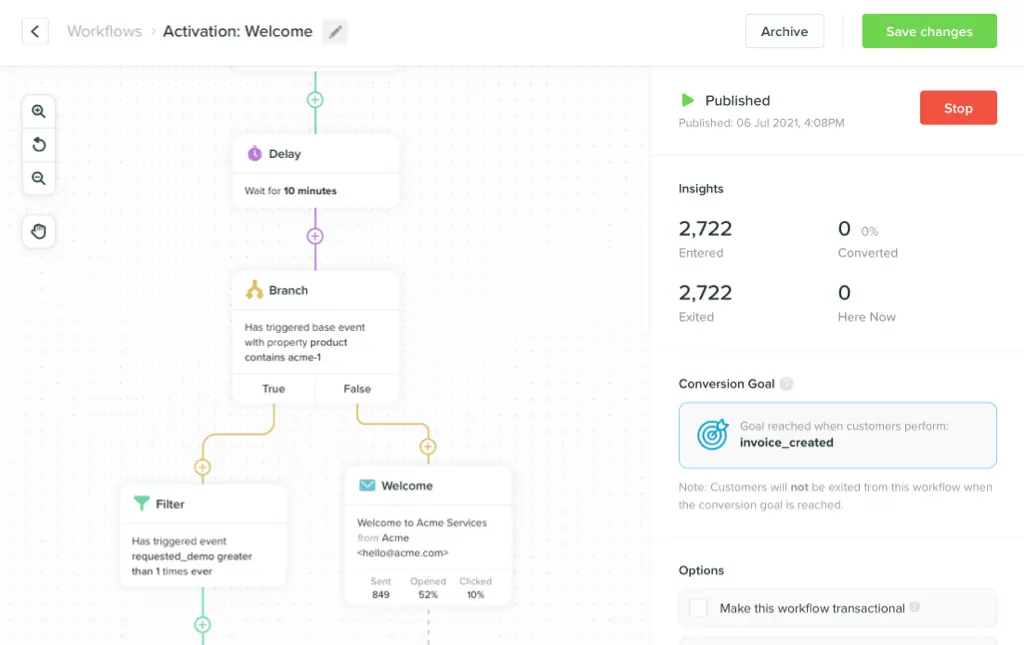
Platforms like Vero let you coordinate email, push, SMS, and in-app messaging from a single behavioral workflow. You set the trigger once, define the channel logic, and let the platform handle coordination. That’s how you scale a multi-channel program without building parallel infrastructure for each channel.
The sequencing matters too. A common pattern is email first, then SMS 24–48 hours later for users who didn’t open. That approach combines email’s depth with SMS’s reach — without hitting users on both channels simultaneously for the same message.
Frequently asked questions
Is SMS or email better for e-commerce?
For e-commerce, both channels have clear roles. Email handles abandoned carts, post-purchase sequences, and winback campaigns — messages that benefit from product images and multiple links. SMS handles flash sales, shipping updates, and re-engagement nudges where immediacy is the deciding factor.
Is SMS or email better for SaaS?
Email is dominant for SaaS lifecycle messaging. Onboarding, feature adoption, and churn prevention all require the depth that email provides. SMS plays a supporting role — useful for time-sensitive alerts or re-engaging users who have gone email-dark.
What’s the open rate difference between SMS and email?
SMS open rates are significantly higher — most industry estimates put them above 90%. Email open rates typically range from 20–40% for engaged audiences, varying by industry and list quality. But higher open rates don’t automatically mean better outcomes — it depends entirely on the message type.
Should I use both SMS and email for the same audience?
Yes, if your audience has opted into both. The channels complement each other and rarely cannibalize results when coordinated properly. The key is using each for the right moment — not doubling up on every send.
How do I collect SMS opt-ins?
SMS opt-in requires explicit consent — typically at sign-up, checkout, or through an in-product prompt. Clearly state what users will receive and how often. Double opt-in is required in many jurisdictions and is best practice regardless.
How do I avoid over-messaging when using both channels?
Set clear frequency rules and respect suppression logic across channels. If a user converts on email, suppress the follow-up SMS automatically. One platform for both channels makes suppression significantly easier to manage.
What platform lets me run SMS and email from one place?
Several platforms support both channels from a single workflow. Vero is a strong fit for product-led and B2C teams — it coordinates email, SMS, push, and in-app messaging with event-triggered logic and direct warehouse integration. Customer.io and Braze also support both channels, with Customer.io suited to mid-market SaaS and Braze to larger enterprise brands. Klaviyo and ActiveCampaign are options if your focus is e-commerce rather than product-driven messaging.
Conclusion: It’s not a competition
The answer to "SMS vs email" isn’t a winner — it’s a framework. Email wins on depth, personalization, and behavioral automation. SMS wins on immediacy, open rates, and reaching users who’ve gone quiet.
The best teams use both — each for what it does best, coordinated from a single platform. The wrong move is committing to one and ignoring the other. The right move is giving each channel the right job.
Vero is a multi-channel behavioral messaging platform built for product-led software teams. It supports email, SMS, push, and in-app messaging in one workflow — no parallel infrastructure required. Pricing is based on active users, not database size — well-suited for B2C and PLG teams. Start a free trial at getvero.com — no credit card required.