- All Posts
- /
- Top 5 Marketing Automation Platforms in 2026
Top 5 Marketing Automation Platforms in 2026
Alternatives-
 Chris Hexton
-
Updated:Posted:
On this page
Marketing automation has never been more crowded. Dozens of platforms promise to send the right message, engage your users, and drive revenue at scale. But they’re not all built the same.
The difference isn’t just features. It’s philosophy — who the tool was built for, how it handles your data, and whether it fits your stack. Picking wrong costs you time, money, and engineering goodwill.
This guide breaks down the top five marketing automation platforms in 2026. We’ve covered what each does best, where each falls short, and who each is actually for. By the end, you’ll know exactly which one fits your team.
What are the best marketing automation platforms in 2026?
There’s a platform for every use case on this list. Vero is the top pick for product-led software teams that need behavioral messaging tied to warehouse data. CustomerIO suits teams that want a built-in CDP alongside their messaging tools.
Braze dominates the enterprise tier with AI-powered personalization at scale. HubSpot is the default choice for marketer-led teams that want CRM and automation in one suite. ActiveCampaign serves SMBs that need email automation with a built-in CRM at an accessible price point.
| Platform | Starting Price | Best For | Key Differentiator | Free Trial |
|---|---|---|---|---|
| Vero | $54/mo | PLG SaaS, B2C, mobile apps | Active-profile pricing + warehouse-native segmentation | 14 days, no credit card |
| CustomerIO | $100/mo | SaaS + enterprise | Built-in CDP, 9,000+ brands | 14 days (startup program: 12 months free) |
| Braze | Custom | Enterprise brands | BrazeAI™, omnichannel at scale | Sales demo required |
| HubSpot | Free–$3,600+/mo | Marketer-led SMB to mid-market | Full CRM + marketing suite | Free plan available |
| ActiveCampaign | From ~$15/mo | SMB, marketer-led | Built-in CRM + 900+ integrations | 14 days |
1. Vero: Best for Product-Led Software Teams
Disclosure: Vero is our own product. We’ve included it because we genuinely believe it belongs on this list — but you should know we’re not a neutral party.
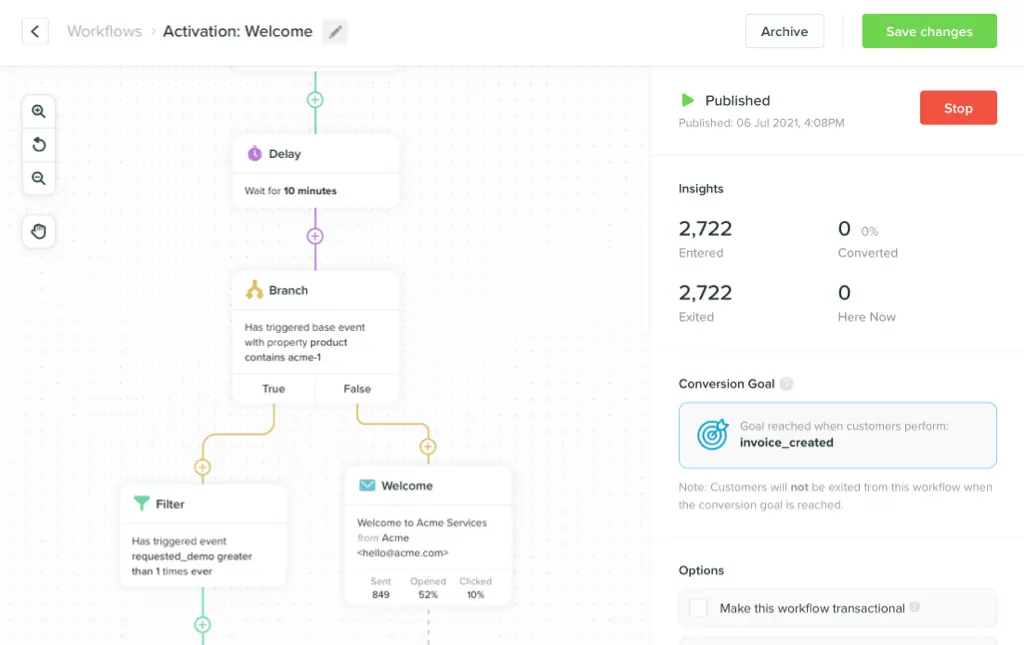
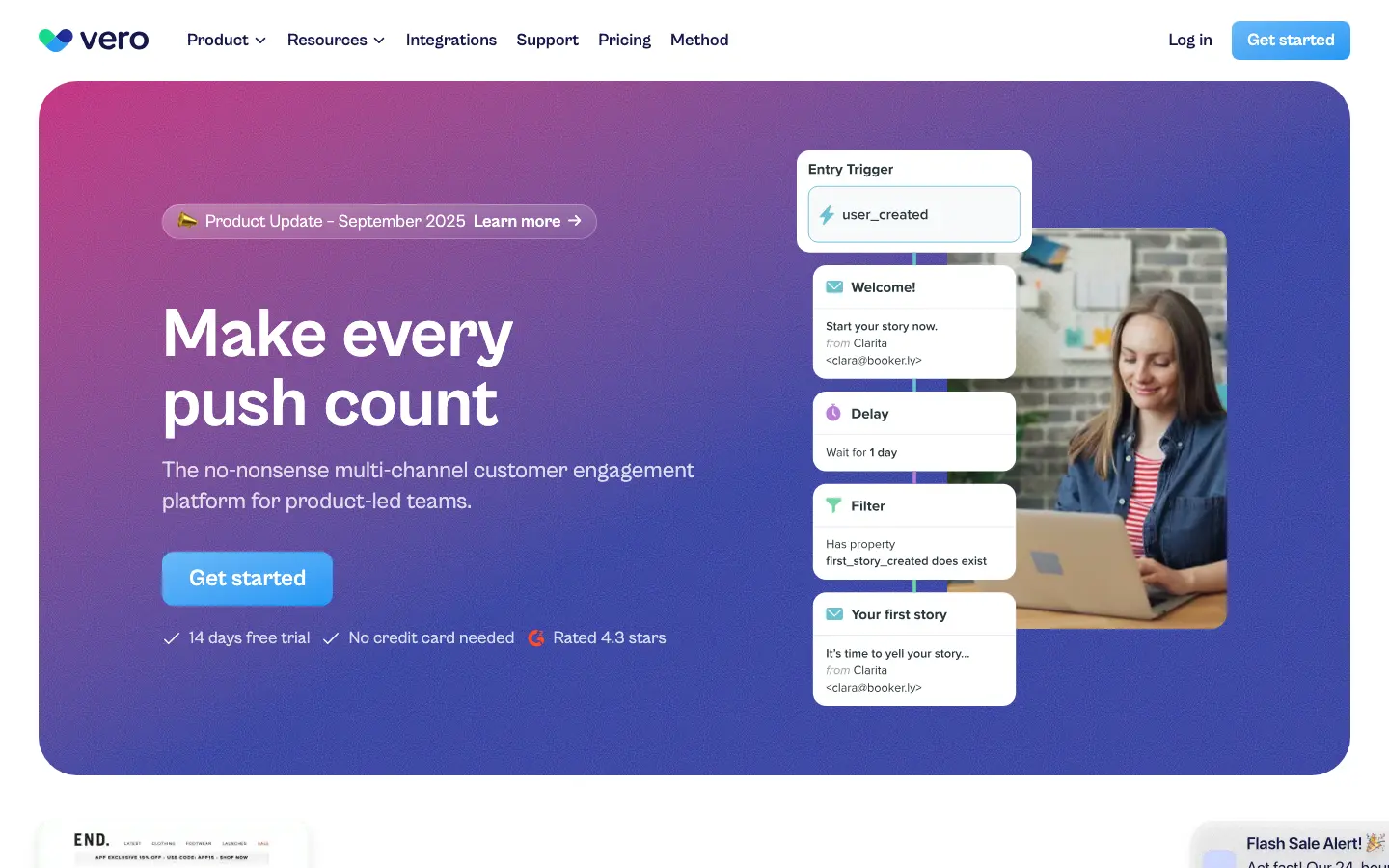
Vero is a multi-channel customer engagement platform built for product-led software companies. It lets teams send event-triggered emails, push, SMS, and in-app messages — all powered by live product data. Founded in 2012, Vero now delivers 5+ billion messages annually at 99.99% uptime.
What sets Vero apart is its pricing model. Most platforms charge per total subscriber — so a B2C company with 500K users pays for all 500K, active or not. Vero charges only for active profiles, a structural cost advantage for PLG and B2C businesses.
Vero also connects directly to your data warehouse. Its Connected Audiences feature lets teams query Snowflake, BigQuery, Redshift, and others without duplicating data into the platform. That’s rare in a category where most tools want you to route everything through their own CDP.
Key features
- Event-triggered messaging: Send messages based on real user behavior — onboarding, activation, abandoned flows, win-back, and more.
- Visual journey builder: Build automated workflows without code, including A/B splits, delays, and multi-channel coordination.
- Connected Audiences: Direct SQL integration with Snowflake, BigQuery, Redshift, PostgreSQL, MySQL, and SQL Server for warehouse-powered segmentation.
- Behavioral segmentation: Segment users by event history, profile attributes, and live warehouse data.
- Multi-channel delivery: Email, iOS/Android push, in-app messaging, SMS, and webhooks — coordinated in a single workflow.
- Developer tools: Full API, Segment and RudderStack integration, and a developer guide built for product infrastructure.
Pricing
- Starter: $54/month (or $49/month billed annually) — 5,000 active profiles, 10,000 emails/month, 20,000 push messages/month, unlimited team members
- Professional: Custom pricing — scales profiles, emails, push, SMS, and events with a fair-use overage policy
14-day free trial, no credit card required.
Pros & cons
Pros:
- Active-profile pricing is a genuine cost advantage for B2C and PLG businesses with large inactive lists.
- Connected Audiences brings warehouse-native segmentation to a price point no enterprise tool matches.
- Developer-credible platform that product and marketing teams can operate without engineering on every change.
- 12+ years of organic growth with 99.99% uptime — proven infrastructure without VC-fueled bloat.
Cons:
- Smaller brand footprint than CustomerIO and Braze — less likely to surface in early vendor evaluations.
- SMS and WhatsApp are still maturing relative to Vero’s email and push capabilities.
- No built-in CDP — a feature for composable-stack buyers, but a gap for teams that want everything in one place.
Customers
Vero is trusted by Dribbble, Unsplash, Pipedrive, Stockpile, and 50+ companies globally. It holds a 4.3-star rating on G2. One customer summed it up: "Vero has one of the best support teams I’ve encountered."
2. CustomerIO: Best for SaaS Teams That Want a Built-in CDP
CustomerIO is one of the most widely used customer engagement platforms in SaaS. It covers email, push, in-app, SMS, and WhatsApp for 9,000+ brands worldwide. Founded in 2012 alongside Vero, it has grown into a top contender from startup to enterprise.
The platform’s biggest differentiator is its built-in CDP layer. Teams can manage customer data, run behavioral campaigns, and sync ad audiences from one place. For companies that don’t already have a CDP, this is a compelling pitch.
Pricing starts at $100/month for 5,000 profiles and 1 million emails per month. CustomerIO charges per total profile — meaning B2C teams with large inactive lists will pay more over time. The $1,000/month Premium tier unlocks HIPAA compliance, a 90-day onboarding program, and dedicated support.
Key features
- Visual workflow builder: Drag-and-drop automation for omnichannel journeys across all supported channels.
- Built-in CDP: Data unification with APIs, webhooks, and reverse ETL for a unified customer view.
- WhatsApp channel: Native WhatsApp support beyond what most mid-market platforms include.
- Design Studio: No-code message creation for email and push.
- A/B testing and cohort analysis: Built-in tools for iterating on campaign performance.
- Custom objects: Enhanced personalization for data structures beyond standard user profiles.
Pricing
- Essentials: $100/month — 5,000 profiles, 1M emails/month, 2 custom object types
- Premium: $1,000/month (billed annually) — custom volume, 10 object types, HIPAA, dedicated support, 90-day onboarding
- Enterprise: Custom — priority support, dedicated CSM, dedicated hardware
- Startup program: Free for 12 months for startups raising under $10M
Pros & cons
Pros:
- Built-in CDP eliminates the need for a separate data layer for many teams.
- WhatsApp support and broad channel coverage stand out among mid-market CEPs.
- Strong startup program — 12 months free for early-stage companies raising under $10M.
- 9,000+ brands and a 4.4-star G2 rating signal proven product-market fit.
Cons:
- Per-profile pricing disadvantages B2C and PLG businesses with large inactive subscriber lists.
- Built-in CDP creates duplicative spend for teams already running Segment or RudderStack.
- Entry price ($100/month) is nearly double Vero’s Starter plan.
- Less suited to best-of-breed stack buyers who prefer composable, non-overlapping tooling.
Customers
CustomerIO serves Notion, Pipedrive, StuDocu, Kraft Heinz, Zara USA, and Schneider Electric. Its 709 G2 reviews and 4.4-star rating make it one of the most reviewed mid-market CEPs.
3. Braze: Best for Enterprise Brands That Need AI at Scale
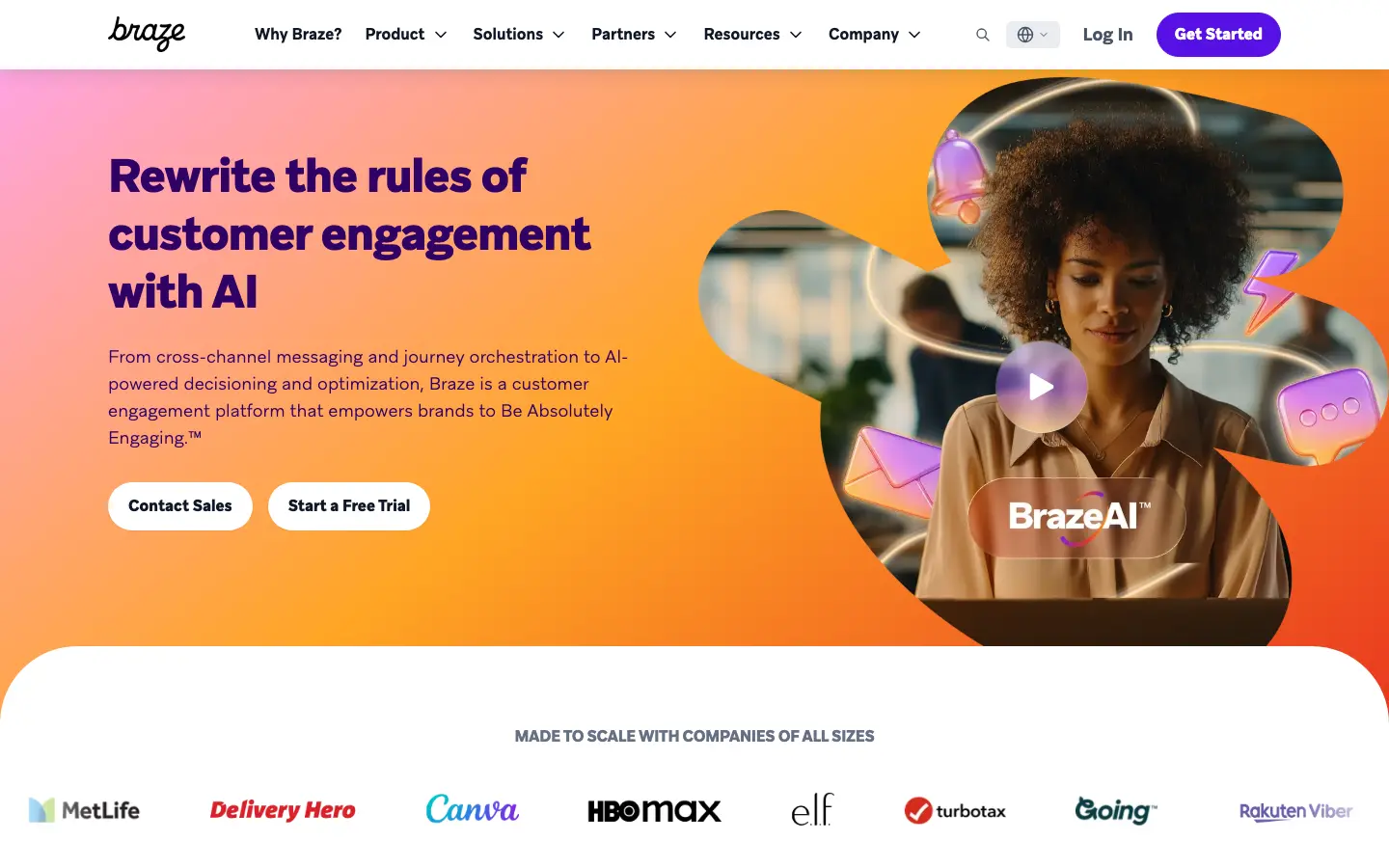
Braze is the dominant enterprise customer engagement platform. Founded in 2011 and public since 2021, it generates $593M ARR from 2,300+ customers across 195 countries. If you need AI-powered omnichannel engagement at the largest possible scale, Braze is the benchmark.
The platform’s BrazeAI™ suite covers predictive intelligence, generative content, and agentic automation. Its Decisioning Studio enables 1:1 personalization across every channel. Currents streams real-time engagement data directly into data warehouses like Snowflake and BigQuery.
The tradeoff is cost and complexity. Braze doesn’t publish pricing — evaluations require a sales conversation and annual enterprise contracts are standard. For lean product teams or companies with under $5M ARR, it’s almost certainly overkill.
Key features
- BrazeAI™: Predictive, generative, and agentic intelligence baked into the platform.
- Journey orchestration: Cross-channel coordination across email, SMS, WhatsApp, RCS, LINE, push, and in-app.
- Braze Data Platform: Data unification and activation across your full tech stack.
- Currents: Real-time data streaming to Snowflake, BigQuery, Redshift, and other warehouses.
- BrazeAI Decisioning Studio™: 1:1 personalization across all channels at enterprise scale.
- Full analytics suite: Deep reporting, attribution, and campaign performance dashboards.
Pricing
Custom — contact sales. Usage-based on Monthly Active Users (MAUs) and message volume. Enterprise annual contracts are standard.
Pros & cons
Pros:
- The most recognized enterprise CEP globally — easiest to justify internally to large organizations.
- Deepest AI and personalization feature set currently available in the customer engagement category.
- Channel breadth including WhatsApp, RCS, and LINE is unmatched among peers.
- $593M ARR and 2,300+ customers across 195 countries demonstrate enterprise-grade reliability.
Cons:
- Opaque pricing and a sales-led motion create friction for teams that prefer self-serve evaluation.
- Complexity is designed for large, dedicated teams — lean PLG teams will be overwhelmed.
- Overkill and over-budget for the vast majority of companies outside the enterprise tier.
- Long implementation timelines delay time-to-value compared to self-serve alternatives.
Customers
Braze powers engagement for Burger King, Grubhub, NBA, HBO Max, Paramount, KFC, Skyscanner, PureGym, NASCAR, and OkCupid. Its 4.5-star G2 rating across 1,412 reviews puts it among the best in the enterprise tier.
4. HubSpot: Best All-in-One for Marketer-Led Teams
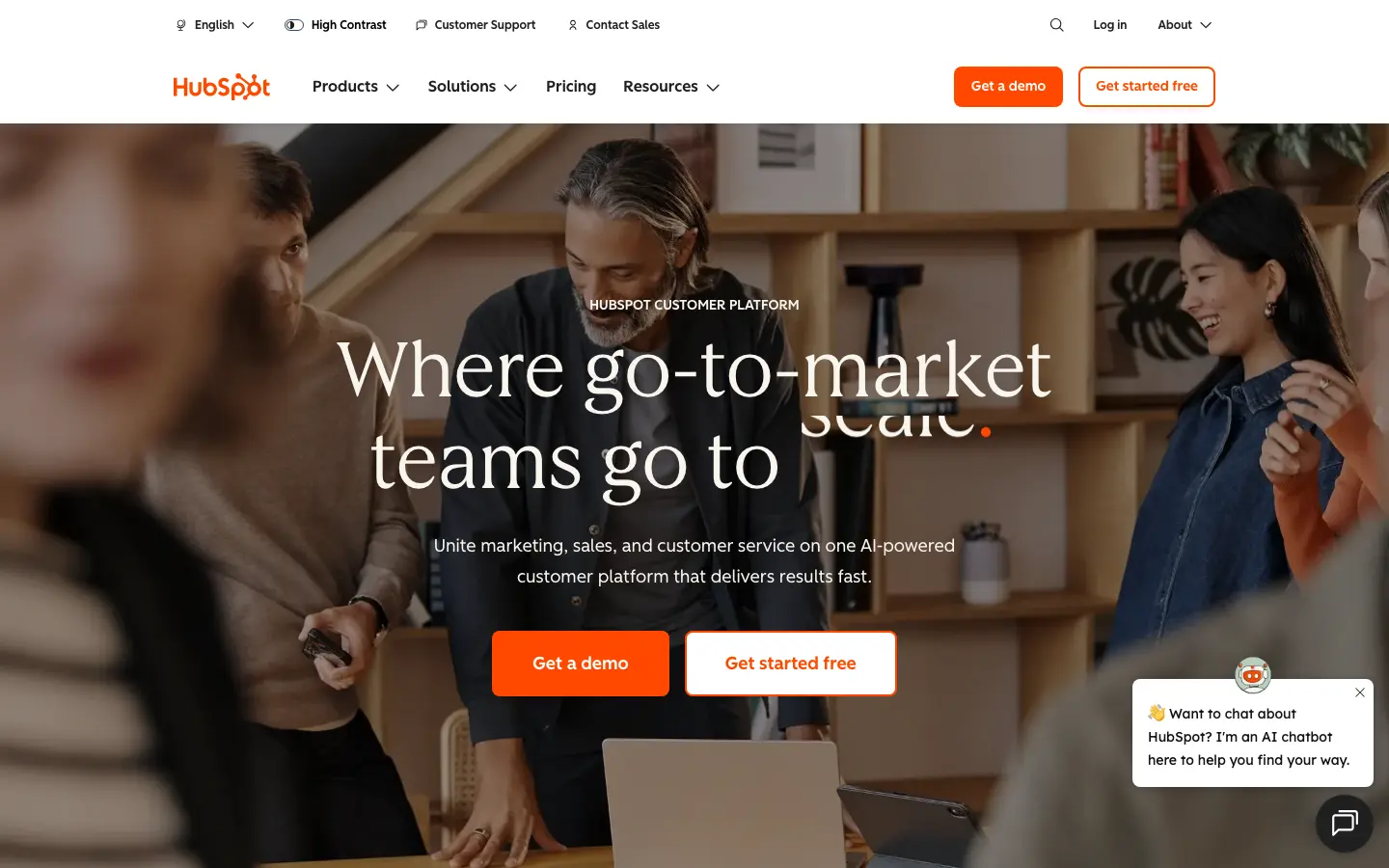
HubSpot is the most recognized name in marketing automation for a reason. It serves 228,000+ customers in 135 countries and generates $2.6B ARR. The platform packages CRM, email, ads, and sales into a single suite.
For marketer-led teams that want to consolidate their stack, it’s a natural default.
The platform’s AI layer — Breeze — powers content generation, predictive scoring, and personalization. Over 1,500 integrations in the App Marketplace connect it to virtually every tool in the modern stack. Non-technical marketing teams can get up and running quickly without heavy engineering involvement.
The limitations show up for product-first software companies. HubSpot has no native data warehouse integration and wasn’t designed for product-triggered behavioral messaging. Its contact-based pricing is also punishing for B2C and PLG businesses with large inactive lists.
Key features
- Full CRM suite: Marketing, sales, service, and operations hubs on a unified customer platform.
- AI-powered automation (Breeze): Content generation, predictive lead scoring, and personalization.
- Visual workflow builder: Email automation and lifecycle management with no-code logic.
- Ads management: Native Facebook, Google, and LinkedIn ad management built in.
- Landing pages and forms: Lead capture built directly into the marketing platform.
- App Marketplace: 1,500+ integrations covering nearly every tool in the modern stack.
Pricing
- Free: Basic CRM, forms, and email with limited features
- Starter: From ~$15/month — core marketing tools and automation
- Professional: ~$800–$890/month — full automation, custom reporting, and A/B testing
- Enterprise: From ~$3,600/month — advanced objects, custom reporting, and SSO
Contact-based pricing; all plans scale by total database size.
Pros & cons
Pros:
- Unmatched brand recognition — the easiest platform to justify internally and to a C-suite.
- Full-suite CRM means sales, marketing, and service share one unified customer record.
- Breeze AI features are accelerating HubSpot’s personalization and content generation capabilities fast.
- The 1,500+ integration ecosystem and massive community resources lower implementation risk.
Cons:
- Contact-based pricing is punishing for B2C and PLG businesses with large inactive subscriber bases.
- No native data warehouse integration — a hard gap for teams with product behavioral data needs.
- Engineering teams consistently struggle to integrate HubSpot with modern product infrastructure.
- Breadth dilutes depth — marketing automation is one module among many, not the core focus.
Customers
HubSpot serves 228,000+ customers in 135 countries across every major industry vertical. Its 4.4-star G2 rating across 12,000+ reviews gives it the highest review volume on this list.
5. ActiveCampaign: Best for SMBs That Need Email Automation with CRM
ActiveCampaign has been in the marketing automation space since 2003 — longer than any platform on this list. It serves 180,000+ businesses in 170 countries and holds a 4.5-star G2 rating across 13,000+ reviews. For SMBs that want email automation plus a built-in CRM, few tools match it at this price.
The visual automation builder is one of the more intuitive in the category. Predictive sending, win probability scoring, and deep eCommerce integrations for Shopify and WooCommerce round out its core feature set. Over 900 app integrations make it highly connectable to an existing stack.
ActiveCampaign’s weaknesses surface most clearly for product-first teams. It charges per total contact — a structural disadvantage for PLG and B2C companies with large inactive lists. It also has no native warehouse integration and limited developer flexibility, which creates friction with engineering teams.

Key features
- Visual automation builder: Intuitive drag-and-drop workflow creation for email and multi-channel journeys.
- Built-in CRM: Deal pipeline and contact management built directly into the platform.
- Predictive sending: AI-powered send-time optimization for better open and click rates.
- Win probability scoring: Lead and deal scoring for sales-aligned marketing teams.
- eCommerce integrations: Deep native connections with Shopify, WooCommerce, and BigCommerce.
- 900+ app integrations: Broad ecosystem connectivity for almost any existing stack.
Pricing
- Starter: From ~$15/month — core email automation
- Plus: From ~$49/month — CRM, landing pages, Facebook Custom Audiences
- Professional: From ~$79/month — predictive sending, site messaging, attribution reporting
- Enterprise: From ~$145/month — custom reporting, SSO, and dedicated support
Contact-based pricing; all plans scale by total list size.
Pros & cons
Pros:
- 180,000+ customers and 20+ years of platform maturity signal real staying power.
- Low entry price makes it accessible for early-stage teams and small businesses.
- Built-in CRM enables sales and marketing alignment without a separate tool.
- Deep eCommerce integrations make it a natural fit for Shopify and WooCommerce brands.
Cons:
- Contact-based pricing penalizes B2C and PLG businesses with large inactive subscriber lists.
- No native data warehouse integration — a hard gap for teams with product behavioral data.
- Engineering teams frequently cite friction with ActiveCampaign’s API and data model.
- Marketer-first architecture limits developer flexibility for product-led teams.
Customers
ActiveCampaign serves 180,000+ businesses across 170 countries. Its 4.5-star G2 rating across 13,000+ reviews is second only to HubSpot in review volume.
Frequently asked questions
What is marketing automation and why does it matter? Marketing automation is software that sends the right message to the right person at the right time — automatically. For product-led and B2C companies, it’s what connects user behavior directly to your messaging. Done well, it drives onboarding, reduces churn, and lifts lifetime value at scale.
How do I choose between Vero, CustomerIO, and Braze? It comes down to scale and stack. Vero fits mid-market PLG and B2C teams with data maturity who don’t want a built-in CDP. CustomerIO is better for teams that want a managed CDP alongside messaging.
Braze is the right call for enterprise brands with large teams and the budget to match.
Is active-profile pricing actually better than per-contact pricing? For B2C and PLG businesses, usually yes. Per-contact pricing charges for every subscriber — active or not. Active-profile pricing charges only for users who actually engage — significantly cheaper for B2C companies with large inactive lists.
Which platform is best for a small SaaS startup? CustomerIO’s startup program offers 12 months free for companies raising under $10M — hard to beat as an entry point. Vero’s $49/month annual plan and 14-day free trial also make it accessible early. For email-only simplicity, Loops is worth evaluating before adding complexity.
Do I need a CDP alongside these platforms? It depends on the platform. CustomerIO and HubSpot include data management layers that reduce the need for a separate CDP. Vero deliberately doesn’t — it pairs with Segment, RudderStack, Hightouch, or Census instead.
For warehouse-native teams, Vero’s Connected Audiences can remove the CDP requirement entirely.
Which platform has the best developer experience? Vero and CustomerIO both score well for teams that need developer flexibility alongside marketing usability. Braze has strong developer tooling but at enterprise complexity and cost. If you need pure developer-first transactional messaging, tools like Resend or Knock are worth evaluating separately.
Conclusion: Pick the Platform That Fits Your Stack — Not Just Your Budget
There’s no universal winner here. The right platform depends on who’s buying, what your data stack looks like, and how active your users are.
For PLG SaaS or B2C teams with a warehouse or CDP already in place, Vero is the strongest fit. Its pricing, warehouse-native data, and developer-ready APIs give both teams what they need — without enterprise overhead.
For teams that want a built-in CDP and don’t mind paying for it, CustomerIO is the right move. It covers more channels and includes a startup program that’s hard to ignore at the early stage.
For enterprise brands with large, dedicated teams, Braze is the benchmark. Its AI features and global scale are unmatched — but so is the cost.
For marketer-led SMBs who want the easiest path to automation, HubSpot or ActiveCampaign will serve you well. HubSpot wins on CRM depth and integration breadth. ActiveCampaign wins on price and email automation maturity for sales-aligned teams.
Still evaluating? Try Vero free, no credit card required. See how behavioral messaging tied to real product data changes what’s possible for your team. Start your free trial at getvero.com.