- All Posts
- /
- Top 6 SMS Marketing Platforms for B2B in 2026
-
 Chris Hexton
-
Updated:Posted:
On this page
SMS remains one of the highest-engagement channels in the marketing mix. Open rates stay above 90%, with response times measured in minutes rather than hours. For B2B companies, the use cases are specific and high-value: product onboarding nudges, transactional alerts, demo reminders, and time-sensitive lifecycle triggers.
But B2B SMS has requirements that consumer SMS platforms aren’t built for. B2B audiences are smaller and more valuable — every message to a $50K ARR account needs to be relevant and well-timed.
Data integration with CRM systems, product databases, and data warehouses matters more than bulk broadcast capability. Compliance requirements — TCPA in the US, GDPR in Europe — need to be handled at the platform level.
This guide covers the top 6 SMS marketing platforms for B2B in 2026. Each is evaluated on developer integration quality, pricing model, data connectivity, and fit for B2B use cases.
What are the best SMS marketing platforms for B2B?
The top 6 B2B SMS marketing platforms are Braze, Customer.io, Iterable, ActiveCampaign, Knock, and Vero.
Braze leads for enterprise B2B teams that need SMS as part of a coordinated multi-channel engagement program. It offers RCS support, AI-driven personalization, and the credibility of a $593M ARR public company.
Customer.io is the strongest mid-market option. It delivers event-driven SMS triggered by real product behavior, a developer-friendly API, and transparent pricing without mandatory sales engagement.
Iterable covers similar enterprise ground with its Nova AI suite and cross-channel journey orchestration. It’s best suited for experience-focused brands with dedicated marketing operations.
ActiveCampaign is the practical choice for B2B teams that need SMS as part of a broader CRM and automation stack. At $15/mo to start, with 900+ integrations, it’s the default recommendation for SMBs.
Knock is the right call for engineering-led product teams. It delivers SMS alongside Slack and Teams in a version-controlled, CI/CD-deployed notification infrastructure.
Vero (our platform) closes the list as the clearest fit for product-led B2B SaaS companies. Active-profile pricing, direct SQL warehouse integration, and a single workflow builder for transactional and lifecycle SMS set it apart.
Top B2B SMS marketing platforms — Comparison table
| Platform | Starting Price | SMS Model | Best For | Key B2B Differentiator | Free Trial |
|---|---|---|---|---|---|
| Braze | Custom (enterprise) | SMS/RCS via Twilio and others | Enterprise B2B brands with dedicated marketing ops | BrazeAI Decisioning · RCS · $593M ARR public co | Demo required |
| Customer.io | $100/mo | SMS as part of omnichannel journeys | Mid-market B2B SaaS product teams | Event-driven · transparent pricing · WhatsApp | Yes (14 days) |
| Iterable | Custom (enterprise) | SMS via journey orchestration | Experience-focused enterprise B2B brands | Nova AI · cross-channel journey depth | Demo required |
| ActiveCampaign | From $15/mo | SMS add-on across plans | SMB and mid-market B2B with CRM needs | 900+ integrations · built-in CRM · accessible entry price | Yes (14 days) |
| Knock | Free / $250/mo | SMS as part of notification infra | Engineering-led B2B product teams | Version-controlled · CLI · Slack + Teams channels | Yes (Free plan) |
| Vero | $49/mo (annual) | SMS in multi-channel behavioral workflows | Mid-market PLG B2B SaaS with warehouse data | Active-profile pricing · direct warehouse SQL | Yes (14 days) |
Braze: Best B2B SMS platform for enterprise multi-channel programs
For enterprise B2B teams, the question isn’t whether SMS is supported. It’s whether SMS integrates cleanly into a broader journey orchestration system. It’s also whether the platform’s AI can determine when SMS is the right channel for a specific user.
Braze answers both questions at enterprise scale. BrazeAI Decisioning Studio uses predictive and agentic intelligence to route users to the right channel based on real-time behavioral signals. RCS support extends SMS into interactive, branded message experiences — images, carousels, and verified sender branding.
Braze Currents streams all engagement data — including SMS interactions — to data warehouses in real time. The SMS channel connects via Twilio and other carrier aggregators, with built-in TCPA and GDPR compliance tooling.
The honest trade-off: Braze requires dedicated marketing operations teams and enterprise budgets. No public pricing, mandatory sales engagement, and annual contracts are the standard. If SMS is the only channel you need to add to an existing stack, this is likely the wrong scale.
Key features
- BrazeAI Decisioning Studio™: AI-driven channel selection — routes users to SMS vs email vs push based on predicted engagement
- RCS support: Interactive SMS with images, carousels, verified sender branding, and suggested replies
- SMS compliance tooling: TCPA and GDPR opt-in management, quiet hours enforcement, carrier compliance
- Braze Currents: Real-time SMS engagement data streaming to Snowflake, Redshift, BigQuery, and other warehouses
- Multi-channel journey orchestration: SMS coordinated within email, push, and in-app workflows
- Global carrier coverage: Multi-carrier SMS delivery across regions with delivery rate reporting
- BrazeAI send time optimization: Predictive send time targeting at the individual user level
Pricing
Custom (contact sales). Usage-based on MAUs and message volume. SMS priced per send, with volume discounts at enterprise scale. Annual contracts standard.
Pros & cons
Pros:
- AI-driven channel routing makes SMS part of an intelligent multi-channel strategy, not a manually triggered broadcast
- RCS support delivers branded, interactive message experiences that standard SMS can’t match
- Real-time warehouse streaming keeps analytics and downstream systems current without custom pipelines
- $593M ARR public company — strongest enterprise credibility signal in the category
- Compliance tooling (TCPA, GDPR) handled at platform level for global B2B operations
Cons:
- No public pricing; full sales engagement required before any evaluation or cost comparison
- Enterprise annual contracts with significant upfront commitment
- Implementation overhead — not suitable for lean or small B2B teams
- Overkill for companies that need SMS as a single-channel addition, not an enterprise engagement system
- Per-MAU pricing doesn’t offer the active-profile advantage of platforms designed for PLG businesses
Customers
Burger King, Grubhub, NBA, HBO Max, Paramount, KFC, Skyscanner, PureGym, NASCAR, OkCupid. 4.5/5 on G2 with 1,412 reviews.
"Braze’s AI channel routing meant our SMS messages reached users at the right moment in the right context — not just when we scheduled them."
— Braze customer
Customer.io: Best B2B SMS platform for mid-market SaaS product teams
The defining characteristic of effective B2B SMS is context. A message triggered by a product event — not a scheduled send — is worth more than ten broadcast messages. Pulling that off requires an event-driven architecture connecting product behavior to messaging logic in real time.
Customer.io is built around this architecture. Events flow in via API or Segment, trigger conditions evaluate against user profiles in real time, and workflows route to the right channel — including SMS.
A B2B SaaS product can use Customer.io to send an SMS when a trial account hasn’t completed setup after 48 hours. Or when a high-value account’s usage drops below a threshold. Or when a scheduled demo is 30 minutes away.
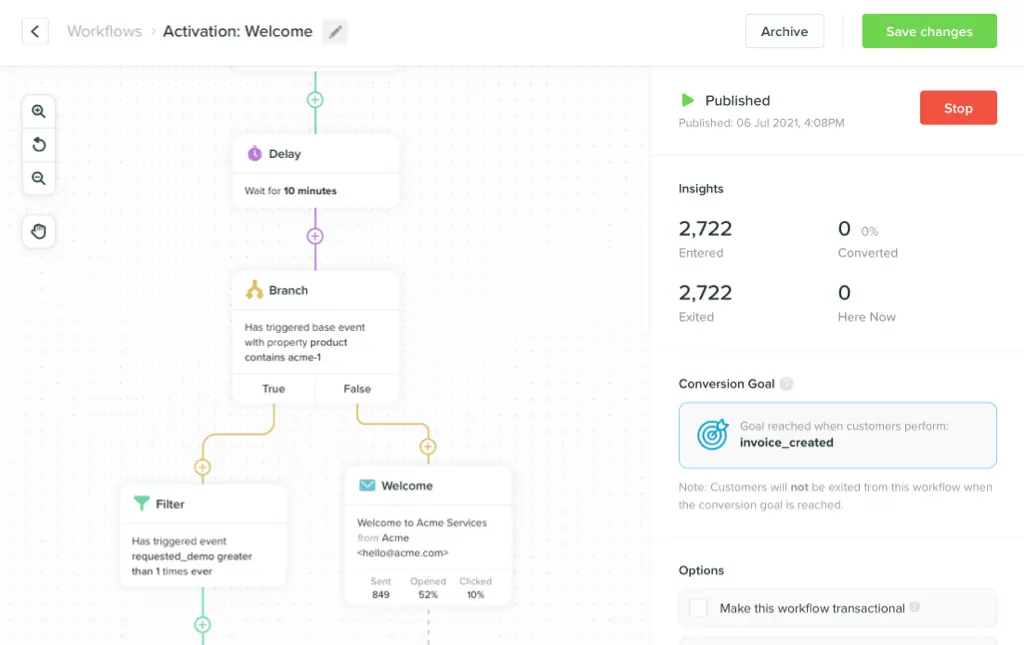
Transparent pricing at $100/mo for Essentials, a 14-day free trial, and WhatsApp support make Customer.io accessible without the procurement overhead of Braze or Iterable. SMS is delivered through Twilio with opt-in management and delivery reporting built in.
Key features
- Event-triggered SMS: Messages sent based on real product behavior — trial status, feature adoption, engagement thresholds
- Visual workflow builder: SMS integrated into multi-step journeys alongside email, push, and in-app without engineering involvement per change
- Behavioral segmentation: Target specific accounts or users based on event history, profile attributes, and product engagement data
- WhatsApp support: B2B international engagement via WhatsApp in the same journey orchestration layer as SMS
- A/B testing: Test SMS content, timing, and channel combinations
- Two-way SMS: Conversational SMS flows with reply handling
- Twilio integration: Primary SMS delivery via Twilio with delivery reporting and opt-in management
- API-first data ingestion: Clean engineering integration for product event data
Pricing
| Plan | Price | Notes |
|---|---|---|
| Essentials | $100/mo | 5,000 profiles · includes email, push, in-app; SMS via Twilio at usage rates |
| Premium | $1,000/mo | Custom volume · Dedicated support |
| Enterprise | Custom | Priority support · Dedicated CSM |
| Startup program | Free 12 months | Startups raising under $10M |
SMS message costs are additional (via Twilio carrier rates) on top of plan fees.
Pros & cons
Pros:
- Event-driven architecture makes B2B behavioral SMS genuinely effective — triggered by product context, not broadcast schedules
- Transparent pricing with a self-serve free trial — evaluate without a sales call
- WhatsApp support covers international B2B accounts where WhatsApp is a primary channel
- Developer-friendly API integrates cleanly with product infrastructure
- 9,000+ brands and 4.4/5 on G2 signal proven infrastructure
Cons:
- Per-profile pricing counts all contacts regardless of activity — cost penalty for B2B PLG companies with large free-user databases
- Built-in CDP creates overlap spend for teams already running Segment or RudderStack
- SMS costs are additive on top of plan fees — budgeting requires Twilio rate awareness
- Not an enterprise platform at Braze or Iterable’s scale — feature depth may fall short for large operations
Customers
Notion, Pipedrive, StuDocu, Kraft Heinz, Zara USA, Schneider Electric. 4.4/5 on G2 with 709 reviews.
"Customer.io lets us trigger SMS based on what users actually do in the product — not what we assume they’ve done."
— Customer.io customer
Iterable: Best B2B SMS platform for enterprise experience-focused brands
For enterprise B2B companies where customer experience across every touchpoint is a strategic differentiator, Iterable’s journey orchestration depth offers capabilities that mid-market platforms can’t match. The Nova AI suite goes further than most in SMS channel routing and personalization.
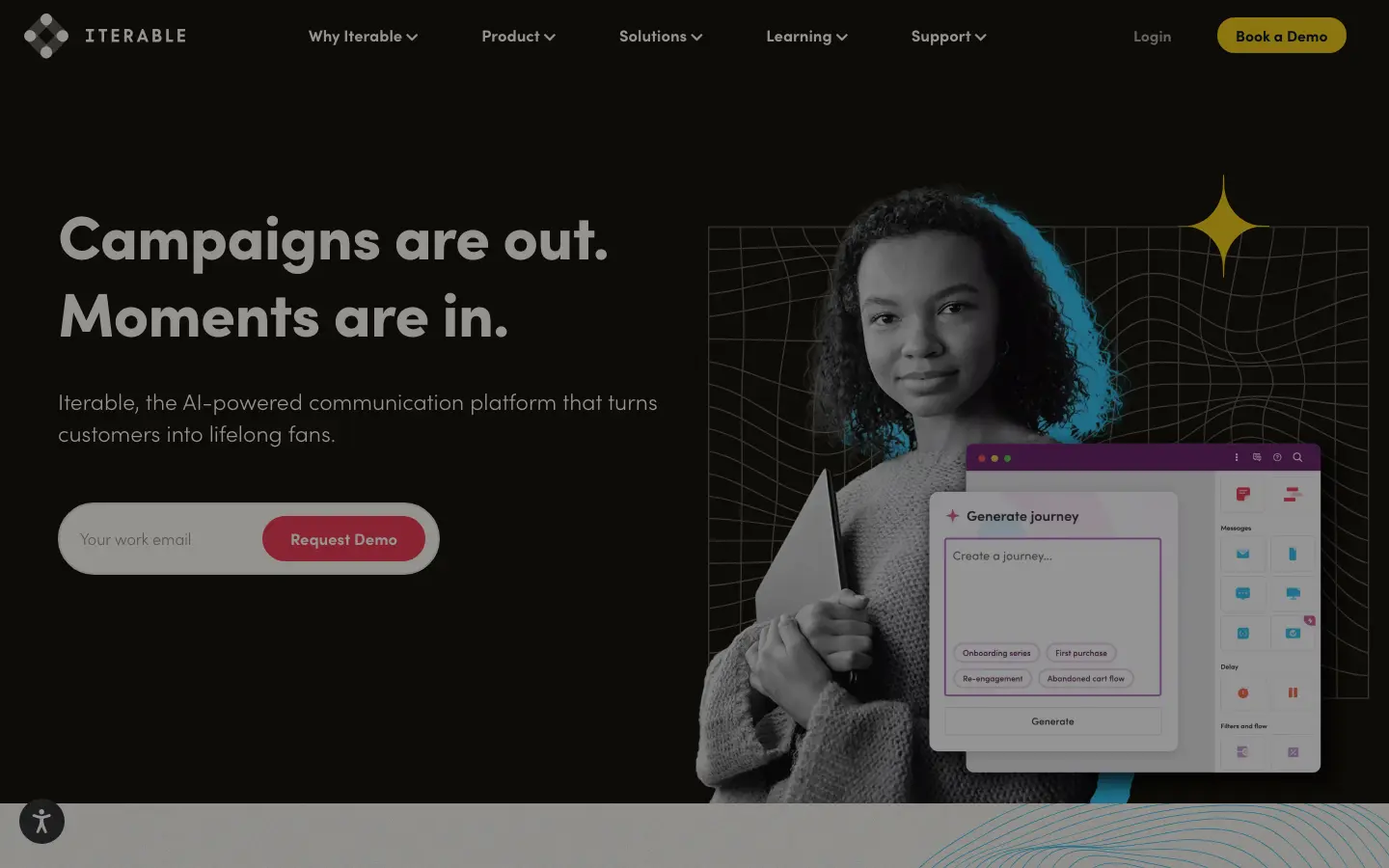
Iterable Nova includes brand affinity scoring — understanding which channel each user responds to most. Predictive goal scoring can route users to SMS or away from it based on predicted response rates. Cross-channel workflows can suppress an SMS follow-up if in-app behavior resolves the issue first.
B2B use cases in Iterable’s customer base include account health alerts, renewal reminders, and upsell notifications. The platform handles TCPA and GDPR compliance, carrier opt-in management, and delivery reporting at enterprise volume.
The structural friction points — no public pricing, mandatory sales demo, annual enterprise contracts — are consistent with the rest of Iterable’s model. For mid-market B2B teams, Customer.io or Vero are more accessible alternatives.
Key features
- Iterable Nova AI suite: Brand affinity scoring, send time optimization, predictive goal scoring — SMS routing based on predicted response
- Cross-channel journey orchestration: SMS coordinated with email, push, and in-app in condition-based workflows
- Engage 1:1: Personalized lifecycle messaging with deep segmentation at individual user level
- Activate Data: Data activation from CRM, CDP, and warehouse sources into SMS targeting
- A/B testing and analytics: Message content, send time, and channel combination testing
- TCPA and GDPR compliance: Carrier opt-in management, suppression lists, quiet hours
- Enterprise delivery infrastructure: High-volume SMS delivery with SLA-backed uptime
Pricing
Custom (contact sales). Enterprise annual contracts. No public pricing tiers. Per-subscriber model regardless of engagement activity.
Pros & cons
Pros:
- Nova AI suite’s brand affinity and predictive goal scoring makes SMS channel decisions data-driven at the individual level
- Cross-channel journey depth for complex B2B lifecycle programs where SMS is one coordinated element
- Proven enterprise scale — $240M ARR, 857 employees, trusted by Asana, Square, Box
- Data activation layer (Activate Data) connects CRM and CDP data to SMS targeting
Cons:
- No public pricing and mandatory sales demo before evaluation — highest procurement friction in this comparison
- Per-subscriber pricing charges for inactive contacts — cost penalty for B2B PLG companies
- Annual enterprise contracts with significant upfront commitment
- G2 reviewers flag reporting as needing improvement — a gap for data-driven B2B teams
- Not suitable for smaller B2B teams that don’t need enterprise journey complexity
Customers
Asana, Square, Redfin, Priceline, Fabletics, Fender, NHL, Morning Brew, Box, Wolt. 4.5/5 on G2 with 691 reviews.
"Iterable’s journey orchestration let us coordinate SMS with every other channel in our lifecycle program — the context a message carries is completely different when it’s triggered by account health data."
— Iterable customer
ActiveCampaign: Best B2B SMS platform for SMB teams with CRM needs
Most B2B SMS platforms in this comparison are built for product-first software companies. ActiveCampaign serves a different buyer — SMB and mid-market B2B companies that need SMS as part of CRM and marketing automation.
Lead nurturing, sales follow-ups, appointment reminders, and deal-stage notifications are its core use cases.
SMS in ActiveCampaign integrates directly into automation workflows alongside email and CRM actions. A sequence might look like: lead fills out a form → email sent immediately → 2-day delay → if email unopened, SMS follow-up sent → CRM task created for sales rep.
Non-technical users can configure this in the visual automation builder. With 900+ integrations, connecting SMS to CRM data from Salesforce or Pipedrive is usually straightforward.
At $15/mo to start (with SMS available at higher tiers), it’s the most accessible entry point for teams without enterprise marketing budgets. The structural limitation: no native data warehouse integration and per-contact pricing that charges for your full database.
Key features
- SMS automation: Integrated into visual automation workflows alongside email and CRM triggers — no separate platform required
- CRM-triggered SMS: Messages triggered by deal stage changes, contact property updates, or pipeline events
- Visual automation builder: Non-technical users configure SMS sequences without engineering involvement
- Two-way SMS: Reply handling within automation workflows
- Lead scoring and segmentation: Behavioral scoring drives SMS targeting — send to the right contacts at the right stage
- 900+ integrations: Connect CRM data from Salesforce, Pipedrive, and HubSpot to SMS workflows
- Predictive sending: AI-driven send time optimization for SMS and email
Pricing
| Plan | Price | Notes |
|---|---|---|
| Starter | From $15/mo | Basic automation; SMS available on higher tiers |
| Plus | From $49/mo | SMS included · CRM · Landing pages |
| Professional | From $79/mo | Predictive sending · Site messaging |
| Enterprise | Custom | Dedicated support · Custom reporting |
Contact-based pricing; scales with total contact count.
Pros & cons
Pros:
- Most accessible pricing in this comparison for SMB B2B teams — SMS available from $49/mo
- Built-in CRM means SMS can be triggered by deal stage, contact property, and pipeline events without a separate integration
- Non-technical users can build and maintain SMS workflows without engineering involvement
- 900+ integrations cover most B2B tool stacks without custom connector work
- 180,000+ customers across 170 countries — proven SMB infrastructure at scale
Cons:
- Per-contact pricing charges for your full database regardless of activity — cost penalty at scale for B2B PLG companies
- No native data warehouse integration — connecting Snowflake, BigQuery, or Redshift requires a third-party sync layer
- Marketer-first platform — engineering teams consistently describe integration with product infrastructure as difficult
- SMS depth is shallower than dedicated CEPs — suitable for CRM-triggered messages, less so for complex behavioral journeys
Customers
180,000+ businesses across 170 countries. 4.5/5 on G2 with 13,000+ reviews.
"ActiveCampaign SMS let our sales team set up follow-up sequences that actually worked — and no one had to call IT to configure them."
— ActiveCampaign customer
Knock: Best B2B SMS platform for engineering-led product teams
Most B2B SMS platforms are operated by marketing teams. Knock is built for engineering teams. In Knock, notification templates — including SMS — live in version control alongside the rest of the codebase.
Changes go through the same code review and CI/CD pipeline as any other product change.
For B2B SaaS products that send SMS as part of their product experience, this distinction matters. An alert that a workspace is approaching its usage limit is a product notification, not a marketing message. It needs to be versioned, reviewed, and deployed with the same rigor as product code.
Knock’s channel set is particularly suited to B2B: SMS alongside email, push, in-app, Slack, and Microsoft Teams. The Slack and Teams channels cover B2B communication surfaces that no other platform in this comparison natively supports.
The free Developer tier provides 10K messages/month across all channels. Starter at $250/mo covers 50K messages.
Key features
- Version-controlled SMS templates: Notification templates live in the codebase — reviewed, versioned, and deployed like product code
- CLI and AI IDE integration: Build and test SMS workflows in Cursor, GitHub Copilot, and standard terminal tooling
- CI/CD deployment: SMS template changes deploy through existing pipelines, not through a SaaS dashboard
- Slack and Microsoft Teams channels: B2B product notification surfaces that no other platform in this comparison natively supports
- User preference management: Users control which channels (SMS, email, Slack) they receive which notification types on
- Send window management: Respect timezone and working hours for SMS delivery to B2B recipients
- AI agent functions: Intelligent, context-aware SMS workflows powered by AI function calling
- SCIM, SAML 2.0 SSO, HIPAA compliance: Enterprise security requirements for regulated B2B industries
Pricing
| Plan | Price | Notes |
|---|---|---|
| Developer | $0 | 10K messages/mo across all channels · 500 AI agent credits |
| Starter | $250/mo | 50K messages · 2.5K guide active users · 2K AI agent credits |
| Enterprise | Custom | Flexible volume · SAML · HIPAA · Per-customer branding · Datadog observability |
Pros & cons
Pros:
- Only platform in this comparison where SMS templates live in version control — the right model for product-triggered B2B notifications
- Slack and Teams channels cover B2B product notification surfaces that dedicated CEPs don’t natively support
- Free developer tier with 10K messages/month across all channels — real utility for evaluation with no commitment
- CLI and AI IDE integration puts SMS development in the same workflow as feature development
- HIPAA compliance makes it viable for B2B companies in regulated industries
Cons:
- Not a marketing automation platform — no behavioral lifecycle campaigns, list management, or campaign analytics designed for marketing team ownership
- Non-technical marketing teams can’t operate SMS campaigns independently — requires engineering involvement for most changes
- Small team (11–50 employees) means limited support resources at enterprise scale
- No warehouse-native segmentation for marketing-driven SMS targeting
Customers
Vercel, Webflow, Medium, Clay, Amplitude, Gorgias, Outreach, Discogs. 4.6/5 on G2 with 107 reviews.
"Knock treats our SMS templates like the rest of our codebase. That’s how product notifications should work."
— Knock customer
6. Vero: Best B2B SMS platform for product-led SaaS companies with warehouse data
Disclosure: Vero is our platform. We’ve included it here for product-led SaaS companies where per-contact pricing creates cost friction and warehouse-native data integration is a core requirement. We’ve been honest about where it does and doesn’t fit.
B2B SMS for product-led SaaS has a specific shape. The messages that matter most are behavioral — triggered by what an account did or didn’t do in the product. They’re personalized with data that lives in a warehouse.
An SMS sent to a decision-maker when their team’s trial is expiring — triggered by a usage event in Snowflake, personalized with account-level context from BigQuery — is worth far more than a scheduled broadcast.
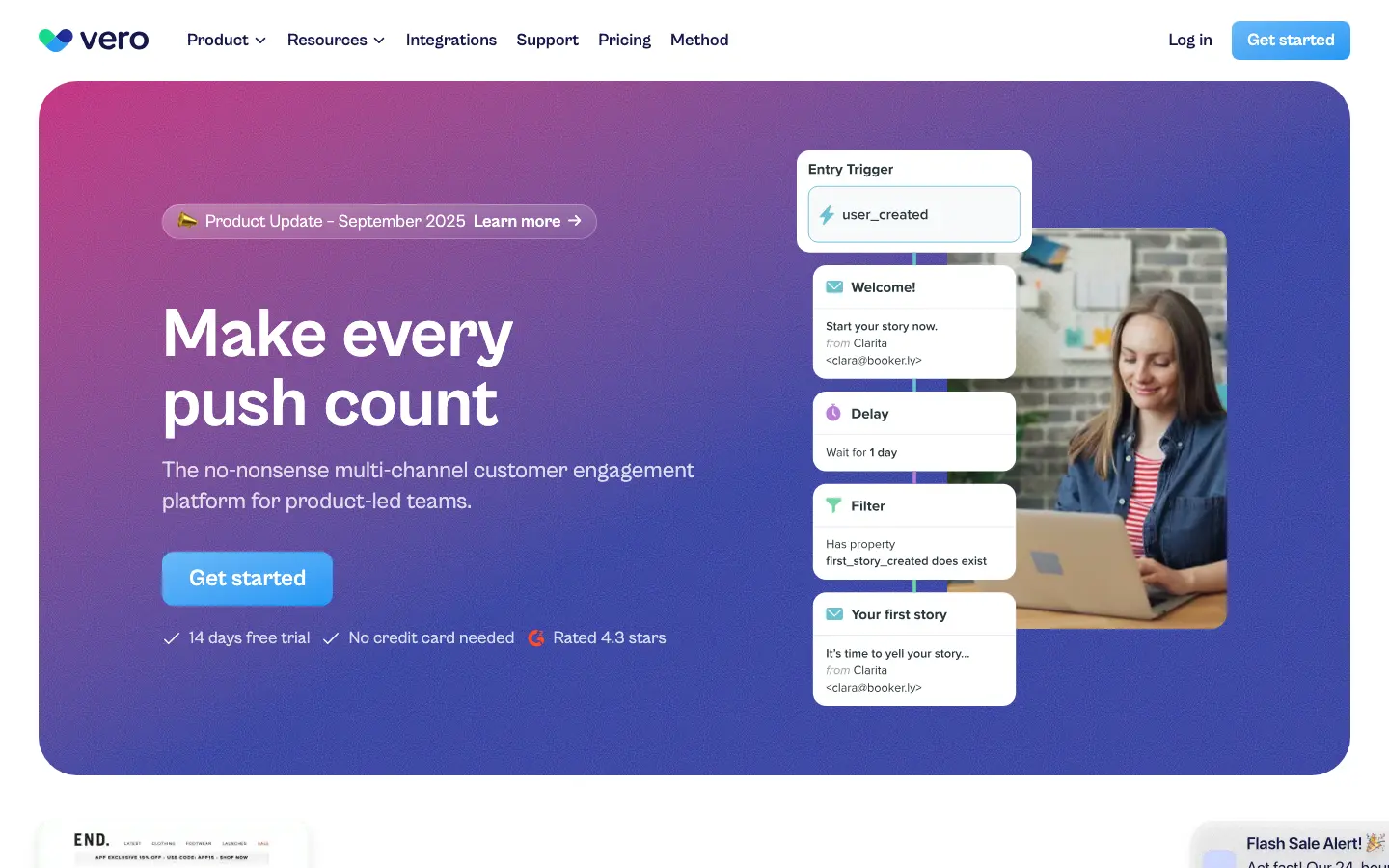
Vero’s Connected Audiences connects directly to Snowflake, BigQuery, Redshift, PostgreSQL, MySQL, and SQL Server via SQL. You use your warehouse data for SMS segmentation without duplicating it into Vero.
A segment built on warehouse data — accounts in trial, users below their usage threshold, churned accounts in the re-engagement window — flows into an SMS workflow alongside email, push, and in-app in a single journey builder.
The pricing model matters specifically for B2B PLG. A B2B SaaS company with 10,000 total users and 2,000 paying accounts pays for 10,000 on per-subscriber platforms. On Vero, you pay for the users active in the billing period.
For PLG businesses where the funnel is wide and the paying segment is a fraction of total accounts, that difference is structural — not a marginal discount.
"We needed something that scales with our send volumes, not our user counts."
— Lawrence Scotland, Sr. Director, Dribbble
Key features
- Active-profile pricing: Charges only for users active in the billing period — structural cost advantage for B2B PLG companies with large free-user bases
- Connected Audiences / Warehouse integration: Direct SQL access to Snowflake, BigQuery, Redshift, PostgreSQL, MySQL, SQL Server — use warehouse data for SMS targeting without duplication
- Best-of-breed CDP fit: Works alongside Segment, RudderStack, Hightouch, Census — no CDP overlap spend
- Multi-channel SMS workflows: SMS coordinated with email, push, and in-app in a single visual journey builder
- Event-triggered behavioral SMS: Messages triggered by product events — trial expiry, usage thresholds, onboarding milestones, account health signals
- Behavioral segmentation: Segment by event history, profile attributes, and warehouse data in the same workflow
- Developer-credible infrastructure: Full API, developer guide, 12 years of production scale — 5B+ messages/year at 99.99% uptime
- 14-day free trial: Evaluate without a sales call, no credit card required
Pricing
| Plan | Price | Includes |
|---|---|---|
| Starter | $49/mo (annual) or $54/mo | 5,000 active profiles · Email · Push · In-app · Webhooks · Unlimited seats |
| Professional | Custom | SMS included · Scales all dimensions · Unlimited seats · Fair use overage policy |
14-day free trial, no credit card required. SMS is available on the Professional plan.
Pros & cons
Pros:
- Active-profile pricing is a structural cost advantage for B2B PLG companies with large inactive or free-user segments
- Direct warehouse SQL integration removes the data sync layer for teams whose account and product data lives in Snowflake or BigQuery
- SMS coordinated with email, push, and in-app in a single workflow — not a bolt-on channel
- Self-serve free trial — evaluate without a sales call, unlike Braze or Iterable
- 12-year track record: 5B+ messages/year, 99.99% uptime, trusted by Dribbble, Unsplash, Pipedrive
Cons:
- SMS is available on Professional (custom pricing) — Starter plan covers email, push, and in-app only
- No WhatsApp yet (in development) — relevant for B2B teams with international accounts
- Smaller customer base and brand recognition than the enterprise platforms in this comparison
- No built-in CRM — not the right choice for sales-led B2B teams that need deal pipeline alongside SMS
Customers
Dribbble, Unsplash, Pipedrive, Stockpile, and 50+ companies globally. 4.3/5 on G2.
"It didn’t make sense to be paying for everything when we don’t need all that stuff."
— Vincent Turner, CEO, Uno
Frequently asked questions
What makes B2B SMS different from B2C SMS?
B2B SMS is lower volume, higher context, and more tied to product or account behavior. B2C SMS often involves broadcast campaigns — promotions, abandoned cart reminders, seasonal offers. B2B SMS is most effective when it’s event-driven, triggered by what a specific account or user did in the product.
The audience is smaller, the individual contact value is higher, and the tolerance for irrelevant messages is lower. Message timing and opt-in management matter more than in consumer contexts.
What compliance requirements apply to B2B SMS?
In the United States, the TCPA requires express written consent before sending marketing SMS to any number. B2B SMS does not get an automatic exemption.
GDPR in Europe requires a lawful basis for processing phone numbers and a clear opt-in mechanism. Most platforms handle opt-in management, suppression lists, and quiet hours at the platform level. The legal obligation to collect and document consent sits with the sender, not the platform.
Which B2B SMS platform has the best data warehouse integration?
Vero. Its Connected Audiences feature connects directly to Snowflake, BigQuery, Redshift, PostgreSQL, MySQL, and SQL Server via SQL. No reverse ETL tool or custom sync pipeline is required.
You query warehouse data directly to build SMS audiences and personalize messages, without storing a copy in Vero. Braze’s Currents streams engagement data out to warehouses in real time, but doesn’t offer the same inbound SQL query model for audience building.
Which platform is best for transactional B2B SMS?
Knock, for engineering-led teams building product notifications. Its version-controlled, CI/CD-deployed model is the right architecture for transactional messages that need to be reliable and auditable.
Customer.io is the best option for teams that want transactional SMS triggered by product events without full engineering ownership. The event-driven architecture handles it reliably without code changes for every new message type.
Which B2B SMS platform has the most transparent pricing?
Customer.io (Essentials at $100/mo) and ActiveCampaign (from $15/mo) publish pricing openly. Vero publishes Starter at $49/mo annually, with Professional pricing available on request.
Braze and Iterable require a sales conversation before any pricing information is available. That’s the highest procurement friction in this comparison.
Does it make sense to use a dedicated SMS tool vs a full CEP?
For most B2B companies, a full customer engagement platform that includes SMS is the better long-term choice. Running a separate SMS tool means maintaining two workflow systems, two data integrations, and two sets of opt-in records.
The exception is engineering-led teams using Knock for product notification infrastructure. The version-controlled, code-first model justifies a separate platform for notifications versus a marketing CEP for lifecycle campaigns.
Conclusion: Choosing your B2B SMS platform
The right B2B SMS platform depends less on SMS-specific features and more on how your organization structures its messaging program overall.
For enterprise B2B brands running coordinated multi-channel programs and needing AI-driven channel decisioning, RCS support, and enterprise-grade infrastructure, Braze is the leading option — with the understanding that you’re entering enterprise procurement territory.
For mid-market B2B SaaS product teams that want event-driven SMS tied to real product behavior and a self-serve evaluation process, Customer.io is the most accessible step up — with WhatsApp support and 9,000+ brands behind the infrastructure.
For enterprise teams with complex journey orchestration requirements and dedicated marketing operations, Iterable‘s Nova AI suite and cross-channel depth serve experience-focused brands at scale — with the same procurement overhead as Braze.
For SMB and mid-market B2B teams that need SMS as part of a CRM and automation workflow — lead nurturing, sales follow-up, deal-stage notifications — ActiveCampaign is the most accessible entry point with the broadest integration ecosystem.
For engineering-led product teams that want transactional and product SMS in version-controlled, CI/CD-deployed infrastructure — alongside Slack and Teams — Knock is the only platform in this comparison built for that model.
For product-led B2B SaaS companies with data in a warehouse and a large free-user funnel, Vero resolves two structural problems at once: active-profile pricing and direct SQL warehouse integration — at a lower cost floor with a self-serve evaluation process.
Want to see how Vero’s active-profile pricing works for your B2B SMS use case? Start a free trial — no credit card required, no sales call needed.