- All Posts
- /
- 10 Best Customer Lifecycle Marketing Software for 2026
10 Best Customer Lifecycle Marketing Software for 2026
Alternatives-
 Chris Hexton
-
Updated:Posted:
On this page
Most customer relationships don’t fail because of a bad product. They fail because the messaging stops making sense. The right message reaches the wrong person, at the wrong lifecycle stage, and the moment is lost.
Customer lifecycle marketing is the discipline of preventing that. It maps every stage of the customer relationship — acquisition, onboarding, engagement, retention, and win-back — and puts the right message at each one. The software you choose determines how precisely you can execute.
This guide covers the 10 best customer lifecycle marketing software options for 2026. We’ve compared pricing, features, and fit across different team types, business models, and lifecycle stages. By the end, you’ll know which platform belongs in your stack.
What are the best customer lifecycle marketing tools in 2026?
The right platform depends on your business model, data maturity, and team structure. Vero combines behavioral automation with warehouse-native segmentation and active-profile pricing — a rare combination at the mid-market price point. Klaviyo leads for e-commerce brands that need lifecycle programs tied to purchase and browse behavior.
Salesforce Marketing Cloud is the enterprise standard for omnichannel lifecycle execution at scale. Omnisend suits e-commerce teams that want email, SMS, and push coordinated in one platform at a competitive price. Intercom is the pick for SaaS teams that want proactive lifecycle messaging alongside their support layer.
Adobe Marketo Engage anchors B2B marketing teams running complex, account-based lifecycle programs. Drip serves e-commerce brands that want CRM-style customer intelligence alongside their automation. Ortto targets SaaS and B2B teams with a CDP, journey builder, and analytics in one product. Mailchimp remains the most accessible entry point for small businesses. Encharge is purpose-built for SaaS teams that need behavior-driven lifecycle email tied to billing data.
| Platform | Starting Price | Best For | Key Differentiator | Free Trial |
|---|---|---|---|---|
| Vero | $54/mo | PLG SaaS, B2C, mobile apps | Active-profile pricing + warehouse segmentation | 14 days, no CC |
| Klaviyo | $20/mo | E-commerce brands | Predictive analytics + active profile pricing | Free plan (250 contacts) |
| Salesforce MC | $1,500/mo | Enterprise brands | CRM-native lifecycle at scale | Sales demo required |
| Omnisend | $16/mo | E-commerce teams | Email + SMS + push in one workflow | Free plan (250 contacts) |
| Intercom | $29/seat/mo | SaaS teams | In-app proactive messaging + Fin AI | 14-day free trial |
| Adobe Marketo | Custom (~$895+/mo) | B2B enterprise | ABM + multi-touch attribution | Sales demo required |
| Drip | $39/mo | E-commerce brands | E-commerce CRM + behavioral automation | 14-day free trial |
| Ortto | $199/mo | SaaS, B2B | Built-in CDP + journey builder + analytics | No free trial |
| Mailchimp | Free–$350+/mo | SMB, general | 13M+ users, easiest to start | Free plan (250 contacts) |
| Encharge | $49/mo | SaaS startups | Stripe/Chargebee/Paddle billing integrations | 14-day free trial |
1. Vero: Best for PLG SaaS and B2C Software Teams
Full transparency: We built Vero, so we’re not a neutral party here. We believe it belongs on any list of the best lifecycle marketing platforms — but you should factor in our bias.
Vero is a multi-channel customer engagement platform built for product-led software companies. It fires event-triggered emails, push notifications, SMS, and in-app messages from live product and warehouse data. Founded in 2012, Vero now delivers 5+ billion messages annually at 99.99% uptime.
What makes Vero distinctive for lifecycle marketing is pricing. Most platforms charge per total subscriber — a B2C business with 500K users pays for all 500K, active or not. Vero charges only for active profiles, a structural cost advantage at every lifecycle stage.
Vero also connects directly to your data warehouse. Its Connected Audiences feature queries Snowflake, BigQuery, Redshift, and others via SQL — without duplicating data into the platform. Every lifecycle segment draws on the most complete behavioral data your company already has.
Core capabilities
- Event-triggered messaging: Fire lifecycle messages from any product event — signup, activation, feature use, inactivity, or custom triggers you define.
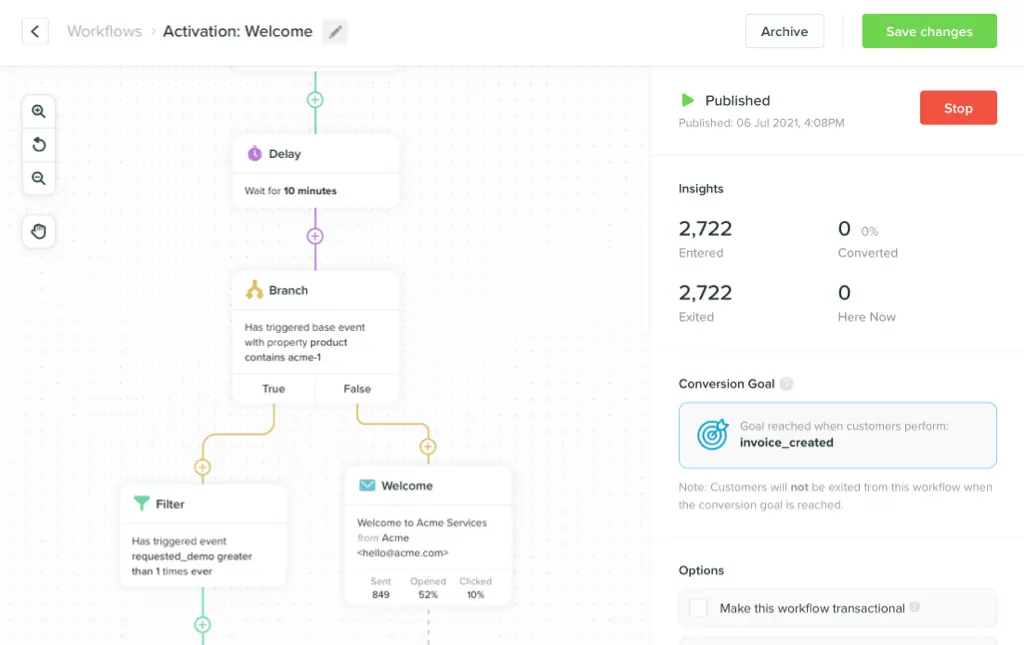
- Visual journey builder: Multi-channel workflows with branching logic, A/B splits, delays, and no code required.
- Connected Audiences: Direct SQL connections to major data warehouses for warehouse-powered segmentation.
- Multi-channel delivery: Email, iOS/Android push, in-app messaging, SMS, and webhooks coordinated in one workflow.
- Behavioral segmentation: Target lifecycle stages by event history, profile attributes, and live warehouse data.
- Developer tools: Full API with Segment, RudderStack, Hightouch, and Census integrations.
What it costs
- Starter: $54/month ($49/month billed annually) — 5,000 active profiles, 10,000 emails/month, 20,000 push/month, unlimited team members
- Professional: Custom — scales profiles, emails, push, SMS, and events; fair-use overage policy
14-day free trial, no credit card required.
Where it excels — and where it doesn’t
Pros:
- Active-profile pricing is a structural cost advantage for B2C and PLG teams with large inactive lists.
- Warehouse-native segmentation brings enterprise-grade data capability to a mid-market price.
- Developer-credible platform that product and marketing teams can operate independently.
- 12+ years of organic growth and 99.99% uptime signal proven infrastructure.
Cons:
- Smaller brand recognition than enterprise lifecycle platforms; may not appear on early shortlists.
- SMS and WhatsApp are still maturing compared to Vero’s email and push capabilities.
- No built-in CDP — by design, but a gap for buyers wanting everything in one place.
Who’s using it
Vero is trusted by Dribbble, Unsplash, Pipedrive, and Stockpile, among 50+ companies globally. It holds a 4.3-star rating on G2. One customer noted: "Vero has one of the best support teams I’ve encountered."
2. Klaviyo: Best for E-Commerce Lifecycle Marketing
Klaviyo is the lifecycle platform e-commerce brands reach for first. It powers over 170,000 businesses and generates roughly $937M in ARR. Those numbers signal genuine product-market fit in DTC and online retail. Every major lifecycle stage has pre-built flows ready to activate.
Klaviyo switched to active profile pricing in early 2025, aligning cost with real engagement rather than total list size. For e-commerce brands with large dormant segments, that change matters. Pricing now starts at $20/month for 500 active contacts.
What separates Klaviyo is its predictive analytics layer. The platform models customer lifetime value, churn risk, and next purchase date from behavioral data. For lifecycle programs, that intelligence changes who you target and when.
Core capabilities
- Predictive analytics: CLV, churn risk, and next order date built into the segmentation layer — not a premium add-on.
- Pre-built e-commerce flows: Welcome series, cart abandonment, browse abandonment, post-purchase, and win-back — all ready to customize.
- Native Shopify integration: Real-time purchase, browse, and cart events fire directly into the lifecycle engine; official Shopify partner.
- Email + SMS: Both channels in one platform with unified contact profiles and opt-out sync.
- AI features: Subject line generation and send-time optimization built into every plan.
- 350+ integrations: Loyalty tools, reviews, and e-commerce tech natively connected.
What it costs
Email plans start at $20/month for 500 active contacts and scale to $720/month at 50K contacts and $2,300/month at 250K. A free plan covers 250 active contacts with 500 emails/month. SMS is billed separately per message.
Where it excels — and where it doesn’t
Pros:
- Deepest Shopify integration in the lifecycle marketing category.
- Predictive analytics (CLV, churn risk, next purchase) are built in at all paid tiers.
- Active profile pricing aligns cost with real engagement, not total list size.
- 170,000+ brands signals ecosystem maturity and deep community resources.
Cons:
- E-commerce-first — weaker fit for SaaS or PLG teams with product behavioral data.
- Email and SMS only; no push notifications, in-app messaging, or webhooks.
- No data warehouse integration for teams with mature data infrastructure.
- Less developer-friendly for custom event pipelines beyond standard e-commerce triggers.
Who’s using it
Klaviyo powers lifecycle programs for Glossier, Mejuri, Stanley 1913, Living Proof, and SKIMS. It holds a 4.6-star rating on G2 across 1,000+ reviews.
3. Salesforce Marketing Cloud: Best for Enterprise Lifecycle Programs
Salesforce Marketing Cloud (SFMC) is the enterprise standard for omnichannel lifecycle marketing. It covers email, SMS, push, in-app messaging, and ads — all connected to the Salesforce CRM data layer. For enterprise teams already running Salesforce, it’s the most natural lifecycle extension available.
Journey Builder is the platform’s core automation engine. It coordinates multi-channel lifecycle sequences from CRM data, behavioral triggers, and real-time customer signals. Einstein AI adds predictive send-time optimization, content recommendations, and engagement scoring across the full lifecycle.
The tradeoff is cost and complexity. SFMC isn’t a self-serve product. Implementation requires dedicated resources — not a quick start. Total cost of ownership, including SMS credits and add-ons, typically runs 2–3x the license price alone.
Core capabilities
- Journey Builder: Multi-channel lifecycle automation across email, SMS, push, and ads — triggered from CRM and behavioral data.
- Einstein AI: Send-time optimization, engagement scoring, and content recommendations built into journey logic.
- Salesforce CRM integration: Native connection to Sales, Service, and Commerce Cloud — the deepest CRM integration in the category.
- Multi-channel delivery: Email, mobile push, SMS, in-app messaging, and digital advertising audiences.
- Data Cloud: Unified customer profiles from CRM, commerce, and behavioral sources.
- Personalization Studio: Dynamic content and AI-powered personalization at scale.
What it costs
Growth Edition starts at $1,500/month per organization (billed annually). Advanced Edition starts at $3,250/month. Enterprise deployments scale to $15,000–$45,000/month at larger contact volumes. Starter and Pro Suites (lighter versions) begin at $25–$100 per user per month.
Where it excels — and where it doesn’t
Pros:
- Deepest CRM + lifecycle integration available — a clear advantage for Salesforce-stack teams.
- Einstein AI is enterprise-grade personalization built directly into journey logic.
- One platform for the full customer lifecycle, from lead through loyalty.
- Proven infrastructure at Fortune 500 enterprise scale.
Cons:
- Enterprise pricing puts it out of reach for most mid-market teams.
- Implementation complexity requires dedicated resources — not a quick start.
- Total cost of ownership is 2–3x the license price when add-ons are included.
- No self-serve trial; all deployments require a sales engagement.
Who’s using it
Salesforce Marketing Cloud is used by Fortune 500 brands in retail, financial services, healthcare, and media that need lifecycle marketing tightly coupled to CRM data at global scale.
4. Omnisend: Best for E-Commerce Omnichannel Lifecycle
Omnisend is built for e-commerce teams that want email, SMS, and push coordinated in one platform — without enterprise pricing. It serves 125,000+ brands and holds a 4.6-star G2 rating across thousands of reviews. The focus is on omnichannel lifecycle sequences that work together, not in silos.
Pre-built automation templates cover the most common lifecycle stages: welcome series, cart recovery, post-purchase sequences, and win-back campaigns. Each is ready to activate and customize, reducing the setup time that kills most lifecycle programs before they ship.
The SMS integration is native, not bolted on. Contacts are shared, opt-out state syncs automatically, and journey logic sequences across channels in a single workflow.
Core capabilities
- Omnichannel automation: Email, SMS, and push coordinated in one lifecycle workflow with shared contact logic.
- Pre-built automations: Cart abandonment, welcome series, browse abandonment, post-purchase, win-back — all pre-configured.
- E-commerce integrations: Native Shopify, WooCommerce, BigCommerce, and Magento connections for behavioral triggers.
- Customer lifecycle analytics: Lifecycle stage reports and advanced segmentation in the Pro plan.
- AI features: Subject line generator, send-time optimization, and product recommendation insertion.
- 250+ segment templates: Built-in segments based on purchase behavior and lifecycle stage.
What it costs
- Free: 250 contacts, 500 emails/month
- Standard: From $16/month — most features, unlimited push, live chat support
- Pro: From $59/month — unlimited emails, built-in SMS credits, advanced lifecycle analytics
- Custom: Available for large accounts
Where it excels — and where it doesn’t
Pros:
- Native email + SMS + push in one workflow at a genuinely competitive price.
- Pre-built lifecycle automations reduce time to launch significantly.
- Strong e-commerce integrations across all major platforms.
- Generous free tier and low Standard entry price make it accessible for growing brands.
Cons:
- E-commerce focused — less suited to SaaS or product behavioral data use cases.
- No data warehouse integration for teams with mature data infrastructure.
- Advanced lifecycle analytics require a Pro plan upgrade.
- Contact-count pricing (including unsubscribed contacts) can inflate costs at scale.
Who’s using it
Omnisend serves 125,000+ e-commerce brands across Shopify, WooCommerce, and BigCommerce. It is particularly strong among DTC brands in fashion, beauty, and health.
5. Intercom: Best for SaaS Lifecycle Communication
Intercom is where SaaS lifecycle marketing meets customer communication. It combines proactive in-app messaging, behavioral email, product tours, and AI-powered support in one platform. For product-led and SaaS teams, lifecycle programs run where users actually are — inside the product.
Proactive messaging is the differentiator. Intercom’s outbound tools trigger in-app messages, banners, and emails from user behavior. These fire during onboarding, at retention risk moments, and at expansion triggers — coordinated by Series, Intercom’s visual campaign builder.
The Fin AI Agent handles inbound support. That means lifecycle messaging and customer support share one data layer — context that makes both more effective.
Core capabilities
- Proactive messaging: In-app messages, banners, and email triggered by user behavior across the lifecycle.
- Series: Visual multi-step campaign builder for onboarding, engagement, and retention sequences.
- Product tours: Interactive in-app onboarding experiences tied to lifecycle triggers.
- Fin AI Agent: Conversational AI for inbound support — shares customer context with lifecycle programs.
- Customer data: Behavioral data layer connecting lifecycle messaging to support interactions.
- Multi-channel: In-app, email, push, and SMS across plans.
What it costs
Plans start at $29/seat/month (billed annually) or $39/month billed monthly for the Essential tier. Advanced and Expert tiers add cost based on seat count and conversation volume. The Proactive Support Plus add-on costs $99/month and unlocks product tours, surveys, and targeted messages. That plan caps at 500 messages/month. A 14-day free trial is available.
Where it excels — and where it doesn’t
Pros:
- The most mature in-app lifecycle messaging capability in the mid-market.
- Proactive and reactive messaging share one customer data layer — no fragmented context.
- Product tours are native, not a third-party integration.
- Strong SaaS positioning with genuine product and lifecycle depth.
Cons:
- Seat-based pricing scales unpredictably with team and conversation volume growth.
- Proactive Support Plus at $99/month has a 500-message/month cap — limiting at scale.
- Total cost is complex — seats, resolution volume, and add-ons make budgeting hard.
- Less suited for e-commerce or high-volume outbound B2B marketing use cases.
Who’s using it
Intercom is used by thousands of SaaS companies globally — from growth-stage startups to enterprise brands. It holds a 4.5-star rating on G2 across 3,000+ reviews.
6. Adobe Marketo Engage: Best for B2B Lifecycle Marketing
Adobe Marketo Engage is the lifecycle marketing standard for B2B enterprise teams. It’s built for long sales cycles, account-based marketing, and multi-touch revenue attribution — the mechanics that most consumer-focused platforms don’t address.
The platform’s AI layer handles predictive engagement scoring, content personalization, and next-best-action recommendations across email, web, ads, and events. For organizations running complex account-based programs with long lifecycles, that depth is hard to replicate elsewhere.
Marketo’s native integration with Adobe Experience Cloud — Analytics, Target, and Experience Manager — makes it a natural fit for teams already invested in Adobe’s broader stack.
Core capabilities
- Lead lifecycle management: Lead capture, scoring, nurturing, and handoff across the full B2B lifecycle.
- Account-based marketing: Account scoring, target account lists, and engagement tracking built in.
- Predictive engagement: AI-powered content personalization and next-best-action recommendations.
- Multi-touch attribution: Revenue attribution across every touchpoint in the lifecycle.
- Adobe ecosystem integration: Native connections to Analytics, Target, Experience Manager, and Commerce.
- Email, web, and ads: Coordinated lifecycle execution across owned and paid channels.
What it costs
Adobe does not publish pricing. All plans are quote-based, billed annually, and scaled by edition (Growth, Select, Prime, Ultimate) and database size. Estimated starting price is around $895/month, with enterprise contracts running significantly higher. There is no free plan or self-serve trial.
Where it excels — and where it doesn’t
Pros:
- Deepest B2B lifecycle and ABM capability in the mid-to-enterprise market.
- Predictive engagement AI is mature and integrated into campaign logic.
- Multi-touch attribution connects lifecycle marketing directly to revenue outcomes.
- Native Adobe Experience Cloud integration for teams with broader Adobe investment.
Cons:
- No transparent pricing — a full sales engagement is required before evaluation.
- Implementation overhead is significant; not suited for lean or early-stage teams.
- Consumer-facing lifecycle use cases (B2C SaaS, mobile apps) are a weak fit.
- Enterprise-only in practice, even at lower contact volumes.
Who’s using it
Marketo Engage is used by enterprises in financial services, technology, manufacturing, and healthcare. Notable customers include GE, Samsung, and Panasonic. It holds a 4.1-star rating on G2 across 2,400+ reviews.
7. Drip: Best for E-Commerce CRM Lifecycle
Drip describes itself as an "e-commerce CRM" — a label that says something specific about how it approaches lifecycle marketing. Beyond sending emails, Drip builds customer intelligence from purchase behavior, browsing patterns, and engagement history. Lifecycle campaigns run on top of that intelligence, not just lists.
The visual workflow builder handles onboarding, win-back, post-purchase, and browse abandonment sequences. Pre-built automation blueprints cover the most common e-commerce lifecycle scenarios — teams can get live in hours, not weeks.
Drip targets e-commerce brands on Shopify, WooCommerce, or BigCommerce generating $1M–$50M in revenue. At that scale, combining email, SMS, and behavioral CRM in one platform removes significant coordination overhead.
Core capabilities
- E-commerce CRM: Builds customer profiles from purchase history, browsing behavior, and lifecycle events.
- Behavioral automation: Workflows triggered by product browsing, cart actions, purchase frequency, and engagement signals.
- Pre-built blueprints: Ready-made workflows for cart abandonment, post-purchase, win-back, and VIP programs.
- Email + SMS: Both channels in one platform with shared contact profiles and opt-out sync.
- Platform integrations: Native Shopify, WooCommerce, and BigCommerce connections.
- Revenue attribution: Per-campaign and per-lifecycle-stage revenue reporting.
What it costs
Drip uses a single-plan model starting at $39/month for up to 2,500 contacts, with unlimited email sends. Pricing scales by contact count. There is no free plan; a 14-day free trial is available.
Where it excels — and where it doesn’t
Pros:
- CRM-style customer intelligence brings depth to lifecycle segmentation beyond standard email tools.
- Pre-built blueprints reduce lifecycle program setup time for e-commerce teams.
- Email + SMS in one platform with real contact-level coordination.
- Strong integration with major e-commerce platforms for behavioral triggers.
Cons:
- E-commerce focused — not suited for SaaS, PLG, or service businesses.
- Pricing scales steeply past 5,000 contacts, reducing competitiveness at larger list sizes.
- No push notifications, in-app messaging, or webhook support.
- Less suitable for complex, multi-channel lifecycle programs outside e-commerce.
Who’s using it
Drip serves e-commerce brands primarily on Shopify and WooCommerce. Its sweet spot is DTC businesses in the $1M–$50M revenue range that want lifecycle marketing automation with CRM-grade customer intelligence.
8. Ortto: Best for SaaS and B2B Lifecycle Automation
Ortto (formerly Autopilot) combines a CDP, visual journey builder, email, SMS, push, live chat, and reporting in a single product. For SaaS and B2B teams that want all of that without stitching tools together, it’s the broadest mid-market option available.
The journey builder is purpose-built for SaaS lifecycle programs: trial onboarding, product adoption, churn-risk detection, and expansion triggers are first-class use cases. AI features — send-time optimization and predictive churn scoring — are included in the Professional tier and above.
Ortto’s analytics are a consistent differentiator in G2 reviews. Teams get lifecycle stage reporting, funnel analysis, and attribution that most standalone email platforms can’t match.
Core capabilities
- Built-in CDP: Unified customer profiles with website tracking, behavioral events, and CRM data.
- Visual journey builder: Drag-and-drop lifecycle automation across email, SMS, push, and in-app.
- SaaS lifecycle flows: Trial onboarding, activation nudges, churn detection, and expansion triggers supported natively.
- Analytics: Lifecycle stage reporting, funnel analysis, and revenue attribution.
- Multi-channel delivery: Email, SMS, web and mobile push, and live chat.
- Integrations: Salesforce, Segment, Slack, and 100+ native connectors.
What it costs
- Starter: From $199/month (or ~$169/month annually) — 5,000 contacts
- Professional: From $509/month annually — 10,000 contacts, A/B testing, predictive analytics
- Business: From $849/month annually — advanced analytics, higher contact limits
- Enterprise: Custom
No month-to-month option above Starter; Professional and higher require annual commitment.
Where it excels — and where it doesn’t
Pros:
- CDP + journey builder + analytics in one platform reduces stack fragmentation.
- SaaS lifecycle use cases (trial, adoption, churn detection) are natively supported.
- Analytics depth is stronger than most standalone lifecycle email tools.
- Salesforce and Segment integrations fit data-mature B2B stacks.
Cons:
- $199/month minimum is expensive for early-stage teams with small contact lists.
- Annual commitment required on Professional and above.
- Less suited for B2C e-commerce or high-volume consumer messaging.
- Smaller brand recognition than enterprise-tier lifecycle platforms.
Who’s using it
Ortto serves SaaS and B2B teams across technology, professional services, and financial services. It holds a 4.3-star rating on G2. Teams consistently highlight its analytics layer as a differentiator in the mid-market lifecycle category.
9. Mailchimp: Best for Small Businesses Starting Lifecycle Programs
Mailchimp is the most-used email platform in the world — 13 million+ businesses send through it. For small businesses and early-stage teams building their first lifecycle programs, that familiarity and accessibility are real advantages. More tutorials, templates, and community resources exist for Mailchimp than almost any other tool in this list.
The Customer Journey Builder handles multi-step automation for welcome series, abandoned cart, and re-engagement sequences. Predictive demographics and purchase likelihood scoring are available on Standard and Premium plans.
Mailchimp’s free plan has shrunk considerably in recent years — 250 contacts and 500 emails/month as of 2026, down from 2,000 contacts in earlier years. For teams with growth ambitions, it’s a starting point, not a destination.
Core capabilities
- Customer Journey Builder: Visual automation for multi-step lifecycle sequences.
- Pre-built templates: 100+ email templates and lifecycle automation blueprints.
- Audience segmentation: Behavioral, demographic, and engagement-based segmentation.
- Ads integration: Facebook, Google, and Instagram ad management built in.
- Predictive demographics: Purchase likelihood and churn risk scoring on Standard and Premium.
- Intuit ecosystem: Connection path to QuickBooks for revenue-tied lifecycle tracking.
What it costs
- Free: 250 contacts, 500 emails/month (daily cap of 250)
- Essentials: From $13/month for 500 contacts
- Standard: From $20/month — includes journey builder and predictive segmentation
- Premium: From $350/month for 10K contacts — advanced segmentation, multivariate testing
All plans are priced by contact count. Mailchimp charges for all contacts — including unsubscribed ones — unless manually archived. Hidden inflation from duplicates and unsubscribes can add 20–40% to listed costs.
Where it excels — and where it doesn’t
Pros:
- The most accessible entry point in this roundup — free plan, intuitive UI, vast resource library.
- 13M+ customers signals long-term platform stability and viability.
- Broad ecosystem: ads, landing pages, forms, and email in one place.
- Intuit backing provides financial stability and a QuickBooks integration path.
Cons:
- Not built for product-led or behavioral event-driven lifecycle messaging.
- Contact-count pricing (including unsubscribes) inflates real costs significantly.
- No data warehouse integration or warehouse-native segmentation.
- Limited developer flexibility — an anti-pattern for engineering-influenced teams.
Who’s using it
Mailchimp serves 13M+ businesses globally — primarily small businesses, solopreneurs, and early-stage brands across every vertical. Its hold on the SMB email market is unmatched.
10. Encharge: Best for SaaS Lifecycle Email
Encharge is a lifecycle email automation platform built specifically for SaaS companies. Unlike general-purpose tools, it’s designed around the SaaS customer journey — trial onboarding, activation, free-to-paid conversion, retention, and win-back. Its native integrations with Stripe, Chargebee, Paddle, HubSpot, and Segment make billing-triggered lifecycle programs straightforward to build.
The Flow Builder is Encharge’s visual automation engine. It supports behavior-based branching from product events, billing state changes, and CRM data. SaaS teams can build lifecycle workflows that respond to what users actually do — not just what day they signed up.
Encharge fills a specific gap in the market. It’s lifecycle email automation for SaaS teams that outgrow simple email tools but aren’t ready for a full customer engagement platform.
Core capabilities
- Flow Builder: Visual lifecycle automation with branching logic driven by events, billing state, and CRM data.
- Behavior-based segmentation: Segments built from product events, Stripe billing status, and HubSpot or Salesforce data.
- SaaS lifecycle templates: Pre-built flows for trial onboarding, activation, free-to-paid conversion, and win-back.
- Billing integrations: Native Stripe, Chargebee, and Paddle connections for billing-triggered lifecycle campaigns.
- Website tracking: Behavioral events from your product and website without additional tooling.
- CRM integrations: HubSpot, Salesforce, and Segment native connections.
What it costs
- Growth: From $49/month for 2,000 contacts ($179/month at 10K contacts) — email campaigns, flow builder, A/B testing
- Premium: From $59/month for 2,000 contacts ($249/month at 10K contacts) — adds transactional email, Salesforce, Segment, and custom objects
A 14-day free trial is available.
Where it excels — and where it doesn’t
Pros:
- Billing integrations (Stripe, Chargebee, Paddle) are a genuine differentiator for SaaS lifecycle programs.
- Purpose-built for SaaS — the templates and flow logic reflect real onboarding and conversion use cases.
- Accessible entry price for SaaS startups building their first lifecycle program.
- Behavior + billing + CRM data in one segmentation layer.
Cons:
- Email-only — no push notifications, in-app messaging, or SMS.
- Smaller platform with a narrower ecosystem than enterprise lifecycle tools.
- Transactional email, Salesforce, and Segment connections require the Premium tier.
- Less suited for e-commerce, B2C consumer brands, or multi-channel lifecycle programs.
Who’s using it
Encharge is used by SaaS startups and growth-stage companies that need behavior-driven lifecycle email tied to billing data. It holds a 4.7-star G2 rating across 100+ reviews — with consistent praise for its billing integrations and SaaS-specific lifecycle templates.
Frequently asked questions
What is customer lifecycle marketing software? Customer lifecycle marketing software helps businesses send the right messages at every stage of the customer relationship. It covers first contact through onboarding, engagement, retention, and win-back. The core function is automating these communications based on what customers actually do — not just when they signed up.
How is lifecycle marketing software different from standard email marketing? Email marketing tools typically focus on campaigns and broadcasts. Lifecycle marketing software tracks behavioral events, segments users by lifecycle stage, and fires messages automatically. This logic is driven by what customers do or don’t do — and it typically spans multiple channels (email, push, SMS, in-app), not email alone.
What’s the most important thing to evaluate when choosing a lifecycle platform? Data integration is the most underrated factor. The best lifecycle messaging runs on real behavioral data — from your product, CRM, or data warehouse. If a platform can’t connect to your customer data, your programs are limited to what the platform already knows.
Do lifecycle marketing platforms charge for inactive users? Most do. Klaviyo moved to active profile pricing in 2025; Mailchimp charges for all contacts including unsubscribes unless manually archived. Vero charges only for active profiles — a structural cost advantage for B2C and PLG businesses with large inactive lists.
Which platform is best for a B2B SaaS team? It depends on team size and budget. Encharge is the most accessible entry point for SaaS lifecycle email. Ortto adds a built-in CDP and deeper analytics for teams that want more. Intercom suits teams where in-app messaging is central to the lifecycle. Enterprise B2B teams with ABM programs should evaluate Marketo Engage.
Which platform is best for an e-commerce brand? Klaviyo leads for Shopify brands with predictive analytics needs. Omnisend suits teams that want email, SMS, and push at a lower price point. Drip is the pick for brands that want CRM-style customer intelligence alongside automation. All three integrate natively with Shopify, WooCommerce, and BigCommerce.
Conclusion: Match the platform to your lifecycle — not just your budget
Customer lifecycle marketing software is only as good as the data it runs on. A platform with the richest feature set but no connection to your product events will produce generic campaigns. Those campaigns miss the moments that matter.
The right platform is the one that connects to your actual customer data, runs on real behavioral events, and is one your whole team can operate. Those three requirements narrow the field faster than any feature comparison.
Start a free Vero trial — no credit card required — and see what behavioral lifecycle messaging makes possible.