- All Posts
- /
- 5 Best Iterable Alternatives in 2026
-
 Chris Hexton
-
Updated:Posted:
On this page
Iterable has raised $343M and generates approximately $240M ARR with 857 employees. Its channel set covers email, mobile push, web push, in-app, and SMS. The Nova AI suite offers predictive goals, brand affinity scoring, and send time optimization.
But Iterable’s model creates specific friction. No public pricing and a mandatory sales demo slow purchasing cycles significantly. Per-subscriber pricing means B2C and B2B PLG teams pay the full rate for inactive users.
At enterprise price points, Iterable also competes directly against Braze. Braze has a broader AI capability set, more channel breadth, and stronger enterprise brand recognition.
This guide covers the 5 best Iterable alternatives for 2026. Each is evaluated on its own merits, with an honest assessment of where it outperforms Iterable.
What are the best Iterable alternatives?
The top 5 Iterable alternatives are Braze, Customer.io, CleverTap, OneSignal, and Vero.
Braze is the most direct enterprise-tier alternative. It offers higher AI capability depth, more channel breadth (including RCS and LINE), and a $593M ARR public company behind the infrastructure.
Customer.io offers a more accessible mid-market alternative. Transparent pricing starts at $100/mo with a 14-day free trial and WhatsApp support. It has less procurement overhead than Iterable’s sales-required model.
CleverTap is the strongest alternative for mobile-first and international brands. It’s particularly dominant in Southeast Asia, India, and MENA. Built-in loyalty modules and AI-driven journey branching differentiate it from Iterable.
OneSignal is the dominant push notification platform. 1 in 4 app publishers use it, with a free tier and transparent pricing at every stage.
Vero (our platform) removes two structural friction points. Active-profile pricing eliminates the cost penalty of Iterable’s per-subscriber model. Direct SQL warehouse integration replaces the need for a data sync layer.
Top Iterable alternatives — Comparison table
| Platform | Starting Price | Channels | Best For | Key Differentiator | Free Trial |
|---|---|---|---|---|---|
| Braze | Custom (enterprise) | Email · SMS/RCS · WhatsApp · Push · In-app · LINE | Enterprise brands with dedicated marketing ops | $593M ARR public company · BrazeAI Decisioning | Demo required |
| Customer.io | $100/mo | Email · Push · In-app · SMS · WhatsApp | SaaS and B2B product teams | Transparent pricing · 9,000+ brands · WhatsApp | Yes (14 days) |
| CleverTap | ~$72/mo (5K MAU) | Email · Push · SMS · In-app · WhatsApp · RCS | Mobile-first and international brands | AI journey branching · Loyalty module · SEA/India strength | Yes (30 days) |
| OneSignal | Free / $19/mo | Mobile push · Web push · Email · SMS · In-app | App publishers and mobile-first products | 2M+ businesses · 12B+ messages/day · Best-in-class push | Yes (Free plan) |
| Vero | $49/mo (annual) | Email · Push · In-app · SMS · Webhooks | Mid-market PLG and B2C SaaS with warehouse data | Active-profile pricing + direct warehouse SQL | Yes (14 days) |
1. Braze: Best Iterable alternative for enterprise teams with AI requirements
Iterable and Braze compete for the same enterprise and upper-mid-market segment. Both require sales engagement, operate on annual contracts, and offer multi-channel journey orchestration.
But the competitive dynamic has shifted. Braze has invested more heavily in AI capabilities, channel breadth, and enterprise brand recognition. This consistently shows up in enterprise evaluations where both platforms reach the final round.
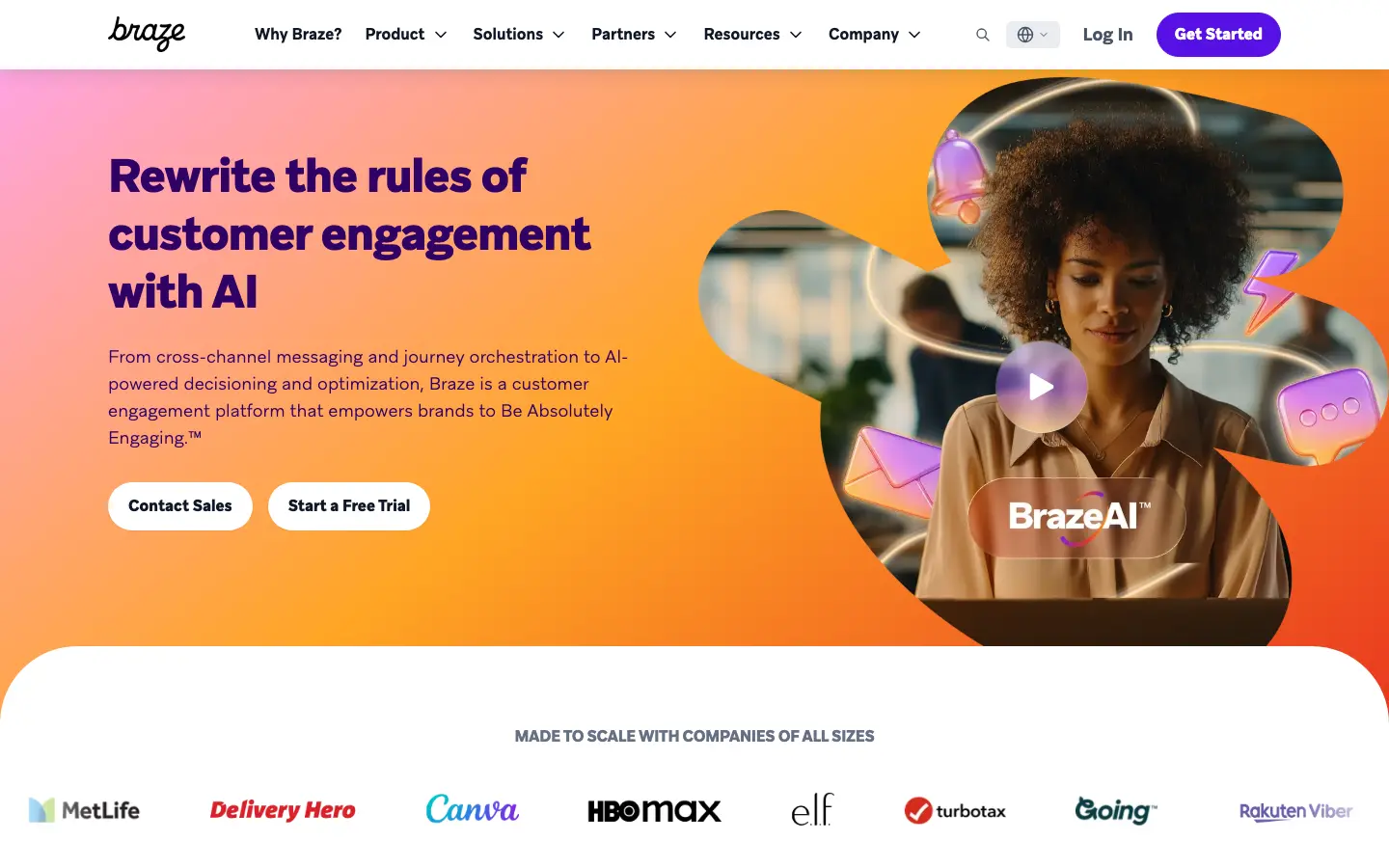
Braze’s BrazeAI Decisioning Studio provides 1:1 personalization using predictive, generative, and agentic intelligence. Channels include WhatsApp, RCS, and LINE alongside email, SMS, push, and in-app. Braze Currents streams real-time data to data warehouses.
At $593M ARR as a Nasdaq-listed public company with 2,300+ customers across 195 countries, the enterprise credibility argument is strong.
For teams where Iterable isn’t meeting AI or channel requirements, Braze is the natural comparison. Iterable’s Nova AI suite is capable but not as deep. G2 reviewers have flagged Iterable’s reporting as an area needing improvement.
Key features
- BrazeAI™: Predictive, generative, and agentic intelligence — send time optimization, content generation, intelligent decisioning
- BrazeAI Decisioning Studio™: 1:1 personalization at scale using real-time behavioral signals
- Braze Data Platform: Data unification, activation, and Currents real-time warehouse streaming
- Full channel coverage: Email, SMS/RCS, WhatsApp, Mobile push, Web push, In-app, LINE
- Journey orchestration: Cross-channel automation with real-time triggers and branching
- Full analytics, attribution, and reporting: Revenue attribution, cohort analysis, campaign performance
- Global infrastructure: 15 offices, 5 continents, 195 countries
Pricing
Custom (contact sales). Usage-based on MAUs and message volume. Enterprise annual contracts standard. No published tiers.
Pros & cons
Pros:
- Deepest AI personalization capability in the category — ahead of Iterable Nova
- Channel breadth (WhatsApp, RCS, LINE) exceeds Iterable’s current channel set
- $593M ARR public company — strongest enterprise credibility signal in the CEP market
- Currents provides real-time warehouse data streaming that Iterable doesn’t match
- 4.5/5 on G2 with 1,412 reviews — stronger review base than Iterable’s 691
Cons:
- No published pricing; full sales engagement required before any evaluation — same friction as Iterable
- Enterprise annual contracts with significant upfront cost
- Implementation overhead — not suitable for lean product teams wanting quick time to value
- Per-MAU pricing doesn’t offer the active-profile advantage of platforms like Vero
- Overkill for companies not needing enterprise AI depth or 195-country infrastructure
Customers
Burger King, Grubhub, NBA, HBO Max, Paramount, KFC, Skyscanner, PureGym, NASCAR, OkCupid. 4.5/5 on G2 with 1,412 reviews.
"When we evaluated Braze and Iterable at enterprise, Braze’s AI decisioning capability was the deciding factor."
— Braze customer
2. Customer.io: Best Iterable alternative for mid-market teams wanting accessible pricing
Iterable’s most consistent friction point in competitive evaluations is procurement overhead. No public pricing, mandatory sales demo, and annual enterprise contracts mean teams can’t run a self-serve trial or get started quickly.
For mid-market teams that value faster decision-making, this process creates unnecessary delays.
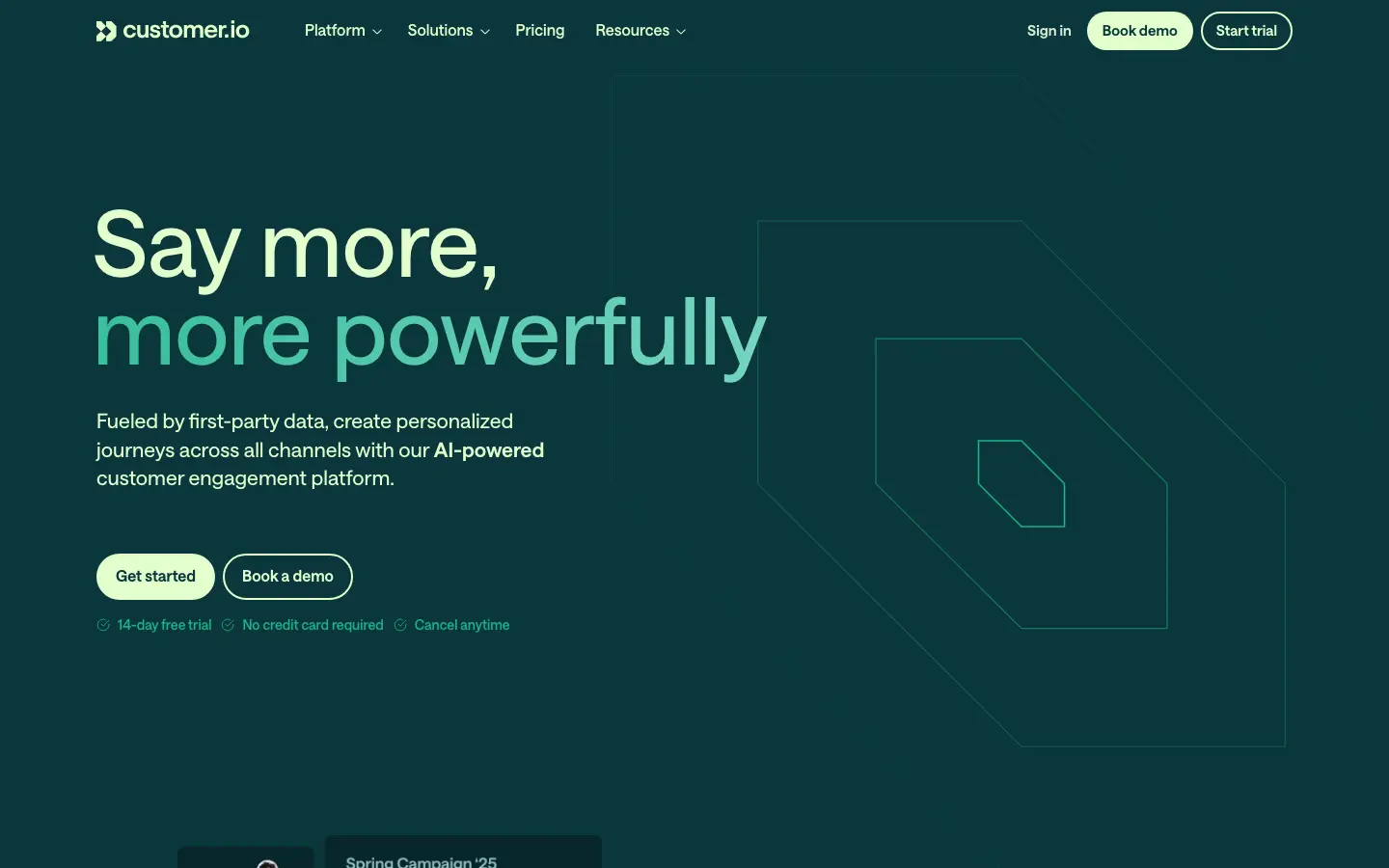
Customer.io removes that barrier. Pricing is public — Essentials at $100/mo for 5,000 profiles, with a 14-day free trial and no credit card required.
9,000+ brands globally signal a platform that has grown beyond startup validation. WhatsApp channel support — which Iterable doesn’t natively offer — is included alongside email, push, in-app, and SMS.
The behavioral messaging architecture is comparable to Iterable’s: event-triggered campaigns, visual workflow builder, A/B testing, and cohort analysis.
The key trade-off: Customer.io is a mid-market platform, not an enterprise one. Teams at the high end of Iterable’s enterprise contract range may find its feature depth insufficient.
Key features
- Event-triggered behavioral messaging: Real-time product data drives campaigns — onboarding, activation, lifecycle, retention, re-engagement
- Visual workflow builder: Drag-and-drop journey automation without engineering involvement for each change
- Omnichannel delivery: Email, push, in-app, SMS, WhatsApp
- Built-in CDP layer: Data unification and activation; reduces dependency on external CDPs for teams that don’t have one
- A/B testing and cohort analysis: Test content, timing, and channels; measure results across cohorts
- Data pipelines: APIs, webhooks, and reverse ETL integrations
- Design Studio: No-code message creation for marketing teams
- Startup program: Free 12-month access for companies raising under $10M
Pricing
| Plan | Price | Notes |
|---|---|---|
| Essentials | $100/mo | 5,000 profiles · 1M emails/mo · 2 object types |
| Premium | $1,000/mo | Custom volume · 10 object types · Dedicated support |
| Enterprise | Custom | Priority support · Dedicated CSM · Dedicated hardware |
| Startup program | Free 12 months | Startups raising under $10M |
Pros & cons
Pros:
- Transparent, public pricing — no sales call required to understand cost
- 14-day free trial with no credit card: evaluate before committing
- WhatsApp channel that Iterable doesn’t natively support
- Behavioral messaging architecture comparable to Iterable’s at a lower price floor
- 9,000+ brands and 4.4/5 on G2 signal proven mid-market infrastructure
Cons:
- Per-profile pricing still charges for inactive contacts — same structural problem as Iterable for B2C and PLG businesses
- Built-in CDP creates overlap spend for teams already using Segment, RudderStack, or Hightouch
- Not an enterprise platform at Iterable’s contract scale — feature depth may fall short at the high end
- Reporting has been flagged as having room for improvement in G2 reviews (similar to Iterable)
Customers
Notion, Pipedrive, StuDocu, Kraft Heinz, Zara USA, Schneider Electric. 4.4/5 on G2 with 709 reviews.
"Switching from Iterable to Customer.io cut our time-to-live in half — the self-serve trial alone saved us two weeks of procurement."
— Customer.io customer
3. CleverTap: Best Iterable alternative for mobile-first and international brands
Iterable’s strongest market is North American enterprise with experience-focused digital brands. For companies with a significant presence in Southeast Asia, India, or MENA, Iterable’s strengths don’t map to the most important use cases.
Deep mobile SDK integration, RCS and WhatsApp as primary channels, and regional infrastructure matter more in those markets.
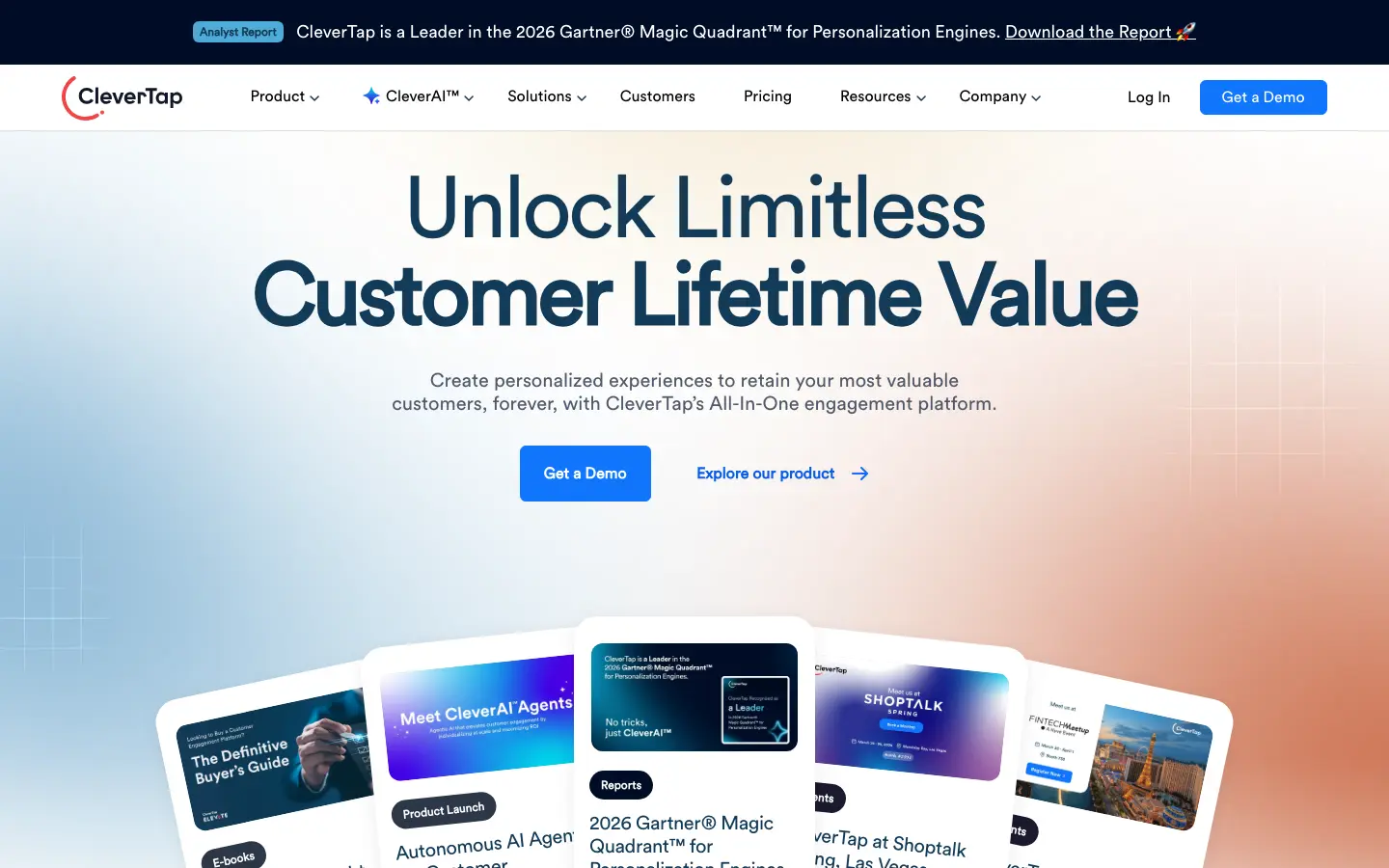
CleverTap is built for mobile-first engagement. It serves 2,000+ brands globally with offices in Mumbai, Dubai, Singapore, São Paulo, San Francisco, Sofia, and Amsterdam.
The CleverAI suite includes IntelliNODE — AI-driven journey branching that adapts path selection in real time. A Loyalty and Promos module handles retention mechanics that Iterable doesn’t natively cover. The Cutting Edge tier includes 10-year data retention.
For international brands where WhatsApp is a primary channel, CleverTap has more depth than Iterable. The trade-off: it’s less developer-friendly and its warehouse integration is weaker.
Key features
- CleverAI + IntelliNODE: AI-powered intelligence with real-time journey branching — adapts path selection based on predicted user behavior
- Predictive segmentation: AI-driven audience identification based on likelihood of specific outcomes
- Product recommendations: Personalization for e-commerce and content-heavy products
- RFM analysis and lifecycle optimization: Recency, frequency, monetary analysis for retention segmentation
- Loyalty and Promos module: Built-in retention mechanics — points, rewards, promotional campaigns
- Visual editor for in-app experiences: No-code in-app message and experience creation
- Full channel coverage: Email, Mobile push, SMS, In-app, Web push, WhatsApp, RCS, Facebook/Google Ads
- SFTP data imports and 10-year data retention (Cutting Edge tier)
Pricing
| Plan | Notes |
|---|---|
| Essentials | From ~$72/mo (5,000 MAU); scales to 100K+ MAU |
| Advanced | Custom — adds hyper-personalization, automated segmentation, premium channels |
| Cutting Edge | Custom — adds CleverAI suite, IntelliNODE, predictive segmentation, product recommendations, 10-year data retention |
Add-on modules available: Advanced Email, WhatsApp, RCS, SMS Direct, Product Experiences, Visual Editor, Loyalty. 30-day free trial.
Pros & cons
Pros:
- Mobile-first CEP with deeper mobile engagement features than Iterable
- Strong international presence — dominant in Southeast Asia, India, MENA; relevant for global brands
- WhatsApp and RCS channels built in — critical for international engagement strategies
- Loyalty and Promos module covers retention mechanics that require third-party tools with Iterable
- IntelliNODE AI journey branching is a genuine differentiator for mobile engagement
Cons:
- Less developer-friendly than Iterable — not built for engineering-influenced buying decisions
- No native data warehouse integration comparable to platforms built for data-mature teams
- Less aligned to best-of-breed stack buyers who want clean CDP and warehouse compatibility
- Primary strength is mobile and international; web-first SaaS companies may find weaker fit
- Pricing at scale (Cutting Edge) can match or exceed Iterable’s enterprise contracts
Customers
2,000+ brands worldwide, with particular concentration in mobile, gaming, e-commerce, and media.
"For our Southeast Asia expansion, CleverTap was the only platform with the WhatsApp depth and regional infrastructure we needed."
— CleverTap customer
4. OneSignal: Best Iterable alternative for push-first mobile and app products
Iterable offers mobile push as one channel within a full CEP suite. For companies where push is the primary engagement channel, paying enterprise CEP pricing for push capability that a more specialized platform handles better doesn’t pay off.
Mobile games, consumer apps, media apps, and app-centric e-commerce fall into this category.
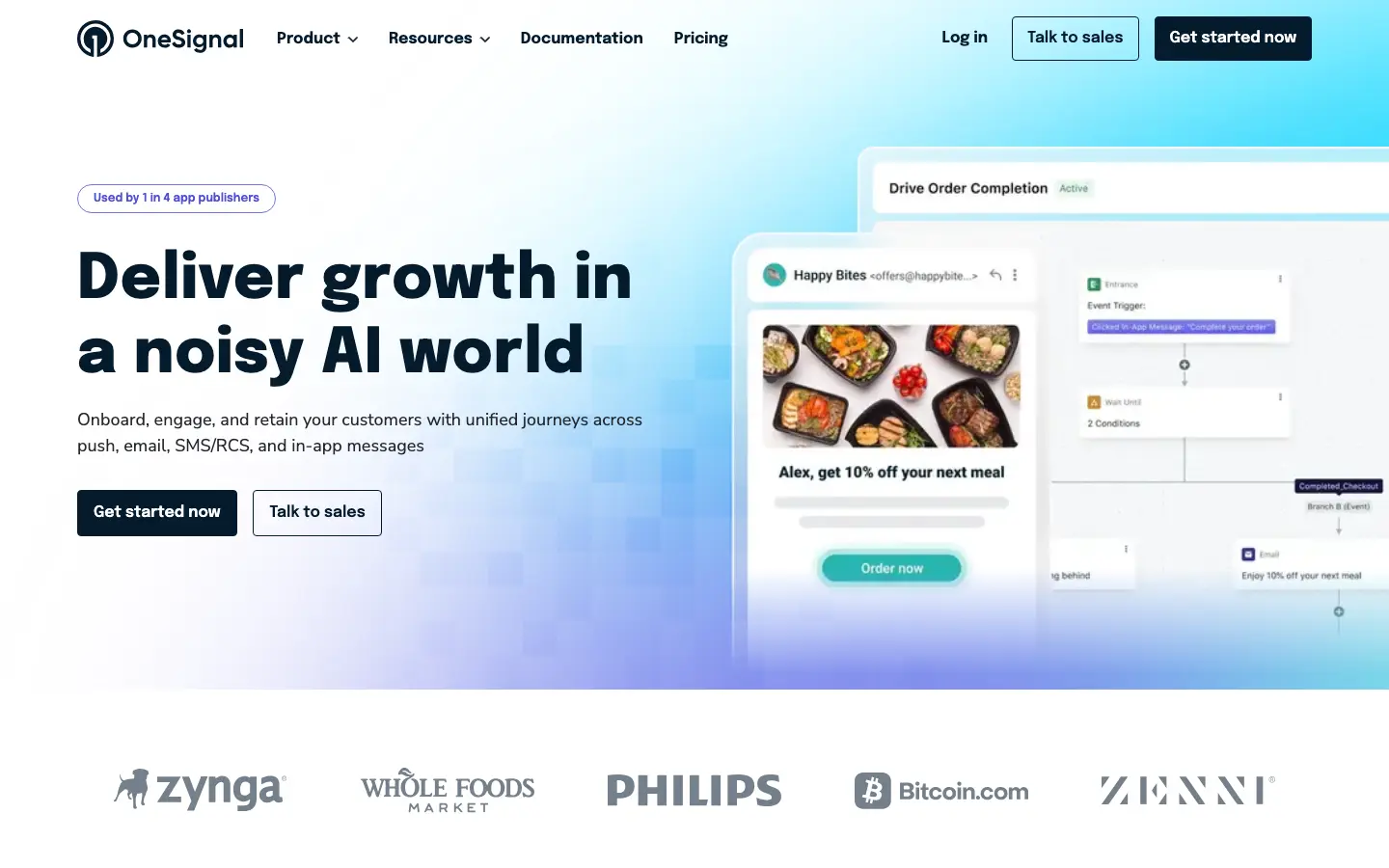
OneSignal is the dominant push notification platform by scale: 2M+ businesses, 12B+ messages per day, and 1.5B monthly active users. 1 in 4 app publishers use it.
SDK coverage is unmatched — Android, iOS, Flutter, React Native, Expo, Unity, and more. Live Activities support for iOS is a real-time engagement capability that most CEPs don’t natively provide.
The freemium model is a meaningful differentiator from Iterable. The free plan covers unlimited mobile push, 10K emails/month, and 1 journey. Growth plans start at $19/mo — no mandatory sales call required.
The honest limitation: OneSignal is a push-first platform, not a full behavioral lifecycle platform. For companies that need comparable depth across all channels, it’s a partial replacement.
Key features
- Mobile and web push notifications: Industry-leading infrastructure — 1 in 4 app publishers use OneSignal; deepest SDK and API coverage in the market
- Live Activities (iOS): Real-time dynamic content on the Lock Screen and Dynamic Island — live scores, delivery tracking, ride status
- Full SDK coverage: Android, iOS, Flutter, React Native, Expo, Unity — every major mobile development environment
- Journey orchestration: Multi-step sequences with behavioral triggers across push, email, and SMS
- Email, SMS/RCS, and In-app messaging: Expanding channel set alongside core push strength
- REST APIs and webhooks: Full programmatic access for engineering-led implementations
- Analytics and lifecycle measurement: Campaign performance, delivery rates, engagement metrics
- Transparent pricing: Public tiers with no mandatory sales engagement
Pricing
| Plan | Price | Notes |
|---|---|---|
| Free | $0 | 10K emails/mo · Unlimited mobile push · 1 journey · 6 segments |
| Growth | From $19/mo | 20K emails included · Mobile push at $0.012/MAU · Web push at $0.004/subscriber |
| Professional | Custom | 20 journeys · Advanced analytics · CSV exports |
| Enterprise | Custom | Frequency capping · Dedicated success manager · SLA |
Pros & cons
Pros:
- 4.7/5 on G2 with 1,155 reviews — highest customer satisfaction in this comparison
- Best-in-class push notification infrastructure — deepest SDK and API coverage on the market
- Freemium entry point with unlimited mobile push on the free plan — no cost to evaluate
- 2M+ businesses and 12B+ messages/day signals proven scale infrastructure
- Live Activities support for iOS is a real-time engagement capability most CEPs lack
Cons:
- Push-first heritage — email, SMS, and journey orchestration are secondary, not core strengths
- Less suited to warehouse-native or data-heavy lifecycle campaign management
- Journey builder is less mature than Iterable’s or Customer.io’s for complex multi-channel orchestration
- Growth plan per-MAU push pricing ($0.012/MAU) can become expensive at high volume
- Not suited for teams that need equivalent depth across all channels — lifecycle email in particular
Customers
Zenni Optical, Zynga, Whole Foods, Philips, DHL, Royal Caribbean, Porsche, Bitcoin.com. 4.7/5 on G2 with 1,155 reviews.
"OneSignal’s push infrastructure is in a different category from everything else we evaluated. The SDK depth alone made the decision easy."
— OneSignal customer
5. Vero: Best Iterable alternative for mid-market product-led and B2C companies
Disclosure: Vero is our platform. We’ve included it here for a specific type of Iterable customer — mid-market product-led SaaS and B2C software companies where per-subscriber pricing and data integration overhead create structural friction. We’ve been honest about where it does and doesn’t fit.
Iterable’s per-subscriber model charges for your full database regardless of engagement. A B2C software company with 500,000 total subscribers and 80,000 actives pays for 500,000. That’s the operational reality for most product-led businesses.
No amount of list management fully resolves it.
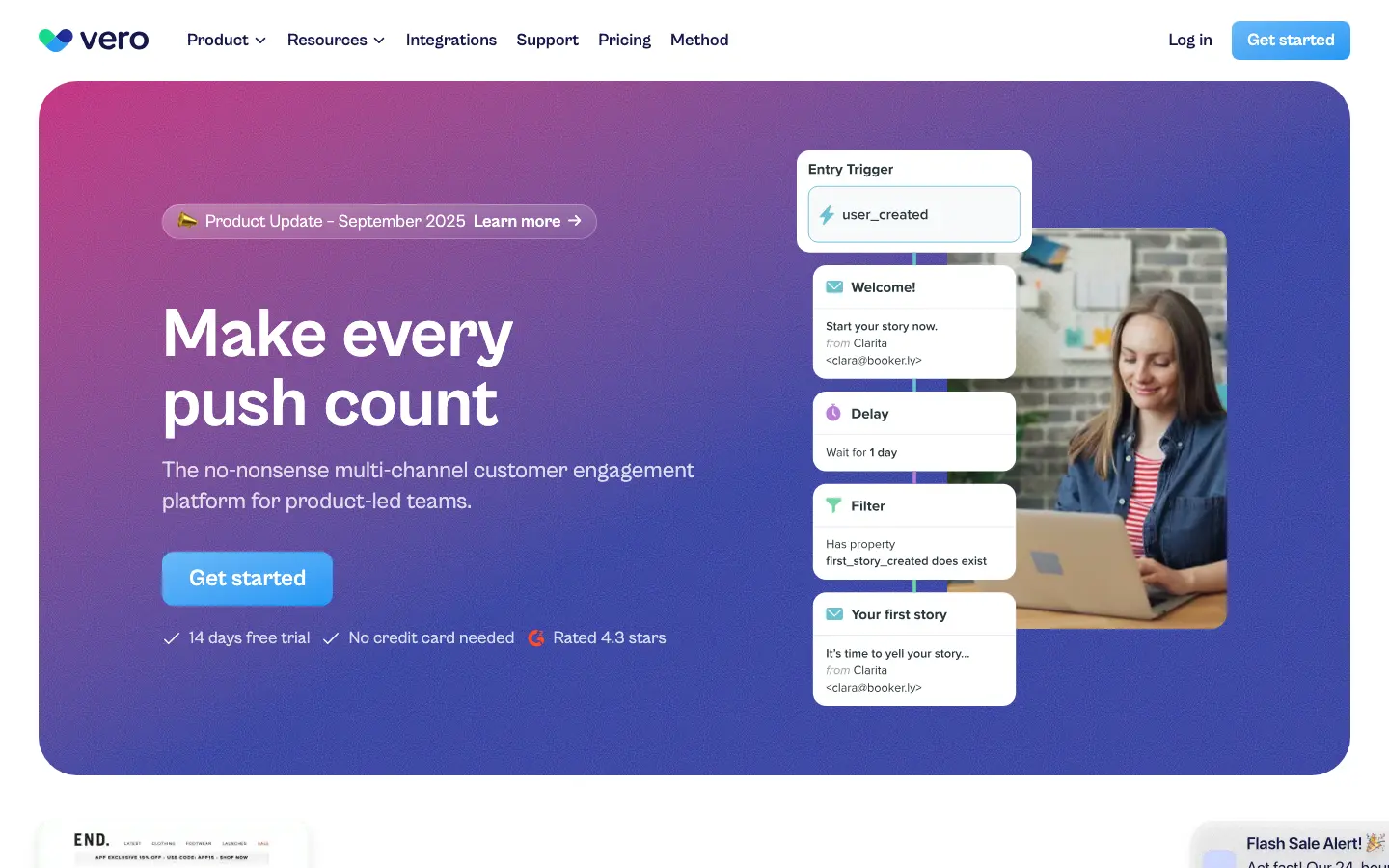
Vero charges only for active profiles. The same business with 500,000 total subscribers and 80,000 actives pays for 80,000. Over a 12-month Iterable contract at enterprise scale, that difference is significant.
The second structural difference is data. Iterable has limited native warehouse integration. Teams with product data in Snowflake, BigQuery, or Redshift need a sync layer to use it — custom pipelines, reverse ETL tools, or CDP middleware.
Vero’s Connected Audiences connects directly to warehouse databases via SQL. Segment and personalize from your existing warehouse data without duplicating it into Vero.
"We needed something that scales with our send volumes, not our user counts."
— Lawrence Scotland, Sr. Director, Dribbble
Key features
- Active-profile pricing: Charges only for users active in the billing period — structural cost advantage over Iterable’s per-subscriber model for B2C and PLG businesses
- Connected Audiences / Data Warehouse integration: Direct SQL access to Snowflake, BigQuery, Redshift, PostgreSQL, MySQL, SQL Server — no data duplication required
- Best-of-breed CDP fit: Works alongside Segment, RudderStack, Hightouch, Census; no CDP spend overlap
- Event-triggered behavioral messaging: Onboarding, activation, abandonment, lifecycle, retention — driven by real product behavior
- Visual journey builder: Multi-channel workflow automation operable by marketing teams without engineering involvement
- Multi-channel delivery: Email, iOS/Android push, in-app messaging, SMS, webhooks coordinated in a single workflow
- Developer-credible infrastructure: Full API, developer guide, 12 years of production scale — 5B+ messages/year at 99.99% uptime
- 14-day free trial: Evaluate without a sales call, no credit card required
Pricing
| Plan | Price | Includes |
|---|---|---|
| Starter | $49/mo (annual) or $54/mo | 5,000 active profiles · 10,000 emails/mo · 20,000 push/mo · 160,000 events/mo · Unlimited seats |
| Professional | Custom | Scales all dimensions · SMS · Unlimited seats · Fair use overage policy |
14-day free trial, no credit card required.
Pros & cons
Pros:
- Active-profile pricing is a structural cost advantage over Iterable’s per-subscriber model for B2C and PLG businesses
- Direct warehouse SQL integration removes the data sync layer that Iterable requires
- Self-serve evaluation with a 14-day free trial — no sales engagement required, unlike Iterable
- 12-year track record with proven infrastructure — 5B+ messages/year, 99.99% uptime
- Best-of-breed stack positioning works for teams already invested in Segment, RudderStack, or Hightouch
Cons:
- No WhatsApp channel yet (in development) — Customer.io and Braze have this
- Smaller customer base and brand recognition than Iterable’s enterprise footprint
- Feature depth in AI personalization (no equivalent to Iterable Nova) — not the right choice for enterprise AI-driven personalization
- SMS channel is newer and less mature than email and push
Customers
Dribbble, Unsplash, Pipedrive, Stockpile, and 50+ companies globally. 4.3/5 on G2.
"It didn’t make sense to be paying for everything when we don’t need all that stuff."
— Vincent Turner, CEO, Uno
Frequently asked questions
Why would I look for an Iterable alternative?
The most common reasons fall into a few patterns.
Procurement friction: Iterable requires a sales demo before any evaluation and doesn’t publish pricing. This slows purchasing cycles and makes competitor comparison difficult.
Pricing model: Per-subscriber pricing regardless of activity is a persistent cost penalty. B2C businesses and B2B PLG companies with large inactive segments are most affected.
Feature requirements: Teams that have outgrown Iterable typically look at Braze for deeper AI. Teams looking for a more accessible mid-market option look at Customer.io.
Data integration: Iterable’s warehouse integration is limited. This creates overhead for data-mature teams with product data in Snowflake, BigQuery, or Redshift.
Does Iterable charge for inactive subscribers?
Yes. Iterable’s pricing is based on total subscriber count — every contact in your database, regardless of engagement level.
For B2C and PLG companies with large inactive segments, this results in significant overpayment. Vero’s active-profile model charges only for users active in the billing period — the most direct structural alternative.
Which Iterable alternative is best for enterprise requirements?
Braze. At enterprise price points, Braze and Iterable are the two most commonly shortlisted platforms. Braze has invested more heavily in AI personalization capability (BrazeAI Decisioning Studio), channel breadth (WhatsApp, RCS, LINE), and enterprise infrastructure.
Teams at the high end of Iterable’s contract range looking for more AI depth consistently land on Braze.
Which Iterable alternative has the most accessible pricing?
Customer.io, for mid-market teams. Essentials at $100/mo with a 14-day free trial and no credit card required makes self-serve evaluation possible. That’s a fundamentally different buying experience than Iterable’s mandatory demo process.
For smaller teams, OneSignal’s free plan (unlimited push, 10K emails/month) is the lowest-friction entry point.
Which Iterable alternative is best for a B2C business with a large subscriber list?
Vero. The active-profile pricing model charges only for users active in the billing period. A B2C business with 1M total subscribers and 150K actives pays for 150K on Vero, versus 1M on Iterable.
This is the single most material structural pricing difference in the category for B2C businesses.
How does Vero compare to Iterable for a PLG SaaS company?
Vero is built specifically for product-led software companies; Iterable is optimized for experience-focused enterprise brands. Vero’s active-profile pricing charges for engaged users — favorable for PLG’s large free-user / smaller paying-user ratio. It also connects directly to data warehouses via SQL.
Iterable’s strengths — deep AI personalization via Nova, enterprise journey orchestration — are more relevant at the high end of PLG at scale. For mid-market PLG companies, Vero’s pricing and data architecture create a better fit.
Is Iterable worth it at enterprise scale?
For the right buyer, yes. Experience-focused enterprise brands with dedicated marketing operations teams and complex personalization requirements are Iterable’s core market.
The trade-offs are the procurement overhead, per-subscriber billing at scale, and increasing competition from Braze’s AI capabilities at the same price tier. For companies evaluating both, the decision usually comes down to AI depth versus journey orchestration preference.
Conclusion: Choosing your Iterable alternative
Iterable is a capable mid-market to enterprise platform with real strengths in lifecycle journey orchestration and AI-powered messaging. The problem isn’t that it’s weak — specific buying patterns create structural mismatches that compound over time.
For enterprise teams that need more AI depth, broader channels, and stronger brand credibility, Braze is the direct upgrade. The AI personalization gap between BrazeAI Decisioning Studio and Iterable Nova is meaningful at enterprise scale.
For mid-market teams frustrated by Iterable’s procurement overhead, Customer.io is the most accessible step down — transparent pricing, a free trial, WhatsApp support, and comparable behavioral messaging depth.
For mobile-first and international brands where WhatsApp and RCS are primary engagement channels, CleverTap has more depth in the areas that matter than Iterable’s primarily North American focus.
For app publishers and mobile-first products where push is the primary channel, OneSignal‘s best-in-class push infrastructure, unmatched SDK coverage, and transparent pricing deliver better results than Iterable’s push capability within a full-suite CEP.
For mid-market product-led and B2C software companies paying Iterable’s per-subscriber rate on large inactive databases, Vero removes both structural friction points — active-profile pricing and direct SQL warehouse integration — at a lower cost floor with a self-serve evaluation process.
Want to see how Vero’s active-profile pricing compares to your current Iterable spend? Start a free trial — no credit card required, no sales call needed.