- All Posts
- /
- 5 Customer Engagement Platforms with an MCP in 2026
5 Customer Engagement Platforms with an MCP in 2026
Alternatives-
 Chris Hexton
-
Updated:Posted:
On this page
The Model Context Protocol (MCP) is quickly becoming the infrastructure layer separating AI-ready platforms from the rest. Anthropic released it in late 2024 as an open standard for AI. By mid-2026, it’s the technical bridge that lets AI tools speak directly to your software—without manual exports or custom code.
Before MCP, getting AI to work with your platform meant copying metrics into a prompt and hoping. With an MCP server, your AI connects to live data. You ask a question in plain language, and it answers using real numbers—no tab-switching, no stale CSVs.
The numbers tell the story. MCP adoption data shows monthly SDK downloads hit 97 million by March 2026—a 970x jump from launch. And 87% of marketers now use generative AI in at least one recurring workflow.
The platforms building MCP integrations early are giving their users a compounding advantage. These are five that have—or are about to.
What are the best customer engagement platforms with an MCP?
Four platforms have live MCP servers: HubSpot, Intercom, MoEngage, and Klaviyo. They cover different use cases—CRM-native marketing, customer communications, mobile-first engagement, and e-commerce. Vero—built for product-led software teams—is bringing its MCP to behavioral messaging in the near future.
| Platform | MCP Status | Starting Price | Best For | Free Trial |
|---|---|---|---|---|
| Vero | Coming soon | From $54/mo | PLG SaaS, B2C software teams | 14 days |
| HubSpot | Live (GA April 2026) | Free plan available | CRM + marketing teams | Free plan |
| Intercom | Live | Custom | Support + comms teams | 14 days |
| MoEngage | Live (Feb 2026) | Custom | Mobile-first consumer brands | 14 days |
| Klaviyo | Live (Sept 2025) | From $45/mo | E-commerce brands | Free plan |
1. Vero: behavioral messaging MCP for product-led teams
Quick note: Vero is our product. We’re genuinely excited about where this is heading—but we’d obviously say that.
Vero is a multi-channel customer engagement platform built for product-led software companies. It handles event-triggered email, push notifications, in-app messaging, and SMS—all driven by real user behavior and product data. The target is mid-market B2C SaaS, B2B PLG businesses, and mobile apps with 50–1,000 employees.
What sets Vero apart at a technical level is its warehouse-native architecture. Teams pull audiences directly from Snowflake, BigQuery, Redshift, or other SQL-connected warehouses without duplicating data. Pricing follows the same logic: Vero charges for active profiles only—not total subscribers.
Vero sends 5+ billion messages annually at 99.99% uptime. Customers include Dribbble, Unsplash, Pipedrive, and Stockpile. The platform holds a 4.3-star rating on G2.
What it does well
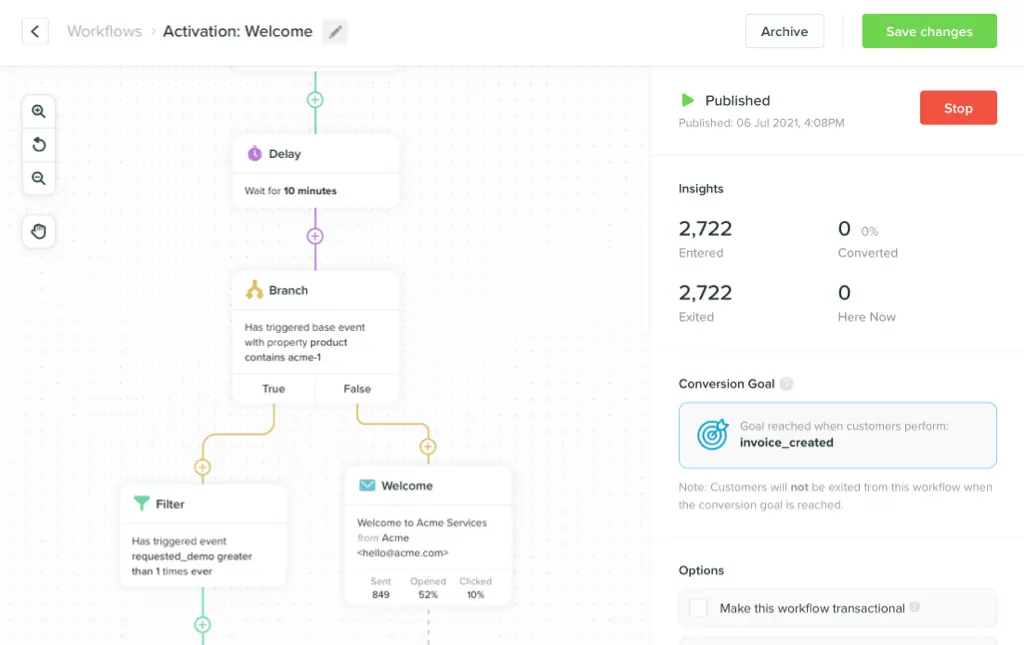
Vero’s visual journey builder handles branching logic, A/B splits, multi-channel coordination, and delays without code. Event-triggered campaigns—onboarding sequences, activation nudges, win-back flows—are the core use case. Behavioral segmentation pulls from event history, profile attributes, or warehouse data via direct SQL queries.
The developer API integrates natively with Segment, RudderStack, Hightouch, and Census. Engineering teams can trust the infrastructure while marketing teams operate campaigns independently. That balance between developer control and marketing usability is rare at this price point.
The MCP: what’s coming
Vero’s MCP is in active development. The planned integration will let MCP-compatible AI tools access campaign data, audience segments, and behavioral workflow status through natural language. Questions like "Which onboarding campaigns have the lowest completion rates this quarter?" will return real answers—not estimates.
Vero’s warehouse-native architecture is expected to shape how the MCP works. The goal: expose warehouse-connected data through a conversational interface, without requiring a separate storage layer.
That would make Vero’s MCP structurally different from platforms that only surface campaign metrics. More details will arrive closer to launch.
Pros & cons
Pros:
- Active-profile pricing is a structural advantage for B2C and PLG teams
- Warehouse-native segmentation via direct SQL—no CDP required
- Flexible enough for engineering teams; operable by marketers without code
- Starter plan from $54/month; free trial, no credit card required
Cons:
- MCP not live yet—timeline to be announced
- Smaller review base and brand recognition vs. enterprise platforms like Braze or Iterable
- SMS and WhatsApp channels still maturing
Pricing and team
Vero’s Starter plan runs $54/month (or $49/month billed annually). It includes 5,000 profiles, 10,000 emails/month, 20,000 push/month, and 160,000 events/month—with unlimited seats. A Professional plan with custom pricing handles larger volumes and adds SMS.
When the MCP ships, product-led teams get a natural-language interface to behavioral messaging infrastructure built on real warehouse data. Start your free trial and explore what’s already live.
2. HubSpot: MCP for CRM-driven marketing teams
HubSpot is one of the most widely deployed CRM and marketing platforms globally. It serves 228,000+ customers across marketing, sales, service, and operations hubs—all built on a single data model. With a free plan and 1,500+ integrations, it has broad reach from SMB to enterprise.
HubSpot moved early on MCP. The HubSpot MCP server reached general availability in April 2026 in two variants. The remote server connects any MCP-compatible AI tool to live CRM data.
The local developer server connects AI dev tools to HubSpot’s CLI for platform development. Both use OAuth 2.0 for authentication.
What it does well
HubSpot covers a wide surface area. That includes email, SMS, push, site messaging, landing pages, ad management, and a full CRM with pipeline and tickets.
Breeze AI—HubSpot’s built-in intelligence layer—handles content generation, lead scoring, and email personalization. The ecosystem is mature; 1,500+ integrations and a large agency network mean HubSpot plugs into almost any stack.
The platform’s core promise is accessibility. Non-technical marketing teams can build and run campaigns without developer involvement. That’s a promise HubSpot has delivered on consistently for years.
What the MCP unlocks
The HubSpot remote MCP gives AI tools read and write access to CRM objects. That covers contacts, companies, deals, tickets, products, quotes, invoices, and lists.
It also provides read-only access to campaign metrics, website pages, landing pages, and blog posts. That’s a wide data surface—useful for reporting, analysis, and workflow automation.
On sensitive data: HubSpot deliberately excludes Personal Health Information and other sensitive properties from the server. Scope control runs through a user-level app with standard OAuth permissions. The account admin connects first; other users connect after.
Strengths and trade-offs
Pros:
- Official remote MCP server in GA since April 2026
- Read and write access to contacts, deals, tickets, and campaigns
- OAuth-based auth with granular scope control
- Free CRM plan available; low barrier to entry
Cons:
- Marketing-first design limits flexibility for product engineers
- Contact-count pricing disadvantages B2C and PLG companies with large inactive lists
- No native data warehouse integration for product-behavioral segmentation
- Breadth can feel like overhead for teams that only need behavioral messaging
Who’s using it and pricing
HubSpot serves 228,000+ customers in 135 countries with approximately $2.6B ARR. Paid plans range from entry-level to $3,600+/month, scaling by contact count and hub tier. For teams already inside HubSpot, the MCP adds meaningful value at no extra cost—it’s part of the platform.
For marketing-led teams who live in HubSpot, the MCP makes daily data access dramatically faster. Querying deals, surfacing open tickets, or pulling campaign stats without building a report saves real time at scale.
3. Intercom: MCP for customer communications teams
Intercom sits at the intersection of marketing messaging and customer support. It powers the chat widgets and in-product messaging flows used by thousands of SaaS products. Its AI assistant, Fin, automates a substantial share of support conversations.
Conversations, help center content, contact management, and lifecycle campaigns all live in one product.
Intercom’s MCP is live and well-documented. The Intercom MCP documentation covers 13 dedicated tools.
Data access spans conversations, contacts, companies, and help center articles. US and EU regions are supported, with EU-region requests processed in-region under Intercom’s data hosting commitments.
What Intercom does
Beyond its chat and support layer, Intercom runs lifecycle campaigns and product tours. It handles conversation routing, team assignment, and SLA tracking at scale. For SaaS companies with high support volume and an active user base, Intercom is often the default choice.
The overlap between support and marketing messaging is where Intercom earns its footprint. A single platform can handle an onboarding sequence, a support conversation, and a retention campaign—all on one contact record.
The MCP in practice
The 13 MCP tools cover universal search, conversation search, contact search, company listing, and article management. Conversation search supports advanced filtering by state, source type, team assignment, and timing statistics. Search results are paginated and cursor-based, built for large workspaces.
Authentication supports OAuth (recommended) or bearer token. One limitation to note: AU-hosted workspaces are not yet supported. Permissions mirror the connected account’s role—what the user can access in the platform, the AI can access via MCP.
What works well (and what doesn’t)
Pros:
- 13 dedicated MCP tools with strong conversation, contact, and article coverage
- EU-region data processing for compliance-sensitive teams
- OAuth and bearer token authentication—flexible for different setups
- Real-time conversation data accessible without manual export
Cons:
- Not a behavioral messaging platform for event-triggered lifecycle campaigns
- AU region not yet supported by the MCP server
- Pricing is enterprise-oriented with no self-serve transparency
- Heavy support focus means weaker fit for pure lifecycle marketing automation
Pricing and customer base
Intercom pricing is custom and sales-driven. It’s built for teams where support velocity justifies the investment—not for self-serve evaluation at the lower end. The platform has a large installed base across SaaS, fintech, and tech-enabled services globally.
For teams whose primary need is customer communications and support—not product-triggered campaigns—the MCP delivers immediate operational value. Querying open conversations, surfacing high-wait tickets, and updating articles through an AI tool removes real friction.
4. MoEngage: MCP for mobile-first consumer brands
MoEngage is the customer engagement platform of choice for many of the largest consumer brands in Asia, MENA, and LatAm. Swiggy, Flipkart, Nestlé, McAfee, Deutsche Telekom—over 1,350 brands use MoEngage. They run cross-channel campaigns across email, push, SMS, in-app, WhatsApp, and cards.
The MoEngage MCP server launched in February 2026 as a hosted connector. It allows AI tools to access live campaign data and build campaign drafts through natural language. Setup uses an OAuth-based authentication flow tied directly to your active MoEngage session.
Why it stands out
MoEngage’s core differentiator is Merlin AI—its built-in layer for predictive segmentation, send-time optimization, and channel selection. The platform’s mobile-first architecture is deep: push notifications, in-app messages, and real-time event tracking are first-class features, not additions.
WhatsApp, RCS, and regional data residency for EU and APAC extend the platform’s reach further. For brands where mobile is the primary engagement surface, MoEngage is often the default. The 2026 IDC MarketScape named MoEngage a Leader in AI-enabled CDPs for B2C users.
MCP capabilities
The MoEngage MCP server covers four areas. These are campaign draft creation (Push and Email), content authoring and preview, cross-channel campaign search and review, and performance analytics. Analytics cover aggregate stats for up to 50 campaigns, with breakdowns by device, locale, A/B variation, and conversion goal.
Analytics are capped at a 30-day window per query. Crucially, publishing remains a human action. The AI can build and validate a draft inside MoEngage—but it won’t go live until a person confirms it.
The good and the bad
Pros:
- Hosted MCP server with OAuth—no local tooling required
- Campaign draft creation and validation through natural language
- Real-time performance analytics across Push, Email, and SMS
- Merlin AI already embedded in journey decisions; the MCP extends it further
- 14-day free trial
Cons:
- No self-serve public pricing—requires sales engagement
- Analytics window capped at 30 days per MCP query
- Less suited to developer-influenced or warehouse-native buying decisions
- Heavier platform with more onboarding overhead than leaner alternatives
Pricing breakdown
MoEngage pricing is custom and MAU-based—contact sales for a quote. A 14-day free trial is available. For consumer brands with large mobile user bases across multiple regions, the platform typically justifies the cost.
5. Klaviyo: MCP for e-commerce teams
Klaviyo is the B2C CRM built primarily for e-commerce. Over 170,000 brands use it—including Glossier, SKIMS, Stanley, and Living Proof. It runs email, SMS, RCS, mobile push, and WhatsApp campaigns with deep Shopify integration and an expanding AI layer.
Klaviyo launched its MCP server in September 2025 and has continued expanding capabilities into 2026. The 2026 update added Query Metric Aggregates for direct performance data access and MCP Apps for interactive charts.
The MCP now connects across Claude Chat and Cowork. Full details live in Klaviyo’s MCP documentation.
What it does well
Klaviyo’s Shopify integration is the deepest in the category. Real-time storefront behavioral data, pre-built e-commerce flows, and predictive CLV, churn risk, and next purchase date are all native. For brands with Shopify as their commerce backbone, Klaviyo is the near-automatic choice.
The platform has expanded beyond email and SMS. Mobile push, WhatsApp, RCS, and social integrations now sit alongside the core channels. Composer—Klaviyo’s AI marketing agent—can audit flows, draft campaigns, and build segments from a single prompt.
What the MCP can do
The Klaviyo MCP enables conversational access to campaign data and account performance. Marketing teams can ask questions like "Which of my new product campaigns is driving the most revenue?" and get real answers. They can compare flow performance across accounts, get AI-driven recommendations, and draft campaigns—all through natural language.
Setup is fast: OAuth or private API key, connected in minutes. Klaviyo’s remote server also supports web-based AI tools, so the MCP works in Claude and Cowork without local configuration.
Pros and cons
Pros:
- MCP live since September 2025—one of the earliest in the category
- Conversational access to campaign analytics, flow performance, and content drafting
- Shopify-native e-commerce intelligence surfaced through the MCP
- Broad channel coverage: email, SMS, push, WhatsApp, RCS
- Free plan available; no credit card required to start
Cons:
- E-commerce-first design means weaker fit for SaaS or PLG product teams
- Pricing scales by contact count—disadvantages brands with large inactive lists
- No native data warehouse integration for non-commerce product data
- MCP features are still evolving; capabilities may shift with updates
Pricing breakdown
Klaviyo’s free plan covers 250 contacts and 500 emails/month. Paid plans start at $45/month for email only (1,001 contacts) or $60/month for email + SMS. Pricing scales by contact count; enterprise contracts are available for high-volume brands.
For e-commerce teams already on Klaviyo, the MCP removes the data-export step from every AI analysis. For teams evaluating Klaviyo, the MCP is a meaningful differentiator available day one.
What teams ask about MCP
What exactly is a Model Context Protocol server?
An MCP server is a standardized interface that lets an AI tool access live data from your platform. Instead of manually exporting data and pasting it into a prompt, the AI connects directly. It queries, analyzes, and—in some cases—creates drafts using real-time information from your account.
Do I need technical skills to set up an MCP with my platform?
Most platforms have designed their MCP setup for non-developers. HubSpot and Klaviyo use OAuth or API key authentication that takes a few minutes.
MoEngage’s hosted server inherits your existing session automatically. If you can configure a standard integration, you can typically set up an MCP.
Is it safe to give an AI tool access to customer data via MCP?
Platforms design MCP access using the same permission model as their existing APIs. HubSpot excludes sensitive data properties entirely from its server. MoEngage’s MCP inherits your account’s role-based permissions—if your role can’t publish campaigns, neither can the AI.
Intercom uses OAuth with explicitly scoped access. Read your platform’s MCP documentation to understand what data is exposed before connecting.
Which of these platforms has the most complete MCP right now?
It depends on what you need. Intercom’s 13 tools cover the broadest data surface—conversations, contacts, companies, and articles. HubSpot’s MCP has the widest CRM object coverage.
MoEngage’s MCP is the most focused on marketing-specific actions: campaign drafting, analytics, and content creation. There is no single winner—it’s use-case dependent.
Can I use an MCP to send campaigns autonomously, or is it read-only?
None of these platforms let an AI send to customers autonomously. HubSpot’s MCP allows read and write access to CRM objects but doesn’t trigger campaigns. MoEngage’s MCP lets the AI build and validate drafts—but publishing is always a human action.
Klaviyo supports campaign creation through natural language, but with human review in the loop. The pattern is consistent: AI assists, humans confirm.
Which platform should your team pick?
For e-commerce teams, Klaviyo is the strongest option right now. Its MCP launched earliest and covers campaign analytics and content drafting. It sits on the deepest e-commerce data model in the category.
For CRM-native marketing teams, HubSpot is the clear choice. Its MCP is in GA with read/write CRM access—included in the platform at no extra cost.
For customer communications and support teams, Intercom’s 13-tool MCP is purpose-built. If your primary surface is conversations and tickets—not lifecycle campaigns—it removes real operational friction.
For mobile-first and global consumer brands, MoEngage is the natural fit. Its hosted MCP, Merlin AI layer, and campaign-drafting capabilities are already production-ready.
For product-led software teams building on behavioral data and warehouse-native architecture, Vero is worth the wait. The MCP is coming—and when it ships, it’ll be the only one built specifically for event-driven, warehouse-connected messaging. Start a free 14-day trial and explore what’s already live.