- All Posts
- /
- 6 Best Customer Engagement Platforms in 2026
-
 Chris Hexton
-
Updated:Posted:
On this page
Customer engagement platforms have splintered into distinct segments. There’s a platform for enterprise brands, one for e-commerce, one for mobile-first teams, and one for lean SaaS startups. Picking the wrong one means paying for channels you don’t use or outgrowing it within a year.
This guide covers the 6 best customer engagement platforms in 2026. Each is evaluated on pricing, channels, AI, and who it’s actually built for.
What are the best customer engagement platforms in 2026?
The 6 best customer engagement platforms are Klaviyo, MoEngage, OneSignal, Iterable, Mailchimp, and Vero.
Klaviyo is the dominant platform for e-commerce and DTC brands — 193,000+ customers, $1.2B ARR, and the deepest Shopify integration on the market.
MoEngage leads for mobile-first consumer brands in APAC, India, and MENA, with Sherpa AI built into journey orchestration.
OneSignal is the strongest option for mobile apps and push-first teams — 4.7/5 on G2 and a genuinely useful free tier.
Iterable is the go-to for mid-market and enterprise brands needing sophisticated cross-channel orchestration.
Mailchimp is the entry point for small businesses — 15M+ users, a free plan, and two decades of deliverability trust.
Vero (our platform) is the strongest option for B2C and product-led teams needing active-profile pricing and direct data warehouse integration.
Best customer engagement platforms — Comparison table
| Platform | Starting Price | Channels | Best For | Free Trial |
|---|---|---|---|---|
| Klaviyo | Free / $45/mo | Email · SMS | E-commerce, DTC, Shopify brands | Yes (free plan) |
| MoEngage | Custom | Email · Push · SMS · In-app · WhatsApp · Cards | Mobile-first, international, consumer brands | Yes (14 days) |
| OneSignal | Free / $19/mo | Push · Email · SMS/RCS · In-app | Mobile apps, push-first teams | Yes (free plan) |
| Iterable | Custom | Email · Push · In-app · SMS | Mid-market to enterprise, experience brands | Demo required |
| Mailchimp | Free / $13/mo | Email · SMS · Ads · Landing pages | Small businesses, solo founders, e-commerce | Yes (free plan) |
| Vero | $49/mo (annual) | Email · Push · In-app · SMS · Webhooks | Mid-market PLG, B2C, warehouse-first teams | Yes (14 days) |
1. Klaviyo: Best for e-commerce and DTC brands
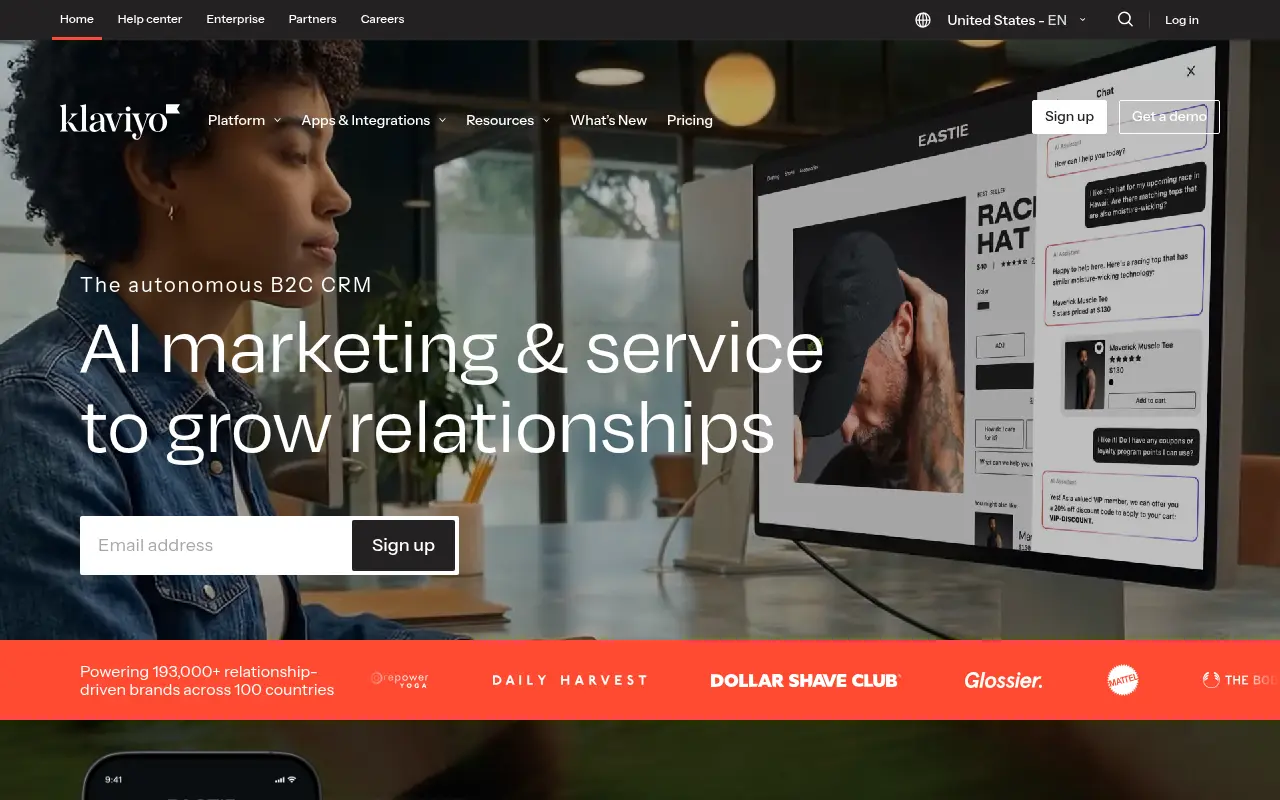
Klaviyo is the default choice for direct-to-consumer e-commerce brands. It’s a ~$1.2B ARR public company (NYSE: KVYO) with 193,000+ customers. If you sell online and Shopify is your platform, Klaviyo is almost certainly on your shortlist.
The product is built around purchase behavior. Cart abandonment, browse abandonment, post-purchase, and winback flows are pre-built and ready to configure. Predictive analytics surfaces CLV, churn risk scores, and next predicted order dates without a data science team.
The limitation is equally clear: Klaviyo is email and SMS only. There’s no push, no in-app messaging, no webhooks. For product-led or multi-channel teams, that’s a hard ceiling.
Key features
- Deep native Shopify integration — official Shopify and Meta partner
- Pre-built e-commerce flows: welcome series, cart abandonment, winback, post-purchase
- Predictive analytics: CLV, churn risk, next order date — no data science team required
- AI-powered subject line and send time optimization
- Klaviyo Reviews integration
- 350+ pre-built e-commerce stack integrations
- CDP layer with unified customer profiles
Pricing
| Plan | Price | Notes |
|---|---|---|
| Free | $0 | 250 contacts · 500 emails/mo · 150 SMS credits |
| From $45/mo | 1,001+ contacts · Email only | |
| Email + SMS | From $60/mo | 1,001+ contacts · Email and SMS bundled |
Contact-count pricing; scales to enterprise contracts for large brands.
Pros & cons
Pros:
- Dominant e-commerce platform — deepest Shopify integration available
- Predictive CLV and churn analytics genuinely differentiated at this price point
- 193,000+ customers and $1.2B ARR signal strong product-market fit
- Free plan lowers the entry bar for early-stage DTC brands
Cons:
- Email and SMS only — no push, in-app messaging, or webhooks
- E-commerce-first data model is a poor fit for SaaS or PLG teams
- Contact-count pricing penalizes brands with large inactive lists
- No direct data warehouse integration for product event data
Customers
Glossier, Mejuri, Stanley 1913, Living Proof, SKIMS, Chubbies. 4.6/5 on G2 with 1,000+ reviews.
2. MoEngage: Best for mobile-first and international brands
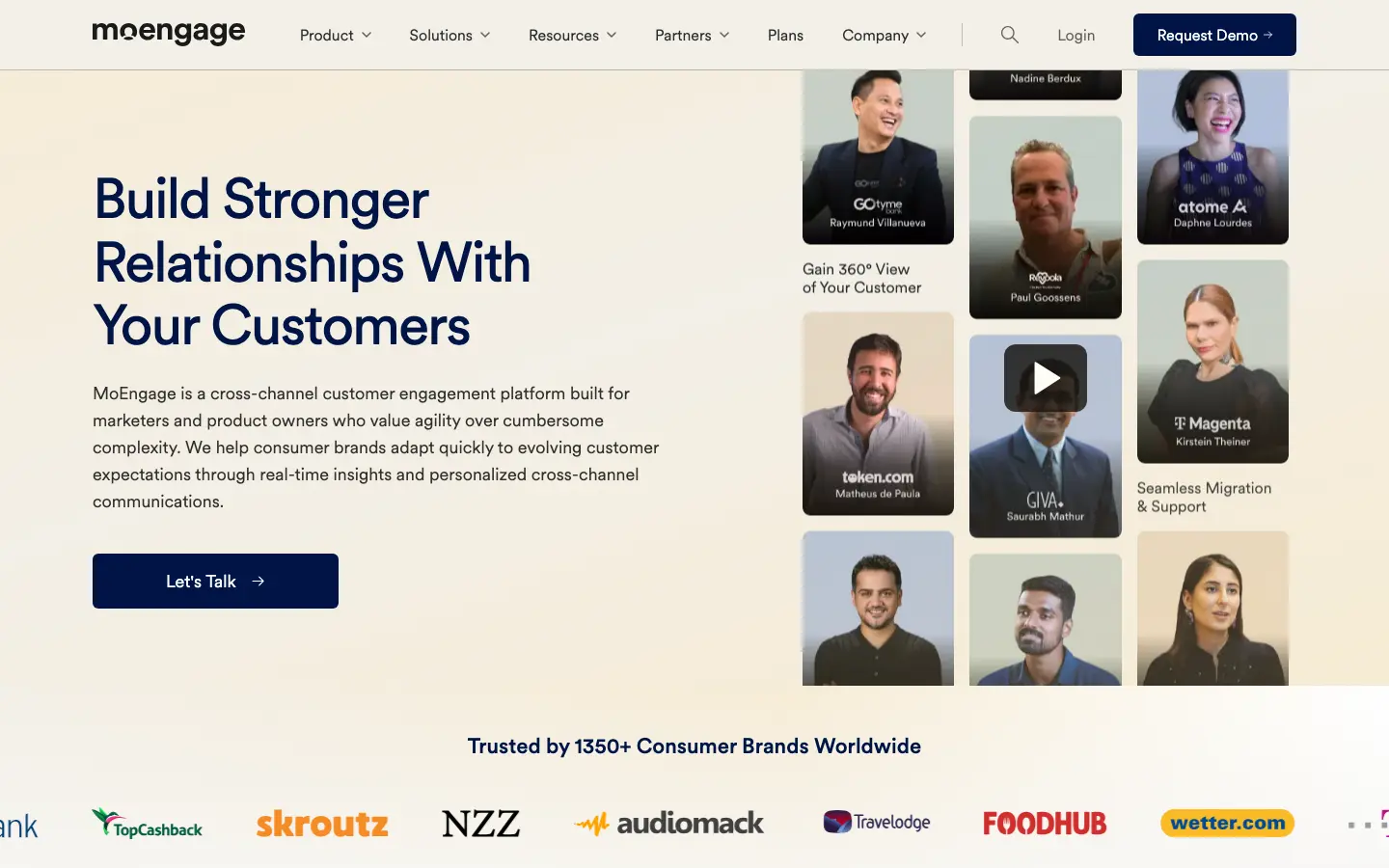
MoEngage is a full-stack CEP built for consumer brands at scale. It raised $280M in a Series F in late 2025, bringing total funding to ~$307M. It serves 1,350+ brands and is tracking toward $100M ARR with a valuation of $900M+.
The platform’s AI layer, Sherpa, powers send-time optimization and predictive segmentation. It runs natively inside journey orchestration — not as an add-on. For brands managing millions of users across mobile and regional markets, that reduces the manual tuning most CEPs require.
Channel coverage is broad: Email, Mobile push, Web push, SMS, In-app, WhatsApp, and Cards. Regional data residency options — EU, US, APAC — make it practical for compliance-sensitive markets. All plans require a sales conversation; no self-serve pricing.
Key features
- Sherpa AI — send-time optimization, channel optimization, predictive segmentation
- AI-powered journey orchestration with real-time behavioral signals
- WhatsApp and Cards as first-class channels
- AMP email support
- Funnel analysis and cohort reports
- Web personalization and on-site messaging
- Regional data residency: EU, US, APAC
- 50+ integrations including Snowflake, BigQuery, Segment
Pricing
Custom (contact sales). Usage-based on MAUs. 14-day free trial available.
Pros & cons
Pros:
- Dominant in India, Southeast Asia, and MENA — unmatched regional infrastructure
- Sherpa AI is mature and deeply integrated into journey orchestration
- WhatsApp as a first-class channel, not a bolt-on
- Regional data residency for compliance-sensitive markets
- 14-day trial available without a full sales commitment
Cons:
- No self-serve pricing or transparent published tiers
- Heavy onboarding overhead for smaller teams
- Less suited for SaaS or PLG teams with developer-influenced buying
- No direct warehouse SQL segmentation equivalent to Vero’s Connected Audiences
Customers
Swiggy, Ola, Vodafone, Ally Financial, Nestlé, McAfee, Mashreq Bank, Deutsche Telekom. 4.5/5 on G2 with 600+ reviews.
3. OneSignal: Best for mobile apps and push-first teams
OneSignal is the most widely used push notification platform in the world. 1 in 4 app publishers uses it. 2M+ businesses, 12B+ messages per day, and a 4.7/5 G2 rating with 1,155 reviews — the highest in this comparison.
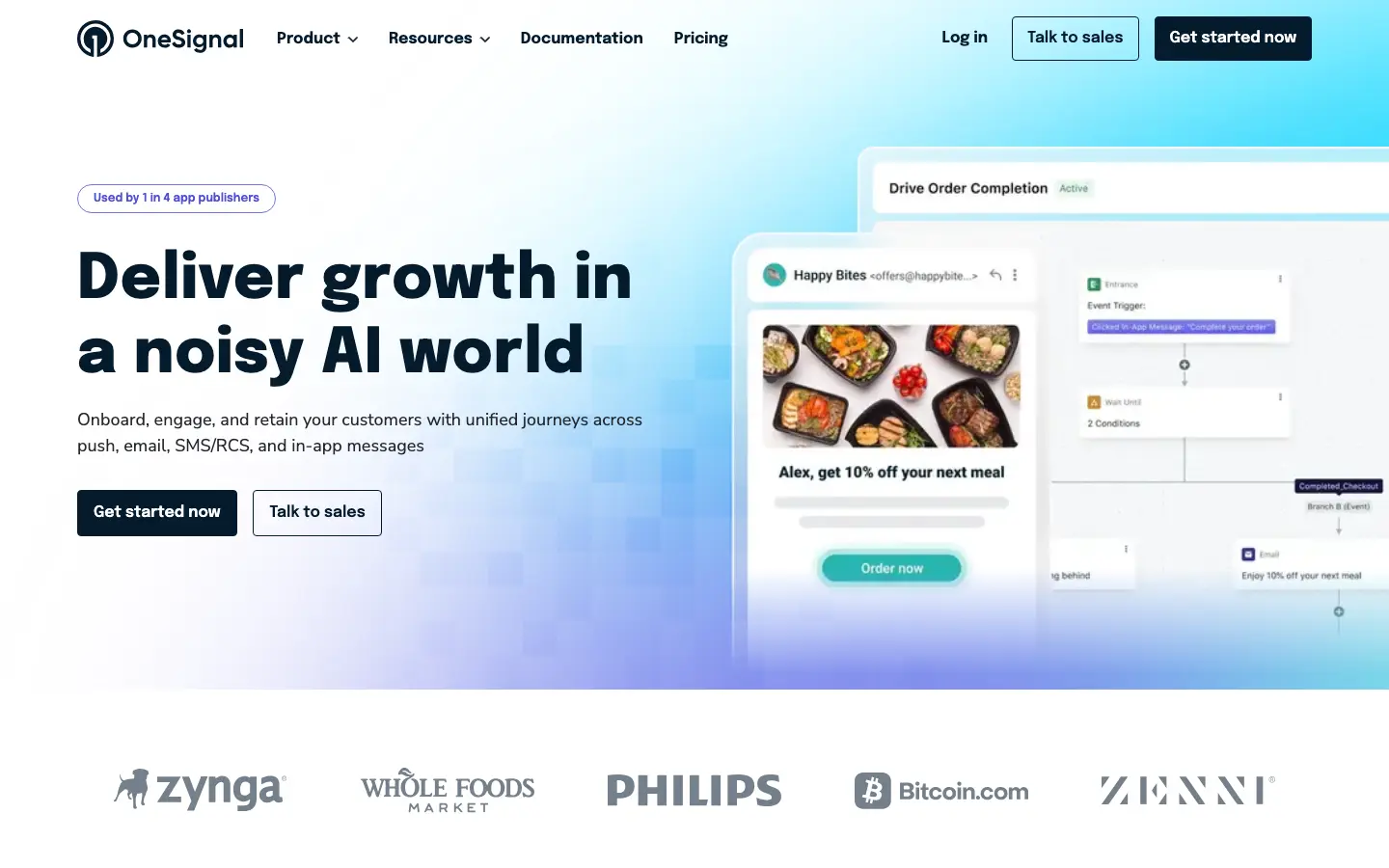
The product started as push infrastructure and built outward from there. SDK coverage spans Android, iOS, Flutter, React Native, Expo, and Unity — the deepest in the category. Live Activities (iOS) and RCS are also supported.
The free plan is genuine: unlimited mobile push and 10K emails per month at $0. Growth plans start at $19/mo. Email and SMS are secondary; teams needing deep behavioral email automation will hit the ceiling.
Key features
- Mobile push: Android, iOS, Flutter, React Native, Expo, Unity SDK coverage
- Web push notifications
- Live Activities (iOS) and RCS support
- In-app messaging and journey orchestration
- REST APIs, webhooks, and event streams
- Email and SMS as secondary channels
- Analytics and lifecycle measurement
Pricing
| Plan | Price | Notes |
|---|---|---|
| Free | $0 | Unlimited mobile push · 10K emails/mo · 1 journey · 6 segments |
| Growth | From $19/mo | 20K emails included · Push $0.012/MAU · Web push $0.004/subscriber |
| Professional | Custom | 20 journeys · Advanced analytics · CSV exports |
| Enterprise | Custom | Frequency capping · Dedicated success manager · SLA |
Pros & cons
Pros:
- Highest G2 rating in this comparison — 4.7/5 with 1,155 reviews
- Deepest mobile SDK coverage: Flutter, React Native, Expo, Unity
- Free plan provides genuine utility — unlimited push and 10K emails/month
- 2M+ businesses signals massive distribution and community trust
- Growth plans from $19/mo — far more accessible than enterprise CEPs
Cons:
- Push-first heritage — email and SMS are secondary, not core strengths
- Journey builder less mature than dedicated CEP competitors
- No native data warehouse integration
- Per-MAU push pricing on Growth plan can become expensive at scale
Customers
Zenni Optical, Zynga, Whole Foods, Philips, DHL, Royal Caribbean, Porsche, Bitcoin.com. 4.7/5 on G2 with 1,155 reviews.
4. Iterable: Best for mid-market and enterprise experience brands
Iterable is the most direct alternative to Braze for teams needing enterprise-level journey orchestration. $343M raised, ~$240M ARR, and a $2B valuation. Sam Allen joined as CEO in August 2025.
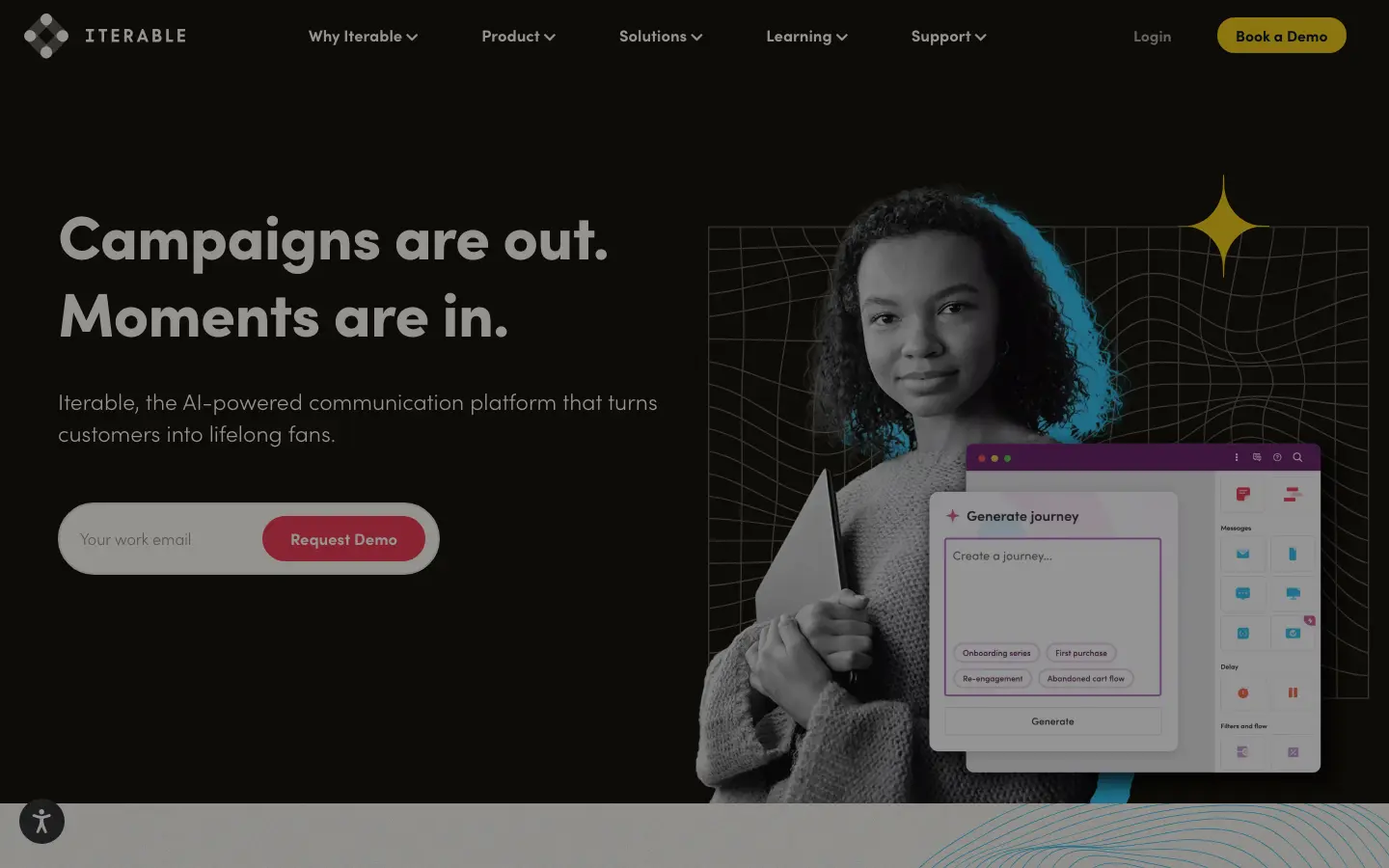
Iterable Nova is the AI suite: send-time optimization, brand affinity scoring, and predictive goals. It’s built for experience-focused brands where journey quality — not just volume — is the primary KPI. Asana, Square, Redfin, and Morning Brew are the reference customers.
No public pricing and no self-serve trial — every deal goes through sales with annual contracts. That’s the right model for the buyer it’s built for. It’s the wrong model for teams that want to evaluate without a procurement cycle.
Key features
- Iterable Nova AI suite: send-time optimization, brand affinity, predictive goals
- Cross-channel journey orchestration: Email, Mobile push, Web push, In-app, SMS
- Activate Data — data activation across your existing tech stack
- Engage 1:1 — behavioral lifecycle messaging with deep personalization
- Optimize Strategy — A/B testing and campaign analytics
- AI-driven segmentation and audience targeting
Pricing
Custom pricing, annual contracts. Demo required. No published tiers.
Pros & cons
Pros:
- Closest feature parity to Braze at a lower entry contract threshold
- Iterable Nova AI suite matches the direction of the enterprise CEP market
- Strong mid-market customer base: Asana, Square, Redfin, Fender, Morning Brew
- $343M raised — significant runway for ongoing product investment
- 4.5/5 on G2 with 691 reviews
Cons:
- No public pricing or self-serve trial — full sales engagement required
- Annual contracts standard; not suited to teams wanting flexibility
- Per-subscriber pricing disadvantages B2C and PLG companies with large inactive lists
- G2 reviewers flag reporting as an area needing improvement
Customers
Asana, Square, Redfin, Priceline, Fabletics, Fender, NHL, Morning Brew, Box, Wolt. 4.5/5 on G2 with 691 reviews.
5. Mailchimp: Best for small businesses and email simplicity
Mailchimp is the most recognized email marketing brand in the world. 15M+ users, ~$1.35B in annual revenue (2025). It was acquired by Intuit in September 2021 for ~$12B.
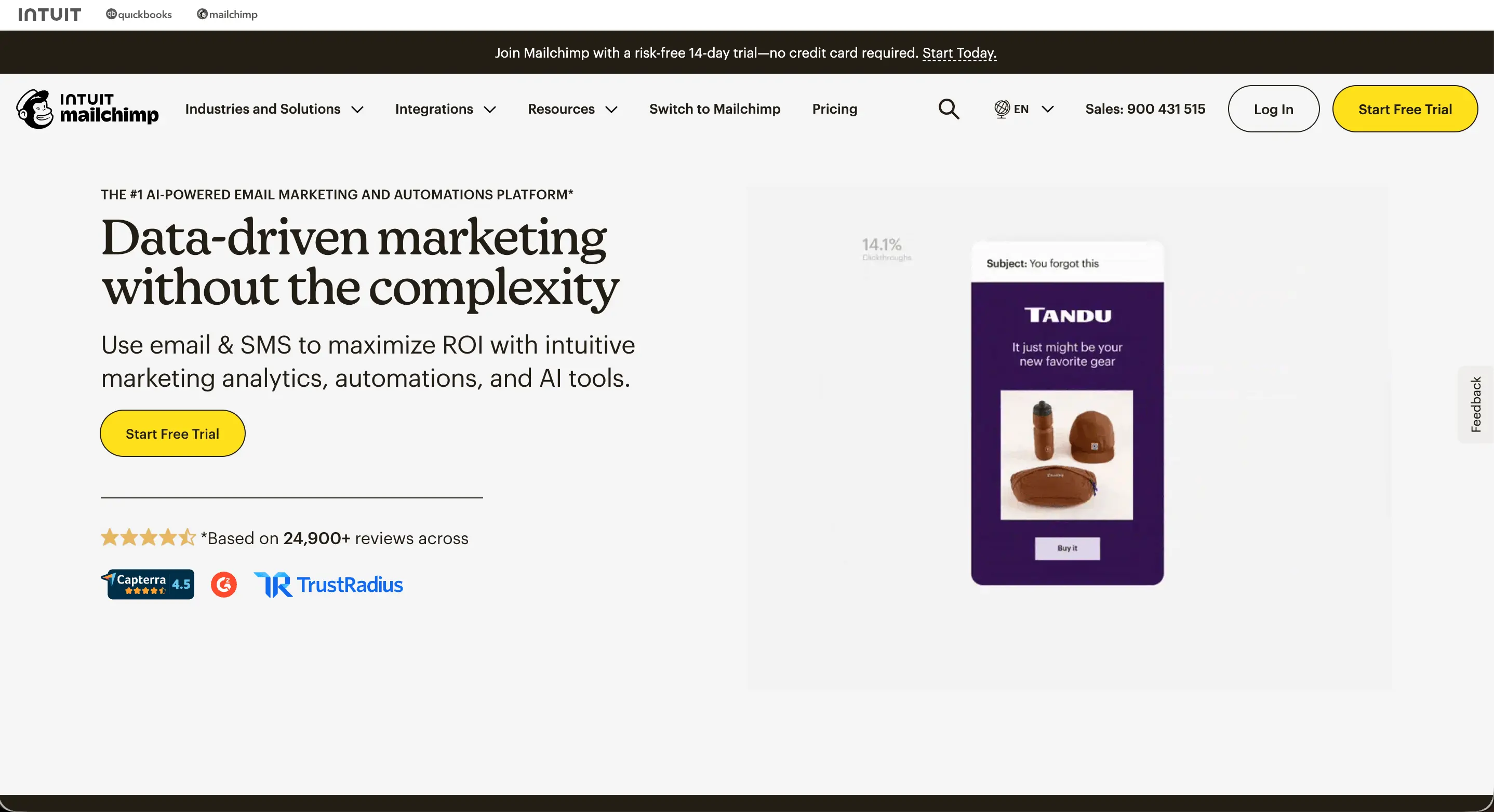
The product is built for simplicity — a visual email builder, pre-built automation templates, and basic segmentation. A/B testing, predictive demographics, and Shopify integrations are on paid tiers. It’s the fastest path from zero to a working email marketing program.
Mailchimp is not a full customer engagement platform. There’s no mobile push, no in-app messaging, and no warehouse integration. It’s the right starting point and the wrong long-term platform for teams with complex product data.
Key features
- Visual drag-and-drop email builder with pre-built templates
- Automated customer journeys and event-triggered sequences
- A/B testing and multivariate testing
- Predictive demographics and purchase likelihood scoring
- Native e-commerce integrations: Shopify, WooCommerce, BigCommerce
- Social media ads management: Facebook, Google, Instagram
- Website builder and landing pages included
- SMS available as an add-on
Pricing
| Plan | Price | Notes |
|---|---|---|
| Free | $0 | 500 contacts · 1,000 emails/mo · 1 audience |
| Essentials | From $13/mo | 500 contacts · 5,000 emails/mo · A/B testing |
| Standard | From $20/mo | 500 contacts · 6,000 emails/mo · Journey builder · Predictive segmentation |
| Premium | From $350/mo | 10,000 contacts · Multivariate testing · Priority support |
Contact-count pricing; all plans scale by contact volume.
Pros & cons
Pros:
- Most recognized email marketing brand globally — 15M+ users
- Free plan with genuine utility for small teams and solo founders
- Intuit backing provides long-term financial stability and QuickBooks integration
- Two decades of deliverability infrastructure and reputation
- Broader than email — ads, landing pages, and website builder included
Cons:
- Not built for product-triggered behavioral messaging or PLG automation
- No mobile push, in-app messaging, or webhooks
- Contact-count pricing penalizes businesses with large inactive lists
- No data warehouse integration for product event data at scale
- Engineering teams consistently find it difficult to integrate with product infrastructure
Customers
15M+ users worldwide — SMBs, solopreneurs, nonprofits, and e-commerce brands. 4.3/5 on G2 with 12,500+ reviews.
6. Vero: Best for mid-market PLG, B2C, and data warehouse teams
Vero is our platform. We’re including it here because it’s directly relevant — but you should weigh that context accordingly.
Most customer engagement platforms penalize the companies that grow fastest. Per-contact pricing charges for your entire database — active or not. Neither model fits a B2C business with a large inactive list or a PLG product with a massive free tier.
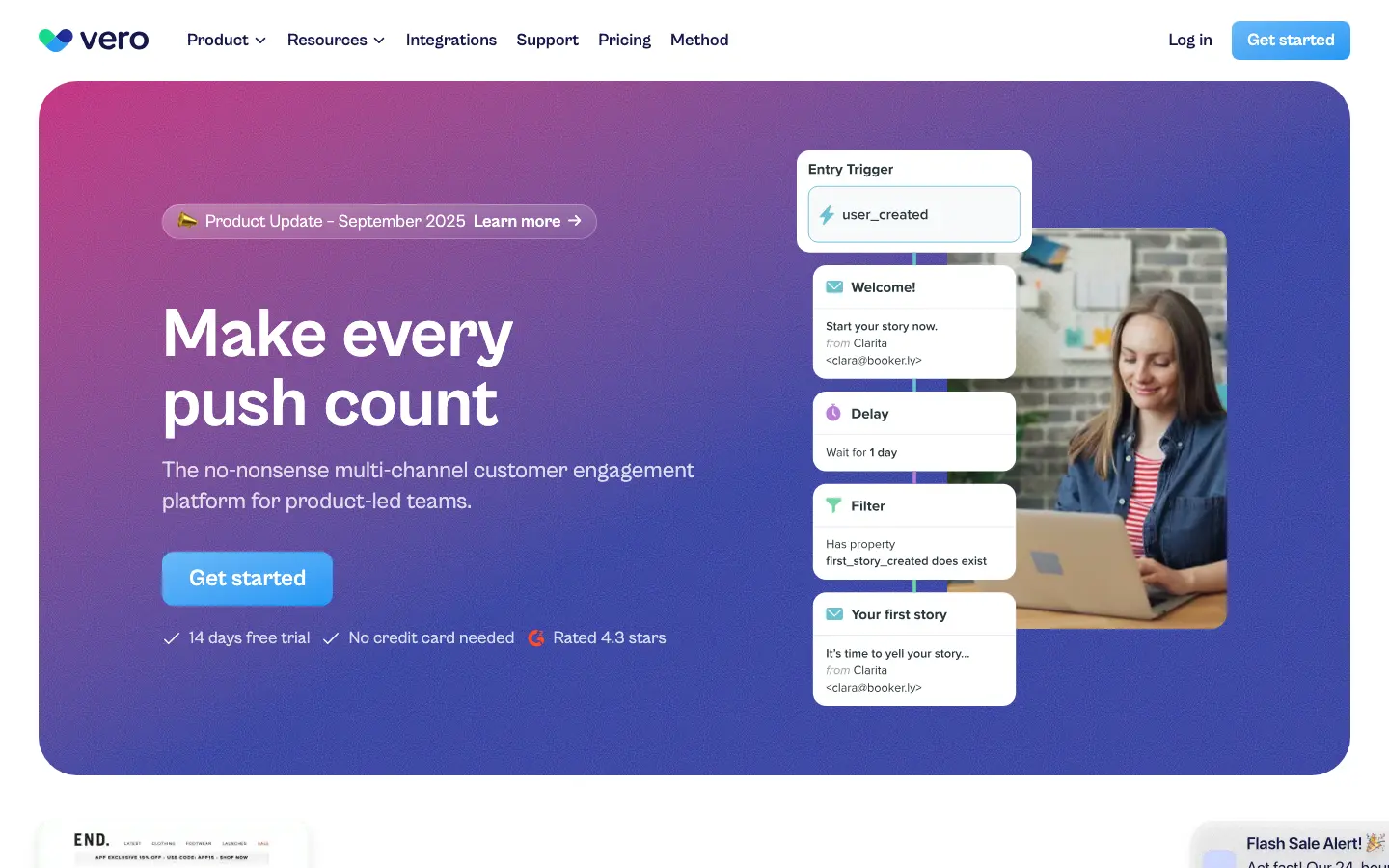
Vero is built around active-profile pricing — you pay only for users active in the billing period. For a business with 200,000 subscribers and 30,000 engaged users, you pay for 30,000. No other platform on this list offers that structural advantage for B2C and PLG teams.
The second differentiator is data architecture. Connected Audiences connects directly to Snowflake, BigQuery, Redshift, PostgreSQL, MySQL, and SQL Server via SQL. You write the query in your warehouse; Vero uses it directly with no data duplication or reverse ETL required.
"We needed something that scales with our send volumes, not our user counts."
— Lawrence Scotland, Sr. Director, Dribbble
Key features
- Active-profile pricing — charges only for users active in the billing period; not total database size
- Connected Audiences — direct SQL access to Snowflake, BigQuery, Redshift, PostgreSQL, MySQL, SQL Server
- Best-of-breed CDP fit — pairs with Segment, RudderStack, Hightouch, Census; no built-in CDP overlap
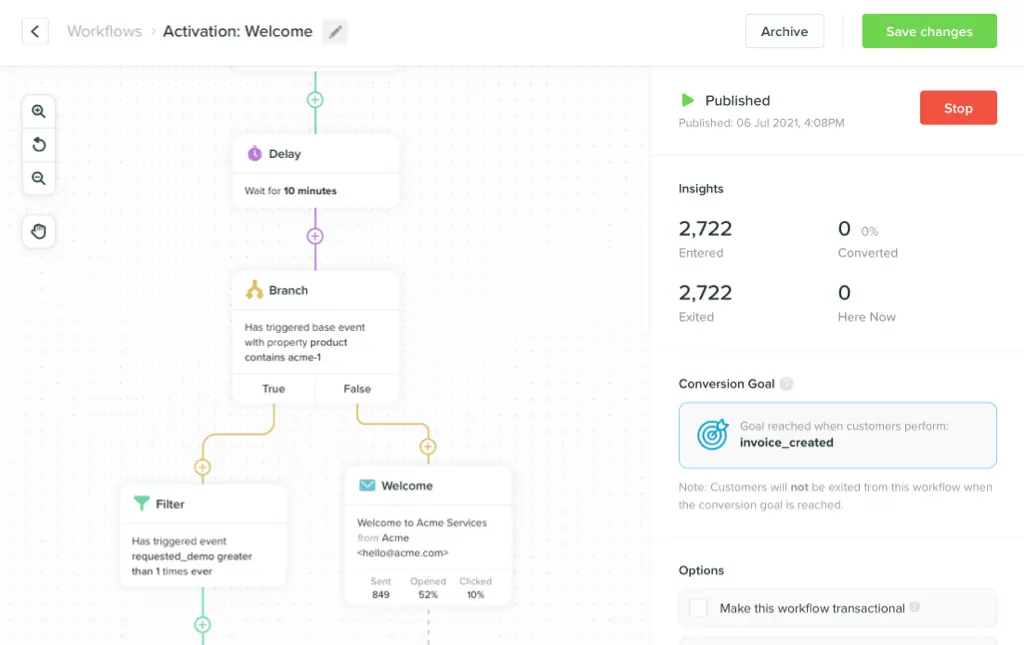
- Event-triggered behavioral messaging — onboarding, activation, abandonment, lifecycle, retention
- Multi-channel delivery — Email, iOS/Android push, In-app messaging, SMS, Webhooks
- Visual journey builder — multi-channel automated workflows without engineering on every change
- Developer-credible infrastructure — 5B+ messages/year, 99.99% uptime, 12-year track record
Pricing
All plans include unlimited team members. 14-day free trial, no credit card required.
| Plan | Price | Includes |
|---|---|---|
| Starter | $49/mo (annual) or $54/mo | 5,000 active profiles · 10,000 emails/mo · 20,000 push/mo · 160,000 events/mo |
| Professional | Custom | Scales all dimensions · SMS · Fair use overage policy |
Teams switching from per-contact platforms typically save 30–50%.
Pros & cons
Pros:
- Active-profile pricing is a structural cost advantage for B2C and PLG teams
- Direct warehouse SQL removes CDP duplication and data sync overhead
- Lowest entry price of any multi-channel CEP in this comparison ($49/mo)
- 14-day free trial with no credit card — evaluate without a procurement cycle
- Pairs cleanly with Segment, RudderStack, Hightouch, Census without overlap
Cons:
- No WhatsApp channel yet
- Smaller brand recognition than Klaviyo, Iterable, or Mailchimp
- SMS is newer and less mature than email and push
- No built-in CDP — a gap for teams that don’t already own one
Customers
Dribbble, Unsplash, Pipedrive, Stockpile, and 50+ companies globally. 4.3/5 on G2.
"It didn’t make sense to be paying for everything when we don’t need all that stuff."
— Vincent Turner, CEO, Uno
Frequently asked questions
What is a customer engagement platform?
A customer engagement platform sends automated, personalized messages across multiple channels based on user behavior. Channels typically include email, push, in-app messaging, and SMS. Unlike basic email tools, CEPs trigger messages from product events — not just manual sends.
Which customer engagement platform is best for e-commerce?
Klaviyo. Its Shopify integration, pre-built DTC flows, and predictive analytics are purpose-built for e-commerce. 193,000+ brands use it. For brands needing both email and SMS, the Email + SMS plan starts at $60/mo.
Which customer engagement platform is best for mobile apps?
OneSignal. 1 in 4 app publishers already uses it. SDK coverage spans Android, iOS, Flutter, React Native, Expo, and Unity. For mobile-first international brands needing WhatsApp and regional data residency, MoEngage is the stronger fit.
Which platform is best for product-led growth companies?
Vero. The active-profile pricing model charges only for engaged users — not the full inactive database that PLG companies accumulate. Connected Audiences integrates directly with the data warehouse where product event data typically lives. Teams using Segment or RudderStack can connect Vero without adding a duplicate CDP layer.
Is Mailchimp a customer engagement platform?
Mailchimp is primarily an email marketing tool with basic automation. It lacks push notifications, in-app messaging, and the behavioral depth of a full CEP. Teams building lifecycle automation around product events typically outgrow it quickly.
Which customer engagement platform has the best free plan?
OneSignal: unlimited mobile push and 10,000 emails per month at $0. Mailchimp’s free plan covers 500 contacts and 1,000 emails per month. Klaviyo’s free plan covers 250 contacts and 500 emails. Vero offers a 14-day free trial on its full platform.
How do I choose between these platforms?
Start with the use case, not the feature list. E-commerce on Shopify → Klaviyo. Mobile-first with international users → MoEngage. Mobile app, push-first → OneSignal. Mid-market or enterprise with complex journey needs → Iterable. Small business starting with email → Mailchimp. B2C or PLG with a warehouse and an active-user pricing problem → Vero.
Conclusion
No single platform is the best customer engagement platform. Each wins clearly for a specific buyer.
Klaviyo is the default for DTC and e-commerce — nothing integrates with Shopify more deeply.
MoEngage leads for mobile-first brands operating internationally, especially where WhatsApp and regional compliance matter.
OneSignal is the clear winner for mobile apps — highest G2 score in the category and a free tier that genuinely works.
Iterable is right for mid-market and enterprise teams needing sophisticated cross-channel orchestration.
Mailchimp is where small businesses should start — lowest barrier to a running email program, 20 years of deliverability reputation.
Vero is the right answer when the pricing model matters as much as the features — active-profile pricing, direct warehouse SQL, and best-of-breed CDP fit for the B2C and PLG teams other platforms penalize.
Ready to try Vero? Start a free trial — no credit card required, no sales call needed.