
- All Posts
- /
- A checklist for good writing
A checklist for good writing
Messaging and Automation-
 Chris Hexton
-
Updated:Posted:
On this page
I’ve been writing on behalf of Vero for more than a decade now. I’ve also read hundreds of great articles, great marketing, great books over that time.
A few common-sense patterns have stood out to me when it comes to good writing. Patterns that define effective writing. Writing that conveys its message clearly, powerfully and enjoyably.
I use this checklist when writing anything for Vero and thought you’d find it valuable too.
Many people are doing less writing, leveraging AI to write for them. In that scenario this list is even more important: your role shifts to that of editor when using AI.
For the record, I write all of the copy in these blog posts myself! I use AI to brainstorm when I get stuck on a point or want to synthesise a few thoughts. But the copy is mine. Maybe I’m just making kerosene lamps on the eve of electricity, but it’s important to me.
Make the core point obvious
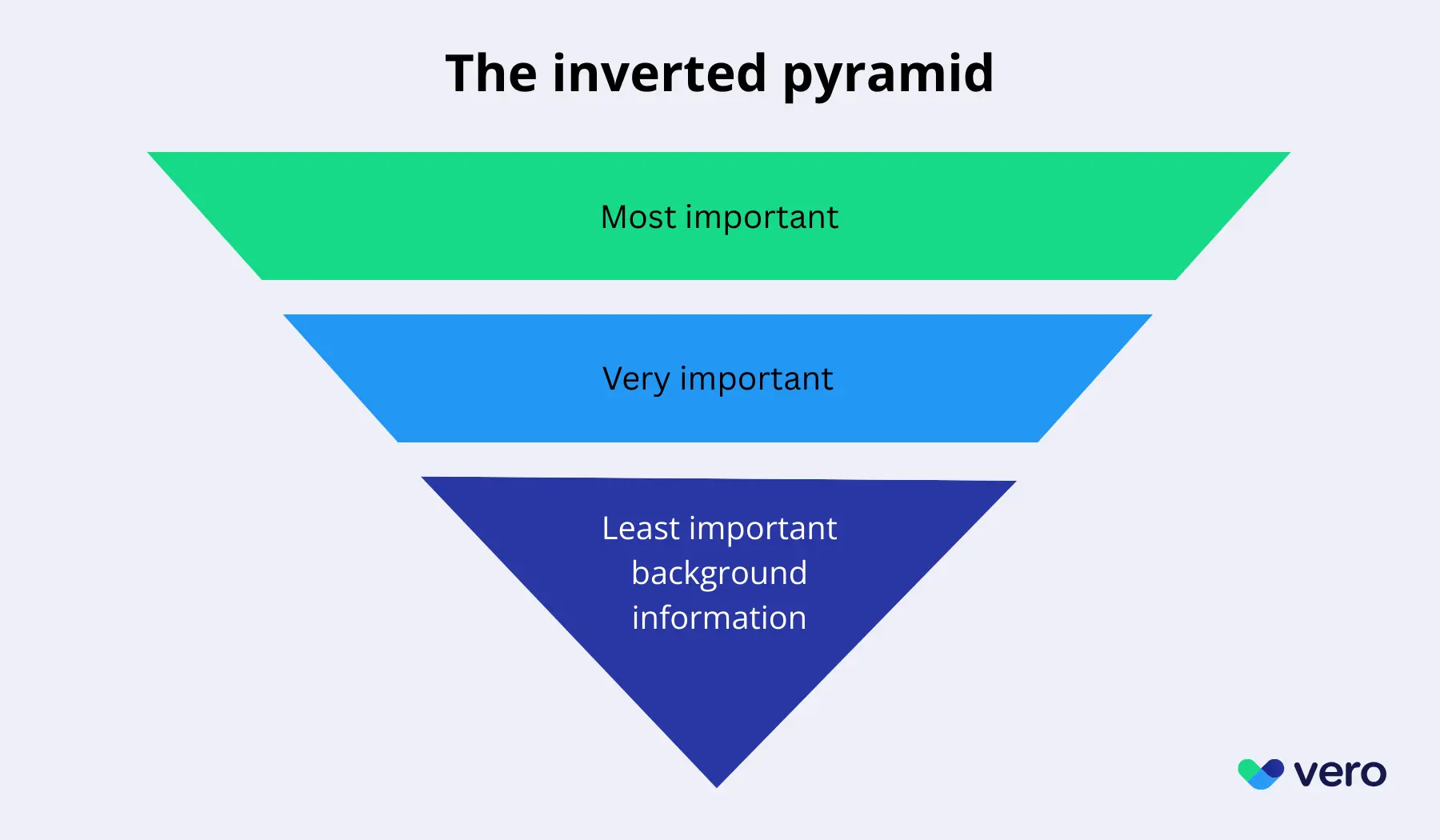
A decade ago, Jimmy wrote on our blog about the inverted pyramid method, which comes from journalism (read the Wiki). The idea being: put the key points first, then expand.
There’s a real tendency when you write to provide a ton of background before the reader knows what you’re even writing about. It’s easy to think that this builds anticipation or momentum.
Wrong. Generally it does the opposite: am I going to read 500 words of preamble before I even really understand the topic? Is anyone? Unlikely.
Make the core point obvious. You’ll lose some readers, who simply aren’t interested in the point you’re going to make…but those that are interested are more likely to read on.
Find and explain the relevance
Relevance answers the question “why now?” Good writing makes it clear why it’s being written in the first place. Why at this moment in time?
Perhaps this relates to the context of the author.
Perhaps it relates to a moment in time.
Even better: the best writing has a certain timelessness. It’s always relevant. But, for most writing, there’s a “why now?” and it helps improve the writing a lot if you can articulate this to the reader.
Take this post: why is it relevant? The idea in my mind is that AI-driven writing has exploded so the need for a clear eye on what makes better writing is more important than ever.
Give missing context
Unfortunately, readers can’t read your mind and don’t have the same memories as you do.
Good writing gives enough context that the reader has everything they need to get value (or enjoyment, or both) from what you’ve read. You can’t assume “deep memory”. Here’s some examples of phrases that assume memory without recapping specifics.
“Given the improvements we announced in Q2…” “As part of our recent restructuring of workflows…” “After the change we made earlier this year…”
What improvements? What did you restructure? What change(s) were made earlier this year?
A piece of writing should have enough context to stand on its own.
Cut!
Cut. Reduce. Delete. It’s fairly easy to fall prey to the idea that great writing needs big words or to have a sense of grandeur.
Not so. When you’re writing articles, essays, non-fiction writing, you’re trying to convey ideas. The adage “if you can’t explain it simply then you don’t deeply understand it” is a good one to remember here.
It’s also easy to fall into the habit of setting a writing target and writing just to hit it. There’s nothing wrong with this as a way to ensure you do write. Setting a goal of writing 2,000 words a week is perfect. But, once you’ve written those words, don’t be afraid to cut a lot of them!
Getting your ideas across to the reader requires clarity of thought. Remove the noise. This is a huge part of great writing.
Be warm. Be human.
This point may be a little more subjective but the writing that stands out to me the most has a certain warmth, a humanity, to it. You get a sense of the author when you’re reading it.
There’s a difference between “technically correct” writing and memorable or enjoyable writing. And that is often a sentence or two that reveals something human: stories, personal observations, a moment of uncertainty, failures, things you’ve learned the hard way.
Anchoring the abstract in something real.
This is the area where I think there’s still room for great writing written by a human to shine versus content written by AI. Perhaps it’ll get to the point AI creates a close-enough simulacrum, but AI just doesn’t have the memories or the true imaginative power your brain does. Drawing on this to give what you’ve written your unique voice is a big part of great writing.
None of these ideas are new. They don’t come from any single book or framework. They’re simply patterns I’ve seen over and over again in the writing I’ve found most compelling.
- Make your point clear.
- Explain why it matters.
- Give the context someone needs to understand it on its own.
- Cut noise.
- And be warm while you’re doing it.
Whether you’re writing everything yourself or using AI and editing its output, this checklist helps you produce messages that are easier to read and more enjoyable to engage with.