- All Posts
- /
- AI and the future of customer engagement platforms
AI and the future of customer engagement platforms
Messaging and Automation-
 Chris Hexton
-
Updated:Posted:
On this page
“If you’re not already using AI to drive X% of your revenue, you’re behind”.
That’s what I could say if I wanted to make you feel guilty.
But it just wouldn’t be true.
AI is here. It’s been here for a while and it’s awesome. But the suggestion that most businesses—those outside the top 1%—are already using it to drive significant revenue, consistently and in a production setting is an overstatement.
Netflix: absolutely they are. The rest of us: we’re getting there.
Things are moving and I’ve had some really interesting conversations with marketers about AI, customer engagement and what tools will be valuable. I think we all feel cautiously optimistic: there are great ideas but it’s a little scary to take your hands off-the-wheel and let the robot drive.
In this post I’m breaking down the ideas I’ve heard for AI-driven features and tools that will drive value in customer engagement. I’d love your feedback on this article: what am I missing? What else would you find cool and powerful to use?
The big categories of AI
Firstly, AI is used interchangeably to describe two big types of systems:
- Machine learning (ML). The system looks at data, learns patterns and makes predictions. Reinforcement learning is a type of ML.
-
NLP and generative AI. Trained on lots of
data, the system can both “understand” human language and
images and generate these.
- LLM. ChatGPT is an LLM. Given input it generates text, based on training with vast amounts of data.
- Computer vision. Midjourney or DALL•E generate images based on input.
There’s more nuance here but this is enough of a primer to start. Onto the ideas. I’ve categorised the ideas I’ve heard into four distinct categories. I’ve described these in the ways we at Vero can use AI to build features and tools for marketers like you.
Content generation
The first way we might use AI is to leverage LLMs and computer vision systems to generate content for messages we’re sending our customers. Think automatically generating subject lines and body copy, creating images, generating variants of subject lines and body copy and so on.
I think this is the most basic use case and many marketers are already doing these things with Claude, ChatGPT, etc.
We could also put “brainstorming” in this category. When I write posts, like this one, I often ask ChatGPT whether it has any pushback on my ideas or suggestions for big areas I’ve missed within a topic. It’s very useful.
I expect to see more-and-more tools adding these features fairly quickly (including Vero) but I also think they’re the least valuable in that they’re easy use cases to nail in ChatGPT, etc. and any product implementation is essentially a “wrapper” on these APIs.
Making it easier to use features
Similar to content generation, NLP and LLMs can be used to make it easier or faster to interact with UI-based features in Vero.
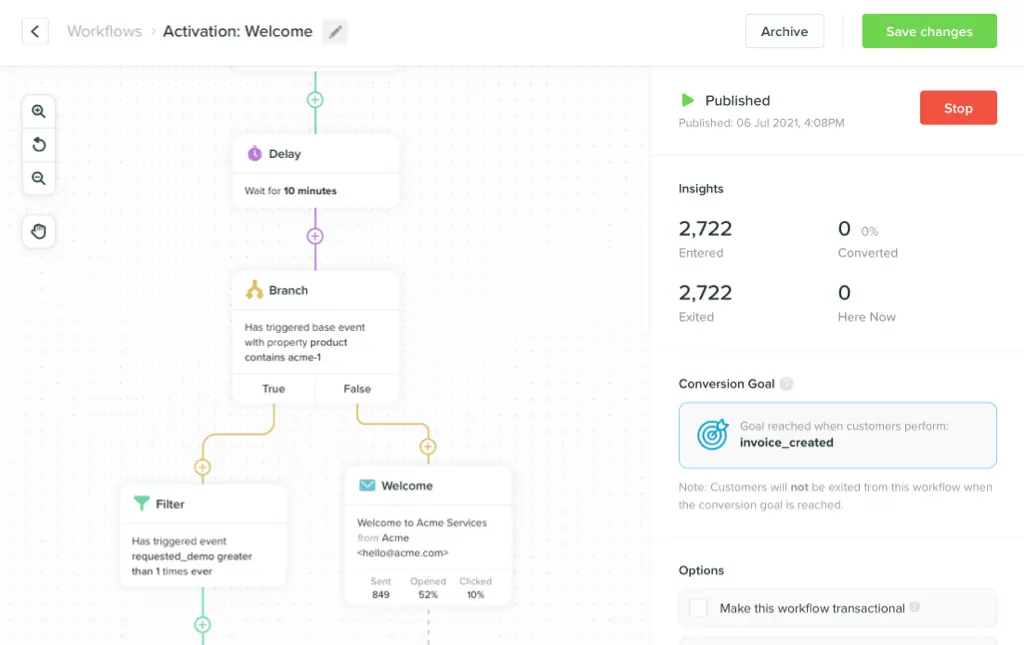
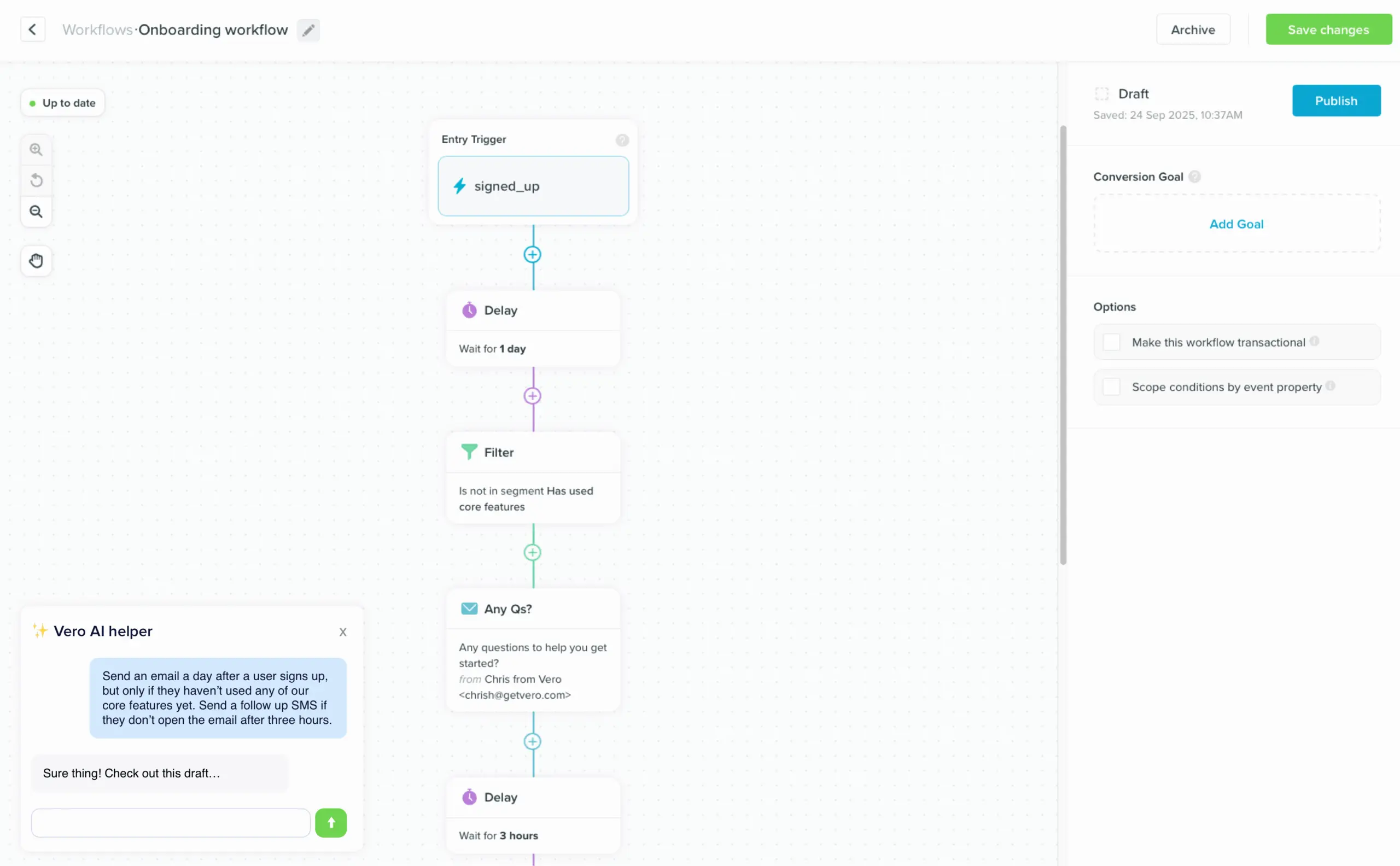
For example, you can imagine asking AI to create a customer journey canvas by saying “Create a customer journey that automatically emails users 24 hours after they abandon their cart. If they don’t open the email, send a push message the hours after that” or “Send an email a day after a user signs up, but only if they haven’t used any of our core features yet. Send a follow up SMS if they don’t open the email after three hours.”
The journey would then appear on screen. Something like this:
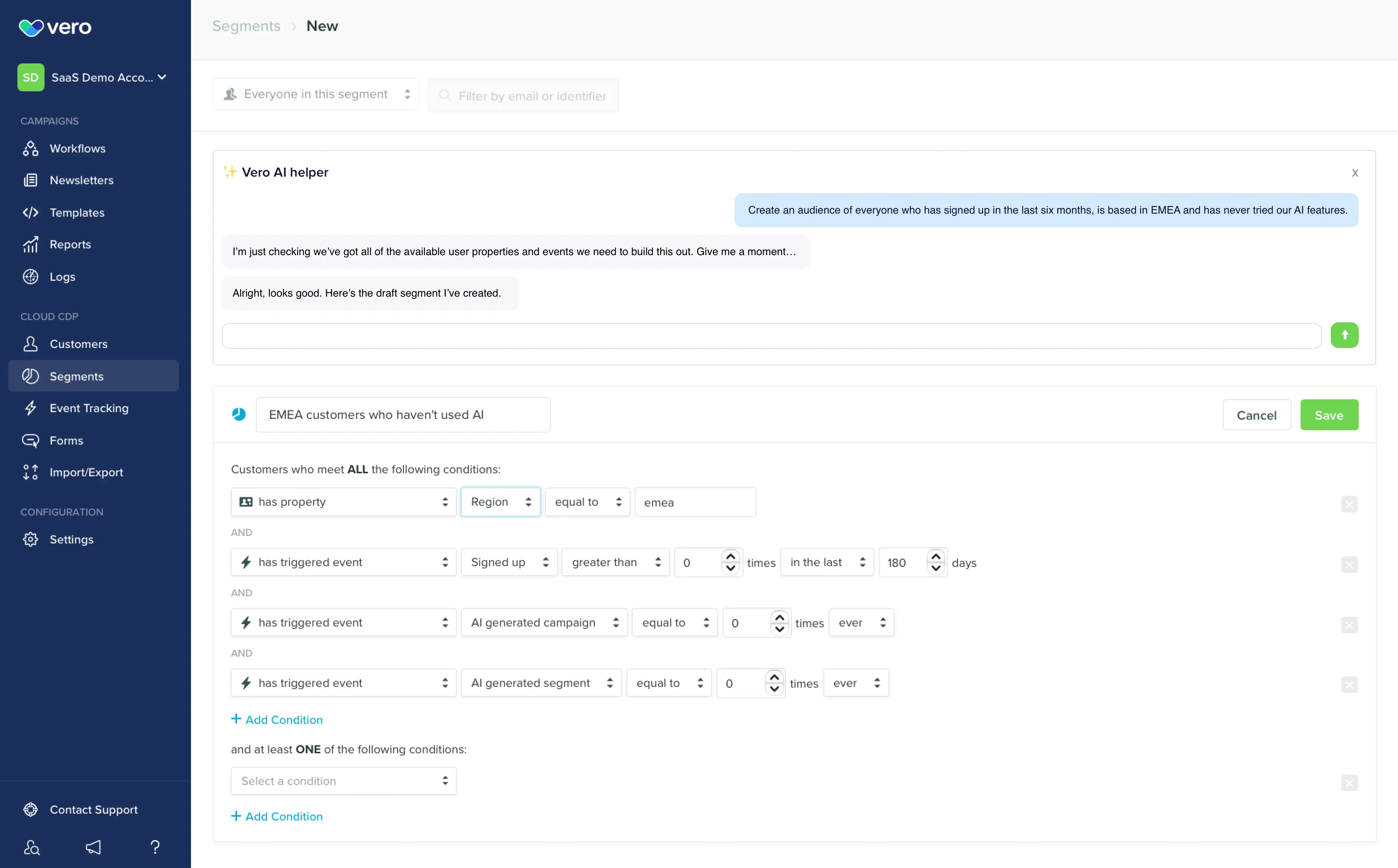
Another common theme is generating the conditions needed to build an audience/segment. You might say “Create an audience of everyone who has signed up in the last six months, is based in EMEA and has never tried our AI features”. Something like this:
Another example, which I really like, is using AI to explain what’s going on in a journey. Some Vero customers have journeys with over 100 nodes. When returning to audit a journey of this complexity it can sometimes be hard to remember exactly what it does. Asking the AI to remind you of the overall context and goal would be really useful.
All of these ideas feel particularly useful for new users, bootstrapping you up the learning curve really, really quickly. Whilst these features won’t change the core of the system, I think it is clear they’re valuable.
Predictions
ML can help build out several types of predictive models. Some examples that I think are immediately valuable:
- Favourite messaging channel. Does a given user prefer to receive messages via email, push, SMS or another channel.
- Best time of day to send a message. This idea has been around for some time. Automatically determining the best time to send for a given user profile to ensure maximum engagement, based on their own past interactions or those of similar customers.
- Next-best product. If your business has a big catalogue of items users can buy or interact with, then using ML can be used to build a model for which item a user is likely to engage with next. Think products in an eCommerce store, items on a marketplace, search results amongst a list of documents and so on.
- Automatic audience building. Automatically marking users as “VIP”, “Likely to churn”, “Heavily engaged” and so on is a no-brainer application of this technology. This is most achievable for segmentation that is standard across an industry, otherwise it’s hard to build viable models. All customers are going to have specific segmentation that only makes sense for their business but there are labels that can be applied for most verticals and business models (SaaS, eCommerce, marketplaces, etc.)
- Recipient risk profile. How risky is a given email address? Is it likely to bounce or otherwise damage our reputation? Is the recipient likely to mark our email as spam?
All of these can be useful in sending more personalised, higher-quality messages to your users. I’m really excited about the potential of these sorts of features because they go beyond what the UI and beyond what a human can realistically do. This is where I really see the value begin to stack up.
Next-best action
Finally, perhaps the holy grail, is “next-best action” based marketing. With this, the system builds a model, or series of models, to determine which message should be sent to which user and when.
We’re all quite familiar with AdTech. When you create campaigns in Meta, Google, LinkedIn, etc. you can specify a list of potential ads (content), guardrails (audiences or exclusions for each ad or campaign) and timing rules (beginning, end dates, etc.) The ad networks can then be set to automatically optimise which images to show and when. As marketers, we don’t specifically build journeys or tell the ad network who to serve which ad to.
Part of this is because we can’t: the ad networks don’t generally exposure individual-level data: it’s a bit of a black box.
But there’s also the argument that this is the most effective way to get results. That the system will optimize better than we ever could.
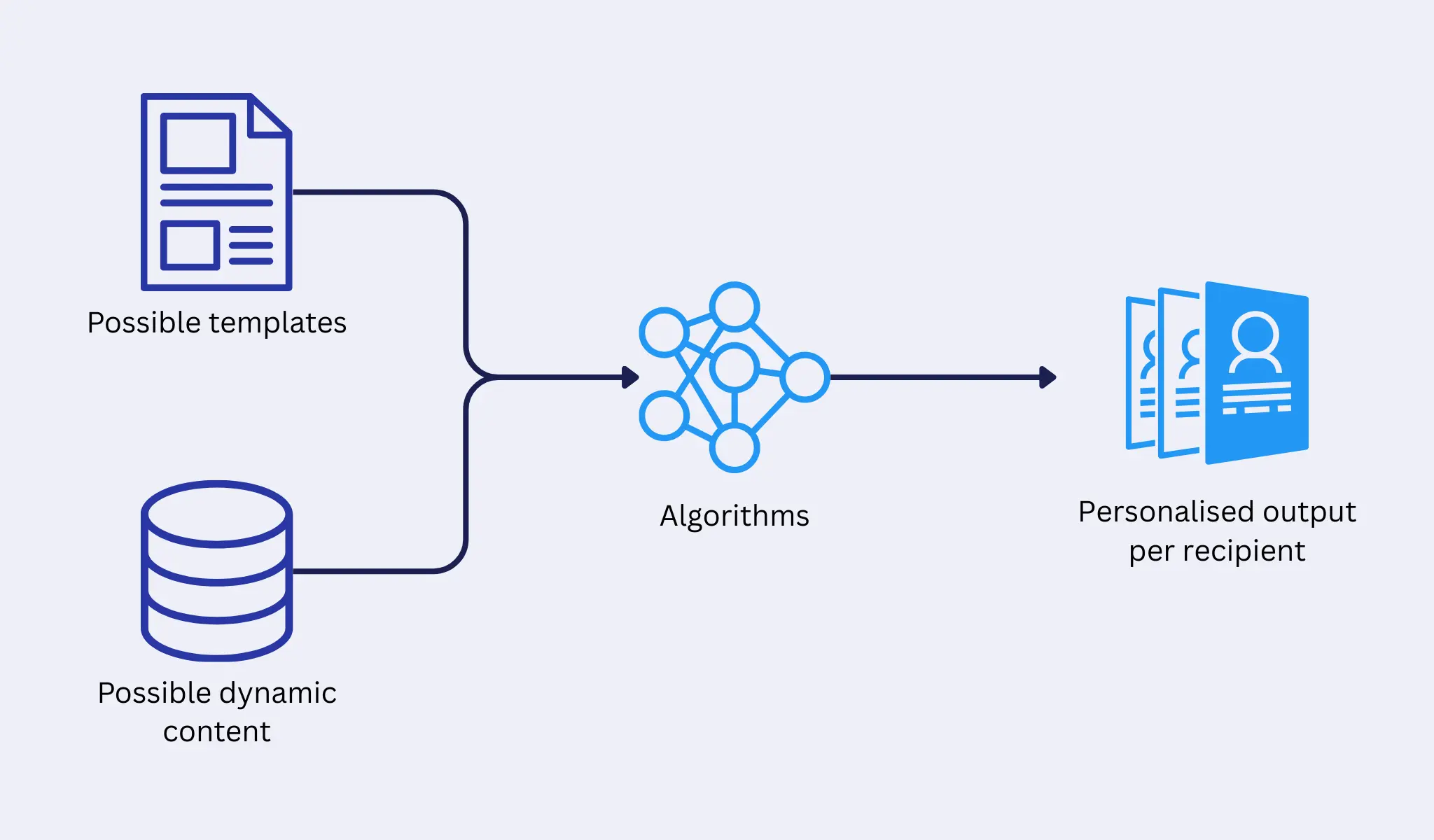
We can envisage the same pattern for messaging:
- Define your content (and variants).
- Define guardrails, such as the master audience of who can or cannot receive each piece of content.
- Set parameters around frequency, e.g. no more than X messages per day/week/month on Y channel.
- Set a goal.
Let the machine do the rest.
This is coming and I think it’s very exciting but, of all the approaches listed here, this is the approach that requires the most data. The really big dogs, like Netflix, have been working with such approaches for years now, perhaps approaching a decade, but Netlflix also has the advantage of hundreds of millions of end users generating hundreds of millions of message interactions with every send.
There’s potential that for industries such as eCommerce, where the customer lifecycle is very similar for all customers, data shared across customer accounts will make this feasible for vendors to offer a viable solution to mid-market and SMB businesses. But, for many customers, their unique customer journeys may call into question whether a reliable model can be built for mid-market or SMB customers.
We’ve been researching exactly what it would take and which customer can benefit from this approach and we’re excited by the potential. That said, even in a world where this exists, our conversations with marketing teams suggest that next-best action campaigns will live alongside journeys and editorial, one-to-many campaigns for some time to come.
What excites you most?
With my product manager hat on, I’m very eager to have more conversations about these ideas and others you have. This is a huge opportunity for all of us as marketers and we want to make sure we build out the AI features that offer the most tangible value first: not just things that are shiny, but things that work.
Let me know what you think.