- All Posts
- /
- Best Email + SMS + Push Messaging Platforms in 2026
Best Email + SMS + Push Messaging Platforms in 2026
Alternatives-
 Chris Hexton
-
Updated:Posted:
On this page
Most messaging platforms support at least one channel well. Far fewer handle all three — email, SMS, and push — without forcing you to compromise on any of them.
The problem with running each channel through a separate tool is coordination. Messages arrive out of order. Opt-out state doesn’t sync. You end up with three dashboards, three billing relationships, and no shared journey logic across any of them.
A single platform that natively handles email, SMS, and push lets you build sequences where the channels talk to each other. Email fires first. Push follows up for non-openers. SMS escalates when the action is time-sensitive. The right message, through the right channel, at the right moment — without patching three tools together.
This guide covers the best platforms that do all three in 2026. We’ve looked at pricing, channel depth, target audience, and what each platform does better than the rest. By the end, you’ll know which one fits your team.
What are the best email + SMS + push messaging platforms in 2026?
Vero is the strongest choice for mid-market product-led software companies — behavioral messaging across email, push, and SMS with active-profile pricing and warehouse-native segmentation. SAP Emarsys (now SAP Engagement Cloud) leads for enterprise retail and consumer brands that want omnichannel messaging with deep SAP CRM integration and 60+ pre-built automation tactics.
Bird suits API-first and developer-led teams that want pay-per-message pricing with no platform fees. Airship is the enterprise standard for mobile-first brands with large app user bases. Bloomreach Engagement targets mid-market to enterprise retailers and consumer brands that need AI-powered personalization across all three channels and beyond.
| Platform | Starting Price | Best For | Key Differentiator | Free Trial |
|---|---|---|---|---|
| Vero | $54/mo | PLG SaaS, B2C, mobile apps | Active-profile pricing + warehouse-native segmentation | 14 days, no credit card |
| SAP Emarsys | Custom (enterprise) | Enterprise retail and consumer brands | 60+ pre-built tactics, native SAP CRM integration | No free trial |
| Bird | Pay-per-message | API-first and developer teams | No platform fees, pay only for what you send | Free to start |
| Airship | Enterprise custom | Mobile-first enterprise apps | Industry-leading push infrastructure, 681B+ notifications analyzed | Sales demo required |
| Bloomreach | From ~$1,585/mo | Mid-market/enterprise retail | Loomi AI across 13+ channels, CDP + messaging in one | No free trial |
1. Vero: Best for Product-Led Software Teams
Disclosure: Vero is our own product. We’ve included it because we genuinely believe it belongs on this list — but you should know we’re not a neutral party.
Vero is a multi-channel behavioral messaging platform built for product-led software companies. It sends event-triggered emails, push notifications, SMS, and in-app messages powered by real-time product and warehouse data. Founded in 2012, Vero now delivers over 5 billion messages annually at 99.99% uptime.
The first major differentiator is pricing. Most platforms charge per total subscriber. A B2C company with 500K users pays for all 500K, active or not. Vero charges only for active profiles — a structural cost advantage for PLG and B2C businesses with large dormant lists.
The second is warehouse-native segmentation. Vero’s Connected Audiences feature connects directly to Snowflake, BigQuery, Redshift, PostgreSQL, MySQL, and SQL Server. Teams use any data already in their warehouse to segment and personalize — without duplicating it into the platform.
Key features
- Event-triggered messaging: Sends based on real user behavior — onboarding, activation, abandoned flows, and lifecycle campaigns.
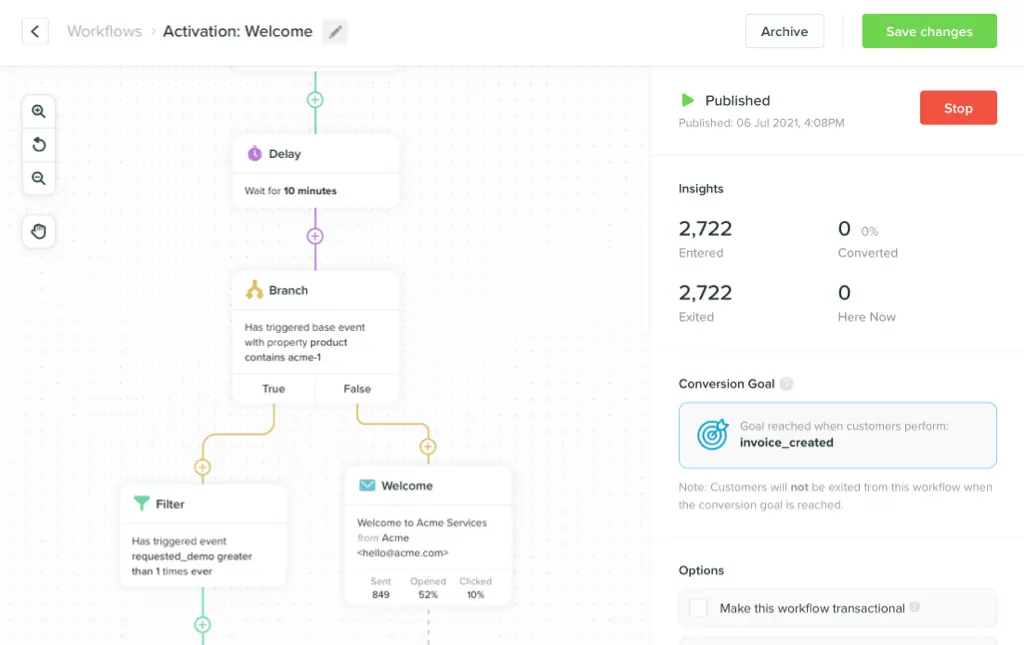
- Visual journey builder: Drag-and-drop automation with branching logic, A/B splits, delays, and multi-channel coordination — no code required.
- Connected Audiences: Direct SQL connection to major data warehouses. Build segments from live warehouse data without storing it in Vero.
- Multi-channel delivery: Email, iOS/Android push, in-app messaging, SMS, and webhooks coordinated in a single workflow.
- CDP integrations: Pairs natively with Segment, RudderStack, Hightouch, and Census — no need to pay for a redundant built-in CDP.
- A/B testing: Tests subject lines, content, timing, and channel combinations.
Pricing
- Starter: $54/month (or $49/month billed annually) — 5,000 active profiles, 10,000 emails/month, 20,000 push messages/month, unlimited team members
- Professional: Custom — scales profiles, emails, push, SMS, and events; fair-use overage policy
Free trial, no credit card required.
Pros & cons
Pros:
- Active-profile pricing is a real cost advantage for B2C and PLG businesses with large inactive lists.
- Warehouse-native segmentation (Connected Audiences) brings enterprise-grade data capability to a mid-market price.
- Flexible enough for engineering teams, operable by product and marketing without a developer on every change.
- Twelve-plus years of organic growth and 5B+ messages/year signal proven infrastructure.
Cons:
- Smaller brand recognition than enterprise-tier competitors — less likely to surface in early vendor shortlists.
- SMS and WhatsApp are still maturing relative to Vero’s email and push capabilities.
- No built-in CDP — by design, but a gap for buyers who want everything in one platform.
Customers
Vero is trusted by Dribbble, Unsplash, Pipedrive, Stockpile, and 50+ companies globally. It holds a 4.3-star rating on G2. One customer noted: "Vero has one of the best support teams I’ve encountered."
2. SAP Emarsys: Best for Enterprise Retail and Consumer Brands
SAP Emarsys — officially rebranded as SAP Engagement Cloud in early 2026 — is an omnichannel marketing automation platform built for mid-market to enterprise consumer brands. It handles email, SMS, mobile push, in-app messaging, web push, and ads within a single platform, underpinned by SAP’s CRM and commerce data layer.
The standout feature for retail teams is the pre-built tactics library. SAP Emarsys ships with 60+ ready-made automation tactics covering welcome series, cart abandonment, win-back campaigns, loyalty triggers, and post-purchase flows — with the channel mix already configured. Teams can activate these in days rather than building journey logic from scratch. The platform also integrates natively with SAP Commerce Cloud and SAP Customer Data Platform, making it the natural choice for enterprise brands already running SAP infrastructure.
The tradeoff is price and complexity. SAP Emarsys is enterprise-only — no public pricing, no free trial, and a sales-led process before evaluation. It’s built for brands with large budgets, dedicated martech teams, and an existing SAP investment they want to extend.
Key features
- 60+ pre-built tactics: Ready-made automation workflows for welcome, abandonment, win-back, loyalty, and post-purchase journeys across all channels.
- Omnichannel delivery: Email, SMS, mobile push, in-app messaging, web push, and ads in one platform.
- SAP ecosystem integration: Native connection to SAP Commerce Cloud, SAP Customer Data Platform, and SAP CRM — no middleware required.
- AI-powered personalization: Generates subject lines, preview text, and content recommendations; AI reporting speeds up campaign analysis.
- Segmentation: Behavioral and transactional segmentation based on purchase history, engagement data, and SAP CRM attributes.
- Revenue attribution: Closed-loop reporting that connects messaging activity to actual revenue in the commerce layer.
Pricing
Custom enterprise pricing only. The model is subscription-based on contact volume and messages sent, with a base platform fee plus per-contact and per-channel rates. SMS pricing varies by country — US rates typically run $0.01–$0.03 per message; EU rates $0.04–$0.08. Push notification delivery is infrastructure-cost-free (Apple and Google don’t charge), but first-time push setup requires Firebase/APNS integration work. No free plan or self-serve trial is available; all deployments require a sales engagement.
Pros & cons
Pros:
- 60+ pre-built tactics dramatically reduce time-to-live for brands entering new automation use cases.
- Native SAP ecosystem integration is a genuine differentiator for enterprise brands already on SAP infrastructure.
- Broad channel coverage (email, SMS, push, in-app, web push, ads) in one contract and one data model.
- AI content and analytics features included without a separate add-on fee.
Cons:
- Enterprise-only pricing and sales process — inaccessible for SMBs or teams without a dedicated martech budget.
- No free trial; evaluation requires full sales engagement before hands-on access.
- Complex initial setup and onboarding overhead — not a fit for lean teams without a dedicated platform administrator.
- Less suited for SaaS or PLG teams; best-fit is retail, fashion, travel, and consumer brands with SAP infrastructure.
Customers
SAP Emarsys is used by major consumer brands across retail, fashion, travel, and financial services. Notable customers include Puma, dm-drogerie markt, and Levi’s — brands with complex multi-country operations and enterprise-scale marketing requirements.
3. Bird: Best for API-First and Developer Teams
Bird (formerly MessageBird and SparkPost) is a communications platform built around per-message pricing with no platform fees or seat-based charges. It supports email, SMS, WhatsApp, RCS, push, and voice — all accessible via API.
The appeal is transparency. Most messaging platforms bury their real cost in per-message fees, overage charges, and feature-gating. Bird publishes per-message rates publicly and charges only for what you send. Email costs $1.50 per 1,000 messages. US SMS starts at approximately $0.00331 per outbound message. Push is included in the platform without a separate per-message fee at standard volumes.
Bird is a strong fit for engineering teams, product-led companies with high messaging volume, and businesses that need multi-channel communications across many geographies — including international SMS routing. The tradeoff is that Bird is infrastructure-forward. It’s not a marketer-friendly journey builder in the way that Vero or SAP Emarsys are.
Key features
- Multi-channel API: Email, SMS, WhatsApp, RCS, push, and voice through one unified API.
- Startup and growth plans: No platform fee; from $15 for 50K emails or $30 for 100K emails.
- International SMS routing: Optimized routing across carrier networks globally, with rates varying by destination country.
- WhatsApp Business API: Includes both Bird’s platform fee and Meta per-conversation pricing for marketing, utility, authentication, and service messages.
- Flows: A visual workflow builder for multi-channel sequencing, available on paid plans.
- Deliverability infrastructure: SparkPost heritage brings enterprise-grade email deliverability and IP management.
Pricing
- Free: No platform fee to start; 5 SMS/day for testing
- Startup: From $15/month — 50K emails included
- Email: $1.50 per 1,000 emails above plan volume
- US SMS: From approximately $0.00331 per outbound message
- Push: Included in platform access; volume-based at scale
- Enterprise: Custom; median contract value reported at ~$38K based on Vendr data
Pros & cons
Pros:
- No platform fees or per-seat charges — pay only for what you send.
- Strong international SMS coverage with optimized carrier routing.
- SparkPost email infrastructure brings enterprise deliverability to teams of all sizes.
- Multi-channel API is clean and well-documented for engineering teams.
Cons:
- Journey orchestration and segmentation are less mature than dedicated customer engagement platforms.
- Not a marketing automation tool — teams need developer involvement to build complex sequences.
- WhatsApp pricing complexity (Bird fee + Meta per-conversation fee) can make cost modeling difficult.
- Less suited for non-technical marketing teams who need a visual, no-code workflow builder.
Customers
Bird serves tens of thousands of businesses globally. Enterprise customers include Uber, Google, and Heineken, primarily for high-volume transactional and operational messaging. The platform is frequently chosen by companies that need SMS and messaging infrastructure across 190+ countries.
4. Airship: Best for Mobile-First Enterprise Apps
Airship is the enterprise standard for mobile push notifications. The platform sent the industry’s first push notification and has since expanded to cover email, SMS, RCS, web push, in-app messaging, and mobile wallet. Its 2026 benchmarks report analyzed over 681 billion push notifications sent to more than 3 billion users across 15 industry verticals — no other platform matches that depth of push intelligence.
The core differentiator is mobile depth. Airship’s push infrastructure is more mature than any other platform in this list. It handles delivery at massive scale, supports rich media (images, GIFs, video), automated behavioral triggers, and granular audience segmentation down to individual device-level signals. Its no-code Experience Editor lets marketers build and deploy native app and website experiences without developer involvement.
Airship is enterprise-only in practice. Pricing starts at roughly $25,000/year for small deployments and scales to $750,000+ for large ones. It’s built for brands with millions of mobile app users where push notification performance directly impacts retention and revenue.
Key features
- Mobile push: Industry-leading push notification infrastructure with rich media, A/B testing, send-time optimization, and quiet hours.
- In-app messaging: Native in-app message creation and targeting without app store updates.
- Experience Editor: No-code editor for building native app and website experiences — the first of its kind.
- SMS and RCS: Supported channels within the same workflow, with RCS enabling rich messaging on Android where it’s supported.
- Email: Available as part of multi-channel journeys; more mature on the mobile side.
- AI features: Automated send-time optimization and audience scoring based on behavioral signals.
Pricing
Enterprise custom pricing only. Deployments typically range from $25,000/year for small implementations to over $750,000/year for large-scale enterprise brands. All plans require a sales engagement and annual contract.
Pros & cons
Pros:
- Deepest push notification infrastructure on the market — 681B+ notifications analyzed.
- No-code Experience Editor enables native app changes without engineering involvement.
- Trusted by the largest consumer brands globally at massive scale.
- Behavioral push triggers and send-time optimization are more mature than any competitor.
Cons:
- Enterprise-only pricing ($25K+ minimum) puts it out of reach for most mid-market teams.
- No self-serve or transparent pricing — requires a sales process before evaluation.
- Overkill for teams that don’t have a large mobile app user base.
- Email and SMS are secondary to push; not the right choice if those are your primary channels.
Customers
Airship’s customer base includes major consumer brands across retail, travel, media, and financial services. The platform is used by airlines, entertainment companies, and retailers that need mobile engagement at scale — think Fortune 500 consumer brands with tens of millions of app users.
5. Bloomreach Engagement: Best for AI-Driven Personalization
Bloomreach Engagement is a marketing automation and personalization platform that covers email, SMS, mobile push, web push, in-app messaging, WhatsApp, web layers, product recommendations, and more — 13+ channels in total. It combines a built-in customer data platform (CDP) with messaging automation and Loomi AI, its native AI layer for send-time optimization, churn prediction, and content generation.
The platform is purpose-built for consumer brands in retail, e-commerce, travel, and financial services. It has particularly strong traction among mid-market and enterprise brands that want AI-driven personalization across a complex channel mix without stitching together a separate CDP and messaging tool. Loomi AI is included in every plan at no extra cost — covering per-contact send-time optimization, purchase and churn likelihood scoring, and AI product recommendations.
Bloomreach is not a fit for early-stage companies or teams on a tight budget. The Shopify app store version starts at $19,020/year; non-Shopify deployments typically begin at $40,000/year and can exceed $250,000/year at scale.
Key features
- 13+ channels: Email, SMS, MMS, RCS, mobile push, in-app messaging, web push, WhatsApp, web layers, ads, and more.
- Loomi AI: Per-contact send-time optimization, churn and purchase likelihood scoring, AI content generation, and product recommendations — included at no extra cost.
- Built-in CDP: Unified customer profiles combining online, offline, and behavioral data across channels.
- Scenario builder: Drag-and-drop journey builder supporting complex, multi-branch workflows across all channels.
- E-commerce depth: Product catalog integration, real-time browse and purchase event tracking, and native personalization for product-led experiences.
- SMS rates: Negotiated aggregator rates for SMS — Bloomreach claims competitive pricing without per-message markup.
Pricing
- Shopify version: From $19,020/year (~$1,585/month)
- Standard (non-Shopify): Custom, typically starting at $40,000/year
- Enterprise: Custom, ranging from $40,000 to $250,000+ annually based on customer count, catalog size, and event volume
No free plan, no free trial (except through the Shopify App Store, which may offer a trial period).
Pros & cons
Pros:
- Most comprehensive channel coverage on the list — 13+ channels in one platform.
- Loomi AI is genuinely integrated, not bolted on — per-contact intelligence at no extra cost.
- Built-in CDP removes the need for a separate data platform for teams without one.
- Strong e-commerce and retail depth with native product catalog integration.
Cons:
- High entry price ($19K/year minimum) rules it out for most SMBs and early-stage companies.
- No free trial outside the Shopify App Store channel.
- Setup and onboarding complexity is higher than most platforms on this list.
- Overkill if you only need email, SMS, and push without the broader AI and CDP features.
Customers
Bloomreach Engagement is used by consumer brands in retail, fashion, travel, and financial services. Notable customers include Puma, Bosch, and other mid-market to enterprise retailers that need AI-powered personalization at scale.
Frequently asked questions
What’s the difference between web push and mobile push? Web push sends browser notifications to users on desktop or mobile when they have your website open or have granted browser permission. Mobile push sends native notifications to users’ iOS or Android devices via your app — even when the app is closed. Mobile push typically has higher open rates and stronger personalization capabilities. Web push is easier to implement (no app required) but reaches fewer users.
Which platform is easiest to start with? Vero is the lowest barrier for non-commerce teams — free trial, no credit card required, and a visual journey builder that’s up and running quickly. Bird is the easiest entry point for developer teams, with free pay-per-message access from day one. SAP Emarsys, Airship, and Bloomreach all require a sales conversation before evaluation.
Do I need separate tools for email, SMS, and push? No. Any platform on this list handles all three natively. Separate tools create coordination problems: opt-out state doesn’t sync, journey logic doesn’t cross channels, and you end up managing three billing relationships. A single platform is almost always the better operational choice.
How should I think about SMS pricing? SMS pricing varies by destination country and carrier. US rates are typically the lowest; international rates can be 2–5x higher. Per-message SMS rates range from roughly $0.003 to $0.05+ per message depending on the platform and volume. Watch for platforms that charge per-message on top of a platform fee — the total cost can be higher than it appears.
Which platform is best for SaaS and product-led companies? Vero. It’s the only platform on this list purpose-built for product-led software companies — with active-profile pricing, direct data warehouse integration, and behavioral event triggers that work with your product data. The others are stronger fits for enterprise retail (SAP Emarsys, Bloomreach), mobile apps (Airship), or infrastructure-first teams (Bird).
Is a free trial available? Vero offers a free trial with no credit card required. Bird is free to start with pay-per-message usage. SAP Emarsys, Airship, and Bloomreach all require a sales conversation before evaluation — no self-serve free trial is available.
Conclusion: Match the platform to your business model
No platform on this list is wrong — but each is built for a different team and a different problem.
If you’re running a product-led SaaS or B2C software company with behavioral data you want to use for segmentation, Vero is built for you. Enterprise retail and consumer brands already running SAP infrastructure should look first at SAP Emarsys — the pre-built tactics library alone saves months of setup. API-first teams with multi-country SMS needs and developer-led workflows should look at Bird. Enterprise mobile brands with large app user bases belong on Airship. And mid-market to enterprise retail brands that want AI-powered personalization across a broad channel mix will find the most depth in Bloomreach.
The right choice comes down to your business model, team structure, and data maturity — not the channel count in the marketing copy.
If you’re building a product-led software business and want to see how behavioral messaging across email, push, and SMS works in practice, start a free trial with Vero — no credit card required.