- All Posts
- /
- Braze vs Customer.io: Which Is Better in 2026?
-
 Chris Hexton
-
Updated:Posted:
On this page
Braze and Customer.io are the two most commonly compared customer engagement platforms for mid-market teams. Both support behavioral email, mobile push, in-app messaging, and SMS. Both have journey builders and have invested heavily in AI since 2024.
But they are not built for the same buyer. Braze is a ~$693M ARR public company designed for enterprise marketing operations teams. Customer.io crossed $100M ARR in September 2025 as a self-serve platform for growth-stage SaaS.
This guide compares both platforms across pricing, channels, data model, AI, and implementation. Every claim is sourced from company financials, G2, and procurement data. If you’re deciding between the two, you’ll have a clear answer by the end.
Braze
Founded in 2011 and headquartered in New York, Braze holds a 4.5/5 G2 rating across 1,412 reviews. Notable customers include Burger King, HBO Max, Grubhub, and the NBA. It raised $175M before going public on Nasdaq in 2021.
Customer.io
Founded in 2012 and headquartered in Beaverton, Oregon, Customer.io holds a 4.4/5 G2 rating across 709 reviews. Notable customers include Notion, Pipedrive, Kraft Heinz, and Zara USA. It has raised ~$93.7M and reached $100M ARR with 111% net dollar retention.
Braze vs Customer.io: Quick verdict
Choose Braze if you’re an enterprise brand with hundreds of thousands or millions of MAUs. You need a dedicated marketing team, enterprise AI, and a budget starting at $60K/year. No platform matches Braze’s AI depth and channel breadth — WhatsApp, RCS, and LINE — at enterprise scale.
Choose Customer.io if you’re a growth-stage SaaS company that needs behavioral lifecycle messaging. It has transparent pricing, a 14-day free trial, and unlimited event tracking without data point billing. Most teams are live within days, not weeks.
If you are evaluating options beyond Braze and Customer.io, it is worth looking at alternatives built around a different pricing model altogether. Vero (our platform) is one — a customer engagement platform that charges only for active users rather than your total database. It connects directly to your data warehouse via SQL and starts at $49/mo. It is worth considering if per-profile or MAU pricing is the reason neither platform fits.
Braze vs Customer.io: Head-to-head comparison
| Braze | Customer.io | |
|---|---|---|
| ARR | ~$693M | ~$100M |
| Customers | 2,528 | 9,000+ brands |
| Founded | 2011 | 2012 |
| Funding | Public (Nasdaq: BRZE) | ~$93.7M raised |
| G2 rating | 4.5 stars · 1,412 reviews | 4.4 stars · 709 reviews |
| Starting price | ~$60K/year (no public pricing) | $100/mo |
| Free trial | No | Yes (14 days) |
| Self-serve | No | Yes |
| Channels | Email · SMS/RCS · WhatsApp · Mobile push · Web push · In-app · LINE | Email · Push · In-app · SMS · WhatsApp |
| Data model | Billable data points | Unlimited events and attributes |
| Warehouse-native | Yes (Zero-copy Canvas Triggers) | Limited (reverse ETL required) |
| Built-in CDP | Yes (Braze Data Platform) | Yes (custom objects) |
| AI suite | BrazeAI Agent Console · Decisioning Studio · Operator | LLM actions · AI segments · AI translations |
| Typical implementation | 12–18 weeks | Days to weeks |
| Net dollar retention | 108% | 111% |
| Best for | Enterprise brands, 500K+ MAU | Growth SaaS, PLG, self-serve teams |
Pricing
This is the most significant practical difference between the two platforms.
Customer.io publishes its pricing. Essentials starts at $100/mo for 5,000 profiles and 1M emails per month. Premium is $1,000/mo (billed annually) and adds custom volume, HIPAA compliance, and a 90-day onboarding program. There’s a 14-day free trial and a 12-month free program for startups that have raised under $10M.
| Plan | Price | Notes |
|---|---|---|
| Essentials | $100/mo | 5,000 profiles · 1M emails/mo · 2 custom object types |
| Premium | $1,000/mo (annual) | Custom volume · 10 object types · HIPAA · 90-day onboarding |
| Enterprise | Custom | Priority support · Dedicated CSM · Dedicated hardware |
| Startup program | Free (12 months) | For companies that have raised under $10M |
Braze doesn’t publish pricing — every deal requires a sales conversation. Based on procurement data, contracts run approximately $30K–$60K/year at Core, $100K–$250K/year at Pro, and $250K–$1M+/year at Enterprise. MAU thresholds are contracted upfront; overages are billed at the same or higher per-MAU rate.
The verdict on pricing: Customer.io wins clearly for teams that want transparency and a low entry point. One important nuance: Customer.io charges for all profiles, not just active users. For B2C and PLG teams with large inactive lists, that cost compounds quickly.
Channels
Braze has the broadest channel set in the category: Email, SMS/RCS, WhatsApp, Mobile push, Web push, In-app, and LINE. The Q2 2025 release added RCS and WhatsApp Commerce with Carousels. For global consumer brands where WhatsApp and LINE dominate, Braze’s coverage is hard to match.
Customer.io covers Email, Push (mobile and web), In-app, SMS, and WhatsApp. That’s a strong channel set for most SaaS and mid-market businesses. The gap versus Braze is RCS and LINE — relevant only for specific enterprise and international use cases.
The verdict on channels: Braze wins on breadth, especially for global consumer brands. Customer.io covers everything a typical SaaS lifecycle messaging stack requires. Both platforms now offer WhatsApp — it’s no longer a differentiator between the two.
Data model and integrations
This is where the platforms diverge most meaningfully for data-mature teams.
Braze bills on data points. Every custom event, attribute, or purchase logged to a user profile counts as a billable unit. Standard engagement data — email opens, push clicks — doesn’t count, but custom data does. Teams with high-frequency event tracking can burn through their allocation faster than expected.
Braze introduced Zero-copy Canvas Triggers in 2025 for direct Snowflake and BigQuery segmentation. Braze Currents streams engagement data back out to warehouses in real time. For enterprise teams wanting bidirectional warehouse integration, Braze has closed a significant capability gap.
Customer.io takes the opposite approach — no data point limits, no attribute caps, no per-event billing. You track everything your product emits and use all of it for segmentation. This is a meaningful operational advantage for data-heavy product teams.
Customer.io’s warehouse integration is more limited than Braze’s. Reverse ETL via partners like Hightouch or Census works, but requires an additional tool in your stack. There’s no direct SQL-to-segmentation capability equivalent to Braze’s Zero-copy Triggers.
Customer.io has a built-in CDP layer — custom objects model non-person data like orders and accounts. Essentials supports 2 custom object types; Premium supports 10. For teams already running Segment or RudderStack, this creates duplicative spend.
The verdict on data: Customer.io’s unlimited event model wins for teams that want simplicity and no billing surprises. Braze’s Zero-copy Triggers and Currents are stronger for enterprise warehouse-first strategies. Neither matches Vero’s direct SQL approach for teams where the warehouse is the system of record.
AI and automation
Both platforms invested heavily in AI in 2025. The gap between them is significant.
Braze launched three new AI products at Forge 2025:
- BrazeAI Agent Console — create custom agents inside Canvas for content generation, data enrichment, and intelligent orchestration
- BrazeAI Decisioning Studio — replaces A/B testing with continuous AI personalization that optimizes toward any metric automatically
- BrazeAI Operator — a conversational, natural-language interface for building campaigns and querying data
The Intelligence Suite also includes Intelligent Timing and Intelligent Selection for Canvas. Intelligent Timing predicts optimal send times per user; Intelligent Selection auto-routes users to winning journey variants. Together, they represent a shift toward AI-managed engagement rather than AI-assisted campaign creation.
Customer.io moved quickly in 2025, adding:
- LLM actions in journeys — pass user data through an LLM (GPT-4, Claude) mid-workflow and store results as journey attributes for personalization or translation
- AI segment generation — describe an audience in natural language; the platform builds the segment conditions
- AI translations in Design Studio — auto-translate email content without leaving the editor
- MCP server integration — the AI assistant can fetch segment conditions and campaign details from external AI tools
Customer.io’s AI features are well-integrated and practically useful for marketing teams. There’s no equivalent to Decisioning Studio’s continuous optimization or Operator’s natural-language interface. For growth-stage teams, the additions cover the practical use cases well.
The verdict on AI: Braze wins at enterprise AI scale. If AI-driven 1:1 personalization at millions of MAUs is a requirement, Braze is the only real option. For a team of 2–10 marketers, Customer.io’s 2025 AI additions are sufficient.
Journey builder and automation
Braze Canvas is the most mature journey builder in the category. It includes Action Paths, Audience Paths, Experiment Paths, Delay Steps, and Message Steps. Canvas handles the most complex multi-channel, multi-step journeys that enterprise marketing teams run.
The complexity ceiling is also a usability challenge. G2 reviewers note that Canvas becomes difficult to navigate as journeys grow complex. Braze’s ease of setup score on G2 is 7.5/10 — lower than most competitors in the category.
Customer.io’s Journeys builder is widely praised for clarity and visual flexibility. Logic-based flows with clear visual hierarchy are approachable for both marketers and engineers. The 2025 additions — Set journey attributes and Wait Until for object conditions — added more sophisticated state management for B2B and subscription workflows.
Customer.io also supports LLM actions directly inside journeys. You can pass user data through an AI step mid-workflow and branch on the result. This AI-augmented branching logic is more flexible than what most platforms offer at this price point.
The verdict on journey builder: Customer.io wins on usability and speed to live. Braze wins on ceiling — for complex enterprise journey orchestration with real-time AI optimization, Canvas has no equivalent at Customer.io’s scale.
Implementation and onboarding
Braze is a significant implementation project. The recommended onboarding timeline is 12–18 weeks, with a best case of 4–6 weeks. A standard implementation requires iOS/Android/Web developers for SDK integration and data engineers for event tagging and streaming.
This isn’t a criticism — it’s a calibration for buying expectations. The complexity is proportionate to the capability. But for teams that haven’t factored in implementation cost, it’s a meaningful additional line item.
Customer.io is self-serve. Sign up, connect your tracking source, and you can have your first campaign live the same day. The Premium plan includes a 90-day structured onboarding program with dedicated support.
Time to value is one of Customer.io’s strongest competitive attributes. Teams migrating from Braze consistently cite reduced operational overhead as a key benefit.
The verdict on implementation: Customer.io wins decisively for teams that want fast time to value. Braze is right for teams with implementation resources and a longer evaluation runway.
Support
Braze provides phone, email, and ticketed support across all tiers. Enterprise customers get a dedicated Customer Success Manager. A partner ecosystem of implementation agencies adds a secondary support layer for complex technical questions.
Customer.io provides email and chat support on Essentials and Premium, with phone support at Enterprise. The Premium 90-day onboarding program is a structured ramp, not just reactive support. Developer documentation is comprehensive and consistently rated well by engineering teams.
The verdict on support: Both platforms provide strong support at the enterprise level. Customer.io has a reputation advantage for mid-market responsiveness across all plan tiers. Braze scales better for the largest, most complex implementations.
G2 ratings
| Braze | Customer.io | |
|---|---|---|
| Overall | 4.5 stars | 4.4 stars |
| Reviews | 1,412 | 709 |
| Ease of setup | 7.5/10 | Higher — cited as a key strength |
| Support quality | Strong at enterprise | Strong across all tiers |
Both platforms hold strong G2 scores. Braze’s larger review base reflects its longer history in the enterprise market. Customer.io’s reviews more consistently praise ease of use and responsiveness across company sizes.
Common Braze criticism: complex setup, Canvas navigation at scale, and unexpected data point billing overages.
Common Customer.io criticism: advanced features have a learning curve, and real-time triggering is less robust than Braze.
Who should choose Braze?
Braze is the right platform if:
- Your MAU count is in the hundreds of thousands or millions and you need real-time personalization at that scale
- You need RCS, LINE, or WhatsApp Commerce — channels Customer.io doesn’t offer
- BrazeAI Decisioning Studio is a genuine requirement, not just a nice-to-have
- You have (or plan to hire) a dedicated marketing operations team
- You’re in retail, media, gaming, travel, or financial services at enterprise scale
- Your budget is $60K+/year and your implementation timeline is flexible
Braze’s customer list makes the positioning clear: Burger King, HBO Max, Grubhub, and the NBA. These are organizations with marketing operations teams larger than most companies’ entire headcount.
Who should choose Customer.io?
Customer.io is the right platform if:
- You’re a growth-stage B2B or B2C SaaS company building behavioral lifecycle messaging
- You want to evaluate self-serve with a free trial and no sales call
- Your team already tracks events via Segment, RudderStack, or direct API
- You don’t want data point billing complexity — unlimited event tracking is a real operational advantage
- Your marketers need to operate campaigns without engineering on every change
- You need WhatsApp without an enterprise price tag
- You’re early-stage and qualify for the 12-month free startup program
Customer.io’s $100M ARR is spread across ~9,000 brands — a much lower average contract value than Braze’s ~$274K ACV. It’s the right platform for companies outgrowing Mailchimp or HubSpot that need behavioral sophistication without enterprise overhead.
Neither fits? Consider Vero
Vero is our platform. We’re including it here because it’s directly relevant — but you should weigh that context accordingly.
Most Braze vs Customer.io comparisons treat it as a binary choice. For one specific buyer type, it isn’t.
If your database is large but your active user core is small — B2C, freemium, PLG, marketplace — both pricing models work against you. Customer.io charges for all 200,000 profiles even if only 30,000 are active. Braze starts at $60K/year regardless of engagement level.
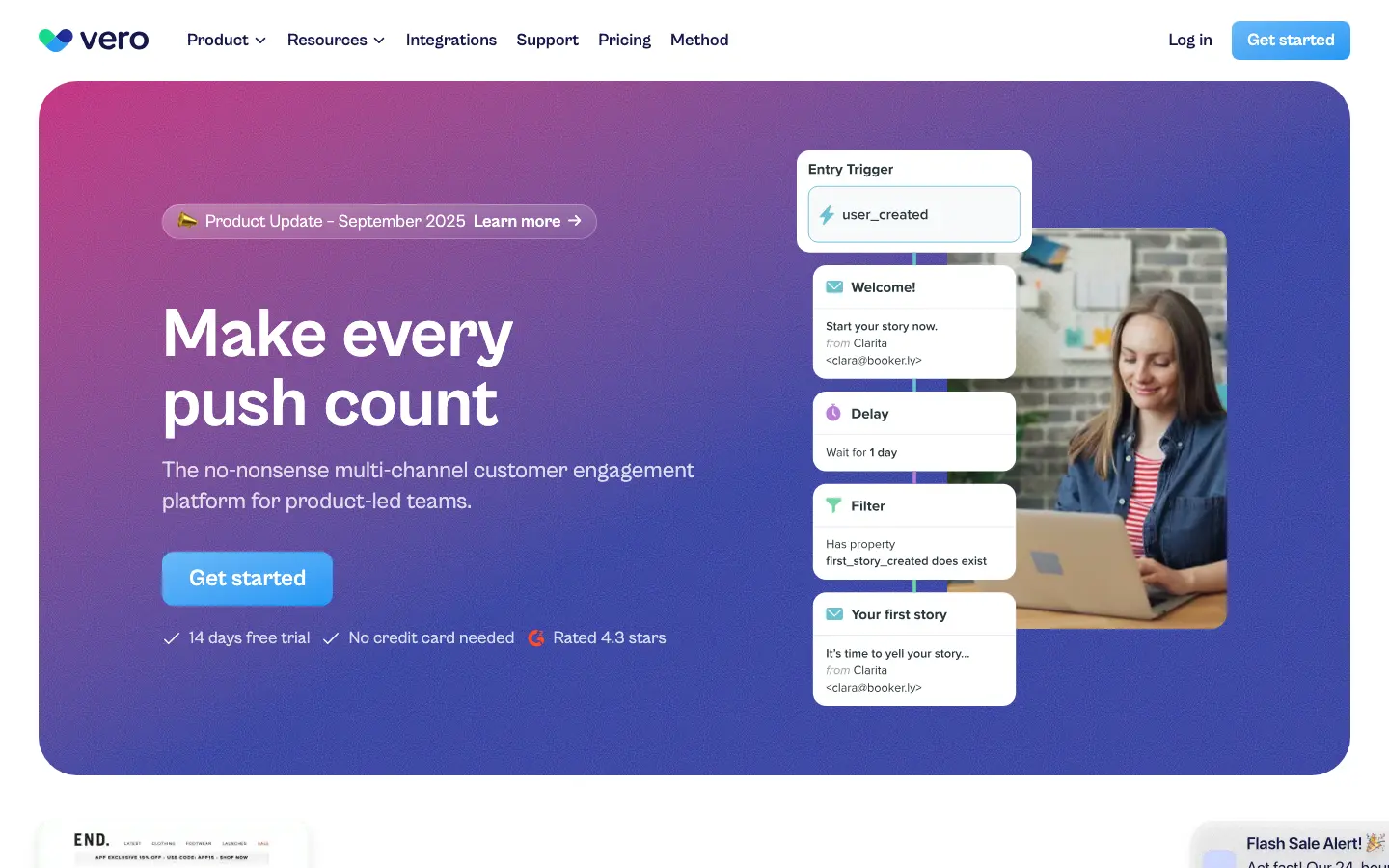
Vero is built specifically for this buyer. Active-profile pricing charges only for users active in the billing period — not your total database. For a business with 200,000 subscribers and 30,000 actives, you pay for 30,000.
Vero’s Connected Audiences provides direct SQL access to Snowflake, BigQuery, Redshift, PostgreSQL, MySQL, and SQL Server. You write the audience query in SQL; Vero uses it directly with no data duplication in Vero’s own storage. Customer.io needs reverse ETL; Braze’s Zero-copy Triggers are excellent but require an enterprise contract.
For teams that already own a CDP, Vero’s positioning is also cleaner. Customer.io and Braze both have built-in CDP layers that overlap with your existing tool. Vero pairs with the CDP you already have rather than competing with it.
Vero starts at $49/mo (annual) with a 14-day free trial, no credit card, no sales call.
| Vero | Customer.io | Braze | |
|---|---|---|---|
| Starting price | $49/mo | $100/mo | ~$60K/year |
| Pricing model | Active profiles only | All profiles | MAU (contracted upfront) |
| Warehouse-native | Yes (direct SQL) | Limited | Yes (Zero-copy Triggers) |
| CDP | No — pairs with yours | Built-in | Built-in |
| Free trial | Yes (14 days) | Yes (14 days) | No |
| Self-serve | Yes | Yes | No |
| Implementation | Days | Days to weeks | 12–18 weeks |
| Best for | B2C, PLG, warehouse-first teams | Growth SaaS, self-serve teams | Enterprise brands, 500K+ MAU |
"We needed something that scales with our send volumes, not our user counts."
— Lawrence Scotland, Sr. Director, Dribbble
Frequently asked questions
Is Braze better than Customer.io?
Braze has a deeper feature set, broader channels, and more sophisticated AI at enterprise scale. Customer.io is easier to implement, with transparent self-serve pricing and no data point billing complexity. For most teams under 500 employees, Customer.io is the more practical choice. For enterprise brands at millions of MAUs with dedicated marketing ops, Braze is the stronger platform.
How much does Braze cost compared to Customer.io?
Customer.io starts at $100/mo for the Essentials plan ($1,200/year). Braze contracts start around $30,000–$60,000/year for 50,000–250,000 MAUs based on procurement data. The entry price difference is 25–50x in Customer.io’s favor.
Can Customer.io handle enterprise scale?
Yes, within its market. Customer.io processes billions of messages and webhooks daily and serves Notion, Pipedrive, and Kraft Heinz. Its ceiling is below Braze’s for AI personalization depth and enterprise channels, but messaging volume is well within range.
Does Braze have a free trial?
No — Braze requires a sales conversation before any evaluation. Customer.io offers a 14-day free trial with no credit card required. Startups that have raised under $10M can apply for 12 months free.
Which platform is better for B2C businesses?
Neither is ideal for B2C businesses with large inactive subscriber lists. Braze charges on MAUs, which is better than per-profile, but still starts at $60K/year. Vero’s active-profile pricing is the structural fit for B2C businesses with large inactive databases.
Which is better for data warehouse integration in 2026?
Braze has the stronger enterprise warehouse story with Zero-copy Canvas Triggers for direct Snowflake and BigQuery segmentation. Customer.io requires reverse ETL partners for warehouse data activation. Vero’s Connected Audiences offers direct SQL to six major warehouses at a significantly lower price point.
What happens when you switch from Braze to Customer.io?
Teams typically report faster iteration cycles, lower costs, and reduced implementation overhead. The trade-offs are reduced AI personalization depth and fewer enterprise channels — no RCS or LINE. Customer.io is a common destination for teams that implemented Braze but underutilized the full feature set.
Conclusion
Braze and Customer.io are both strong platforms. The comparison is less about which is objectively better and more about which problem you actually have.
Braze is the right answer for enterprise brands with dedicated marketing ops, a $60K+/year budget, and genuine AI personalization needs. The implementation cost and pricing are proportionate to the capability. But the capability has to be a real requirement, not just aspirational.
Customer.io is the right answer for growth-stage SaaS teams that want behavioral lifecycle messaging with transparent pricing and fast setup. It crossed $100M ARR with 111% net dollar retention — a capital-efficient platform with strong unit economics. For most SaaS teams, it has everything required without the enterprise overhead.
Vero is the right answer if your B2C or PLG model means paying for large inactive user volumes under either platform’s pricing. Active-profile pricing, direct SQL warehouse integration, and no CDP duplication make it the structural fit when the pricing model matters as much as the feature set.
Evaluating Vero as an alternative to Braze or Customer.io? Start a free trial — no credit card required, no sales call needed. Teams switching from Braze typically save 30–50%.