- All Posts
- /
- How to Create an Effective Email Drip Marketing Campaign That Converts
How to Create an Effective Email Drip Marketing Campaign That Converts
Alternatives-
 Chris Hexton
-
Updated:Posted:
On this page
Most marketing teams send email campaigns. Fewer build drip sequences. Even fewer build ones that actually convert.
The gap isn’t about tools — it’s about intent. A one-off campaign broadcasts the same message to everyone on your list. A drip campaign responds to one subscriber, at one specific moment, based on what they’ve done.
Automated sequences generate 41% of email revenue while representing just 5.3% of total sends. Email marketing returns $36 for every dollar invested — drip campaigns are where that ROI concentrates. Build them deliberately and that structural advantage is yours.
This guide covers everything: goal-setting, sequence design, copywriting, segmentation, timing, A/B testing, and measurement. Use it to build campaigns that move subscribers from first touch to paying customer — and keep them there.
What is an email drip campaign?
A drip campaign is a series of automated emails triggered by a subscriber’s behavior or status. Each message moves the reader one step closer to a defined outcome — activation, purchase, renewal, or re-engagement. The trigger is what makes the message feel timely and relevant.
"Drip" describes the release cadence — each email building on the one before it. The first introduces the problem, the second adds proof, the third reframes the stakes. By the time the final email arrives, the subscriber has the context they need to act.
The difference from a newsletter is fundamental. A newsletter goes to your whole list on a schedule. A drip responds to something a specific person did — and that specificity is the source of the conversion advantage.
Drip campaigns work across every stage of the customer lifecycle. A prospect who just filled out a form gets a different sequence than a churned customer you’re trying to recover. The core logic is always the same: trigger, content, goal.
Step 1: Define your goal and your trigger
Before opening an email builder, name one goal. Not a general direction. One specific outcome — the action you want the subscriber to take by the time the sequence ends.
The most common drip types include welcome sequences, lead nurture campaigns, cart recoveries, win-back flows, and post-purchase series. Each requires a different trigger, a different tone, and a different definition of success. Mixing goals in one sequence is the fastest way to dilute your conversion rate.
Your trigger and goal must align. An onboarding sequence fires when someone creates an account. A win-back campaign fires when a user hasn’t logged in for 30 or 60 days.
A cart recovery fires when a session ends without a purchase. The tighter the trigger-goal connection, the more relevant every email becomes. Weak alignment is why most sequences feel random to subscribers.
Don’t skip this step. Teams that skip it build generic sequences that try to do too many things. They almost always convert at nothing.
Step 2: Map the sequence before you write
Resist the urge to open your email editor first. Sketch the full sequence in a document before writing a single word. Map how many emails you need, what each accomplishes, and what happens when a subscriber clicks — or doesn’t.
Welcome sequences typically run 3 to 5 emails over 7 to 10 days. Lead nurture campaigns commonly use 4 to 7 emails over two to three weeks. The right length depends on your goal and how much context a subscriber needs before they’re ready to act.
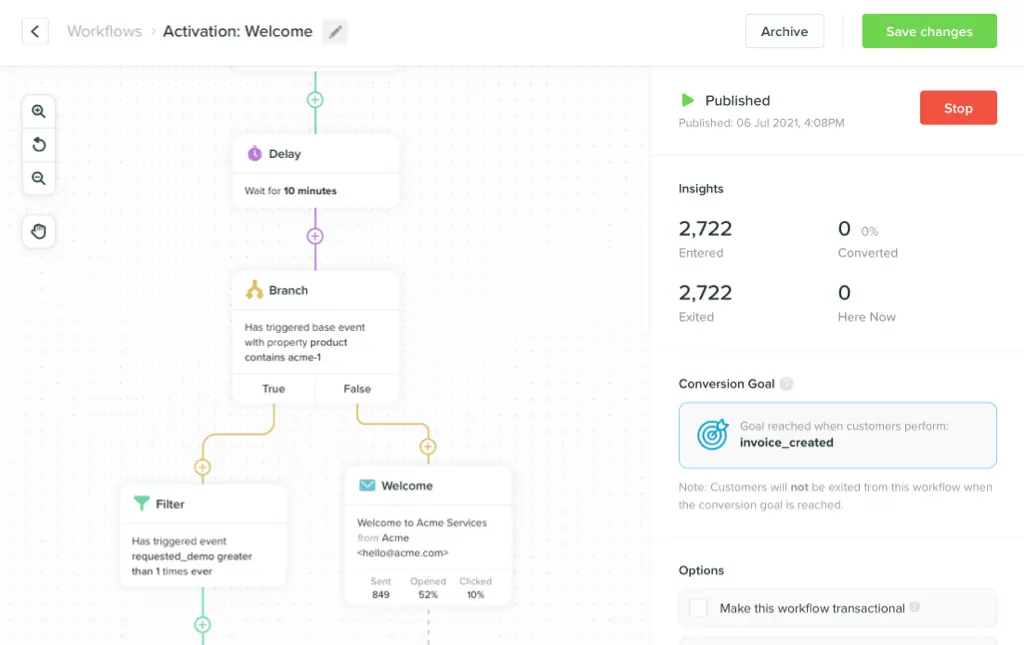
Build in branch logic early — these decisions determine whether your sequence adapts to behavior or ignores it. If someone clicks email two’s CTA, they may not need email three’s pitch — they already showed intent. If no one opens email one, does email two go out with the same subject line or a different one?
Draw it out first. A sequence flowchart on paper takes 20 minutes. Reworking your logic after building five emails takes hours.
Think about the content arc before writing any individual email. The sequence should tell a cohesive story, starting with the subscriber’s problem. Readers who experience the full arc convert at significantly higher rates than those who see each email in isolation.
Step 3: Nail your subject lines
The subject line is the only barrier between your email and the archive. A strong subject line earns the open. Nothing else matters if the email doesn’t get opened.
Personalized subject lines reach 46% open rates compared to 35% for generic ones. Adding a first name, a behavioral reference, or a product the subscriber interacted with closes that gap immediately. It takes seconds to add and returns a measurable lift every time.
Short subject lines consistently outperform long ones. Lines with 2 to 4 words generate the highest open rates in nearly every study. Questions outperform statements — "Did you forget something?" beats "Cart reminder" every time.
Preview text is the second line of defense. Most email clients show 40 to 90 characters of preview text alongside the subject line. Use it to extend the subject line’s hook, not repeat it.
Test every subject line before assuming it works. Run A/B tests on every email in the sequence, especially the first one. Email one sets the open rate trajectory for everything that follows — get it right.
Step 4: Write email copy that moves people forward
Each email in your sequence has one job. One message. One call to action. Adding a secondary CTA "just in case" splits attention and lowers the conversion rate on both options.
Start with the reader’s problem, not your solution. The subscriber is thinking about their situation, not your product. Make the first sentence about them — and earn the right to pitch by sentence three.
Keep paragraphs short — two sentences, three at most. Long paragraphs signal effort most readers won’t spend. Write like you’re messaging one person — conversational copy outperforms polished prose in drip contexts.
Most drip emails perform best at 150 to 300 words. Longer emails give subscribers more to skim — and most will stop reading before the CTA. If your message needs more context, link to a landing page rather than extending the email itself.
Match tone to sequence type. An onboarding email should feel warm and encouraging. A win-back email can be more direct — the subscriber is slipping away, and the tone should reflect that urgency.
Step 5: Segment your audience and trigger on behavior
Segmented, triggered campaigns drive 77% of email ROI. That number isn’t an argument for segmentation — it’s a mandate. Sending the same message to your entire list is the most reliable way to lower conversions and increase unsubscribes.
Start with the broadest useful segments: new users, trial users, paying customers, and churned users. These groups have fundamentally different needs, different objections, and different definitions of value. A welcome sequence that works for a new signup will feel tone-deaf to a customer who upgraded last month.
Layer behavioral signals on top. Users who completed onboarding need a different message than those who signed up and never returned. Customers who’ve purchased twice respond differently to upsell messaging than first-time buyers — segment at that level.
Use behavioral triggers wherever possible instead of time-based delays. "Send this email 3 days after signup" is easy to configure — but "send this email when the user hasn’t completed step 2 of onboarding" is precise. Precise triggers make sequences respond to what subscribers actually do, which is what drives conversions.
Step 6: Time your sends correctly
Spacing matters as much as content. Emails too close together drive unsubscribes; emails too far apart let momentum die and context fade. The right cadence depends on your sequence type.
Send the first email immediately — within minutes of the trigger event. Delays kill intent. A subscriber who signs up and waits 24 hours for a welcome email has already moved on mentally.
For welcome and onboarding sequences, 2 to 3 days between emails is the right default. For longer lead nurture campaigns, 4 to 7 day gaps reduce fatigue without losing the thread. Monitor unsubscribes at the email level — a spike after a specific send signals wrong timing or wrong content.
Most platforms let you optimize send time based on when each subscriber is most likely to open. This alone can lift open rates 5 to 10 points without changing a word of copy. Test it on your highest-volume sequences first.
Vero fires emails the moment a behavioral trigger fires, not at a fixed scheduled time. When a user completes an onboarding step, the next email can go out immediately. That precision makes email feel like a helpful product feature rather than a marketing interruption.
Step 7: A/B test one variable at a time
A/B testing is how good sequences become great ones. The trap is running too many experiments at once. Change the subject line, send time, and CTA simultaneously, and you can’t tell which variable moved the result.
One element per test. Subject line, opening sentence, CTA copy, email length, or send time — test each separately. Run each experiment until you have a meaningful sample size. Fewer than 1,000 recipients per variant rarely produces data you can trust.
Start with subject lines — they determine whether the email gets opened at all. Then move to CTAs, then to the opening line. Testing in that order means you’re improving each layer of the funnel before moving to the next.
Don’t just declare a winner and move on — document what worked and by how much. A testing log prevents re-running the same experiments and accelerates every future sequence you build. Treat your drip campaign as a living program, not a finished artifact.
Step 8: Measure what drives revenue
Three metrics matter most: open rate, click-through rate, and conversion rate. Open rate reflects your subject line; CTR reflects your copy and CTA. Conversion rate tells you whether the email moved someone to the goal.
Track all three — but weight conversion rate most heavily. A 40% open rate with a 0.1% conversion rate is a vanity metric. An 18% open rate with a 4% conversion rate is a revenue driver.
Revenue per email is the benchmark mature programs use. Divide email-attributed revenue by total sequence sends, then watch it climb as you test. That number is your clearest signal the campaign is working.
Also track unsubscribes at the email level, not just the campaign level. A spike after a specific send is diagnostic — it tells you either the content missed or the timing was off. Both are fixable once you can see them.
Set benchmarks before you launch, not after. Average open rates vary by industry — B2B SaaS typically runs 25–35%, while consumer brands trend lower. Know what "good" looks like in your category before judging whether a campaign needs tuning.
Common drip campaign mistakes to avoid
Starting without a behavioral trigger is the most common mistake. Time-based sequences — "send this email 5 days after signup" — are easier to build but harder to make feel relevant. Behavioral triggers take more setup but produce meaningfully better results because each email arrives in response to something real.
Writing for the list instead of the segment is the second mistake. Generic copy tries to resonate with everyone and ends up resonating with no one. The fix is segmentation at the trigger level — build one sequence for each meaningful segment, not one for all.
Ignoring deliverability is the third mistake. Even a perfectly written drip converts at zero if it lands in spam. Keep your list clean, suppress unengaged subscribers, and monitor sender reputation as seriously as open rates — it’s the foundation everything else rests on.
Frequently asked questions
How many emails should a drip campaign include?
It depends on the goal. Welcome sequences use 3 to 5 emails over 7 to 10 days; lead nurture campaigns run 4 to 7 emails over 2 to 3 weeks. Win-back flows typically use 3 emails before marking a contact as inactive — start conservative and extend only if engagement holds through the full sequence.
What’s the difference between a drip campaign and a newsletter?
A newsletter goes to your full list on a fixed schedule, regardless of what subscribers have done. A drip is triggered by a specific behavior and personalized to the individual’s position in the journey. Newsletters build brand awareness; drip campaigns drive specific, measurable actions — and the ROI difference between the two is significant.
How often should I send emails in a drip?
Send the first email immediately — within minutes of the trigger event. For welcome and onboarding sequences, space follow-ups 2 to 3 days apart; for longer nurture campaigns, 4 to 7 days. Let engagement rates guide your cadence — falling open rates across a sequence signal you’re sending too fast.
What’s the best trigger to build sequences around?
Behavioral triggers consistently outperform time-based ones. The most effective are specific product events: signup, completing an onboarding step, first purchase, extended inactivity, or abandoned checkout. The more closely the trigger maps to something meaningful the subscriber did, the more relevant the email feels.
How do I know if my drip campaign is converting?
Track open rate, CTR, and conversion rate for each individual email in the sequence. Revenue per email is the clearest benchmark once a program matures past initial optimization. Look for consistent improvement across testing cycles — a well-maintained drip should get measurably better with every iteration.
Should every email in a drip have a hard CTA?
No. Early emails should build context and trust before pushing an action. Use soft CTAs — "see how it works," "read the guide" — in the first two or three emails. Reserve hard CTAs — "start your free trial," "complete your purchase" — for later in the sequence, once the subscriber has enough context to act.
Conclusion: Build it deliberately, improve it continuously
A drip campaign is not a one-time project. It’s a machine you build deliberately, test continuously, and improve incrementally. The teams with the highest-converting sequences think more carefully about triggers and sequence logic than they do about prose.
The fundamentals stay constant. Define the trigger, map the sequence, segment by behavior, write with one CTA, test relentlessly, and measure against revenue. Every step in that chain builds on the last — skip one and the campaign underperforms.
The difference between a 1% and a 6% conversion rate is rarely the writing — it’s the iteration. Teams with the best sequences got there by running more tests and measuring more carefully. The compounding effect of those small wins adds up faster than most teams expect.
Ready to build drip campaigns powered by real behavioral and product data? Start a free Vero trial today — no credit card required.