- All Posts
- /
- The Ultimate Guide to SMS Marketing in 2026
-
 Chris Hexton
-
Updated:Posted:
On this page
SMS marketing has one number that makes every other channel jealous: a 98% open rate. Email averages around 28%. Push notifications hover near 5%. No other channel gets read by nearly everyone who receives it.
But high open rates don’t automatically mean high returns. SMS is a high-trust, high-cost-per-mistake channel. Sending the wrong message at the wrong time to an uninterested subscriber damages your brand and your sender reputation in ways that are hard to undo.
This guide covers everything you need to run SMS marketing effectively in 2026 — from compliance to list building, best practices to platform selection.
Why SMS marketing works in 2026
The numbers are consistent across sources. 90% of SMS messages are read within three minutes of delivery. Response rates average 45%, compared to 6% for email. Click-through rates for SMS campaigns run between 18% and 35%.
The reason is structural, not novelty. SMS lands in a personal space — the same inbox as messages from family and friends. Every subscriber opted in by name. That context creates a default level of attention that no other marketing channel can replicate.
ROI benchmarks reflect this. Businesses report an average return of $21–$71 for every $1 spent on SMS marketing. Automated flows — triggered by real product events like cart abandonment or trial expiry — convert at a 3.81% click-to-conversion rate, nearly four times the 0.97% rate for broadcast sends.
Types of SMS marketing
Promotional SMS
Promotional SMS messages drive sales, announce discounts, and create urgency. Flash sale alerts, limited-time offers, loyalty rewards, and seasonal campaigns all fall here. These are the messages most subscribers think of when they sign up.
Frequency matters more here than anywhere else. 1–4 promotional messages per month is the widely cited sweet spot. Sending more than that increases unsubscribes without proportional revenue lift.
Transactional SMS
Transactional messages are triggered by user actions or system events. Order confirmations, shipping updates, appointment reminders, password resets, and two-factor authentication codes are all transactional. These messages don’t require the same frequency discipline — subscribers expect and want them.
Transactional SMS has the highest engagement of any SMS type. Response rates are elevated because the message is directly relevant to something the subscriber just did. For product-led software companies, transactional SMS is often the highest-value use case.
Conversational SMS
Conversational or two-way SMS enables real dialogue between a brand and a subscriber. Customer support, post-purchase surveys, feedback collection, and qualification flows all use this format. It requires infrastructure that handles inbound replies, not just outbound sends.
Two-way SMS is still underused by most marketing teams. The brands that do it well — asking a single question and routing responses into a workflow — report significantly higher engagement than one-way campaigns.
SMS compliance in 2026
SMS compliance is not optional. Penalties under TCPA (Telephone Consumer Protection Act) run from $500 to $1,500 per violation — per message. A single non-compliant campaign sent to 10,000 people is a serious legal exposure.
TCPA (United States)
TCPA requires prior express written consent before sending any marketing SMS. Consent must be given specifically for your brand — one-to-one consent is now mandated by the FCC as of late 2023. Bundled opt-ins shared across multiple brands or affiliates no longer count.
Permitted sending hours are 8 AM to 9 PM in the recipient’s local time zone. No exceptions. Opt-outs must be honored immediately — the April 2025 FCC update tightened this to real-time processing, with a maximum of ten days.
Store consent records for a minimum of five years. The TCPA statute of limitations for claims is four years, so your records need to outlast any potential claim window. Fifteen states — including California, Florida, and New York — layer additional requirements on top of federal law.
10DLC registration
All business SMS in the United States must be registered through The Campaign Registry under the 10DLC (10-Digit Long Code) framework. Unregistered campaigns face carrier filtering that can reduce delivery rates to 60–70%. Plan 4–8 weeks for registration before your first send.
10DLC registration links your business identity, your sending number, and your campaign use case. Carriers use this to filter spam and protect consumers. Registration is a one-time process per campaign type, not per message.
GDPR (European Union)
GDPR applies to any SMS sent to recipients in the EU, regardless of where your business is based. The legal basis is typically explicit consent — clear, specific, and freely given. Pre-checked boxes and bundled consents don’t meet the standard.
Subscribers must be able to withdraw consent at any time. Every message must include an opt-out mechanism. Data retention limits apply — you can’t hold subscriber data indefinitely once they’ve opted out.
Building your SMS list
An SMS list built on quality consent outperforms a larger list built on weak opt-ins. 84% of consumers opted in to receive texts from at least one business in 2025. The opportunity is there — the question is how you capture it.
Keyword opt-in
Keyword opt-in is the most common list-building method. A subscriber texts a word ("JOIN", "VIP", "DEMO") to your number and receives an automated confirmation. It requires no form, no page load, and works anywhere you can print or display a phone number.
Keyword opt-ins work best for in-person contexts — events, retail, packaging, outdoor advertising. They’re frictionless and instantly verifiable. The confirmation message is also your first brand impression via SMS — make it clear, useful, and on-brand.
Web form opt-in
A web form with an SMS consent field converts at higher rates when placed at high-intent moments — checkout, post-signup, or a dedicated landing page. Disclosure language must appear above the submit button. Double opt-in — a confirmation message the subscriber must reply to — is best practice and significantly reduces spam and bot signups.
Checkout consent
Checkout is the highest-intent moment in e-commerce. Adding an SMS consent checkbox at checkout — with clear disclosure — consistently delivers higher-quality subscribers than any other growth tactic. These subscribers have just spent money with you; they’re the most likely to engage with transactional and promotional follow-ups.
Incentivized opt-in
Offering an incentive — a discount, early access, or exclusive content — in exchange for SMS consent reliably lifts list growth rates. The incentive sets a clear expectation: you’ll send things worth having. Subscribers who opt in for value tend to retain better than those captured through generic sign-up prompts.
SMS marketing best practices
Keep messages short
One SMS message = 160 characters or fewer. Going over 160 characters splits your message into two segments — doubling the per-message cost and sometimes breaking delivery across carriers. Say what needs to be said. Cut the rest.
Always identify your brand
Every message must include your brand name. Recipients don’t store business numbers in their contacts. A message that opens with a discount but no sender name will be read as spam by most people. Open with the brand name every time.
Include a clear opt-out
Include opt-out instructions in every promotional message — "Reply STOP to unsubscribe" is the standard. It’s legally required in most markets. It also reduces spam complaints, which directly affects your sender reputation and deliverability.
Send at the right time
Timing affects open rates more than most marketers expect. Mid-morning (10–11 AM) and early evening (5–7 PM) in the recipient’s local time zone consistently outperform other windows. Never send before 8 AM or after 9 PM — it’s both a compliance requirement and a fast way to earn opt-outs.
Personalize beyond the first name
First-name personalization is table stakes. The highest-converting SMS messages reference something the subscriber did — viewed a product, abandoned a cart, started a trial, missed a renewal. Behavioral personalization requires connecting SMS to your product data. The effort compounds: each relevant trigger message performs significantly better than a generic broadcast.
Test send times and message copy
SMS audiences are small enough that statistical significance takes time to reach. Run A/B tests over multiple campaigns before drawing conclusions. Test one variable at a time — send time, CTA wording, message length, or incentive size. Small improvements in CTR compound significantly at scale.
Set clear frequency expectations at opt-in
Tell subscribers how often they’ll hear from you before they opt in. "Get 2–4 messages per month with exclusive offers" sets an expectation that reduces surprise opt-outs later. Subscribers who know the frequency are more tolerant of occasional promotional sends.
SMS and multi-channel: where the real leverage is
SMS in isolation is useful. SMS coordinated with email, push, and in-app messaging is where the leverage multiplies. A single user action — cart abandonment, trial expiry, a failed payment — should trigger a coordinated response across the right channels, not a siloed SMS blast.
The typical pattern: an email goes out first. If the user doesn’t open within a set window, an SMS follows. If they click the SMS but don’t convert, an in-app message greets them on next login. Each channel handles what it does best — email for context and detail, SMS for urgency and reach, in-app for conversion in the product.
This kind of orchestration requires a platform that coordinates all channels from a single workflow, rather than separate tools managed in parallel. It also requires a data model that can trigger messages from real product events — not just manually scheduled campaigns or CRM fields.
Vero: SMS built into behavioral lifecycle workflows
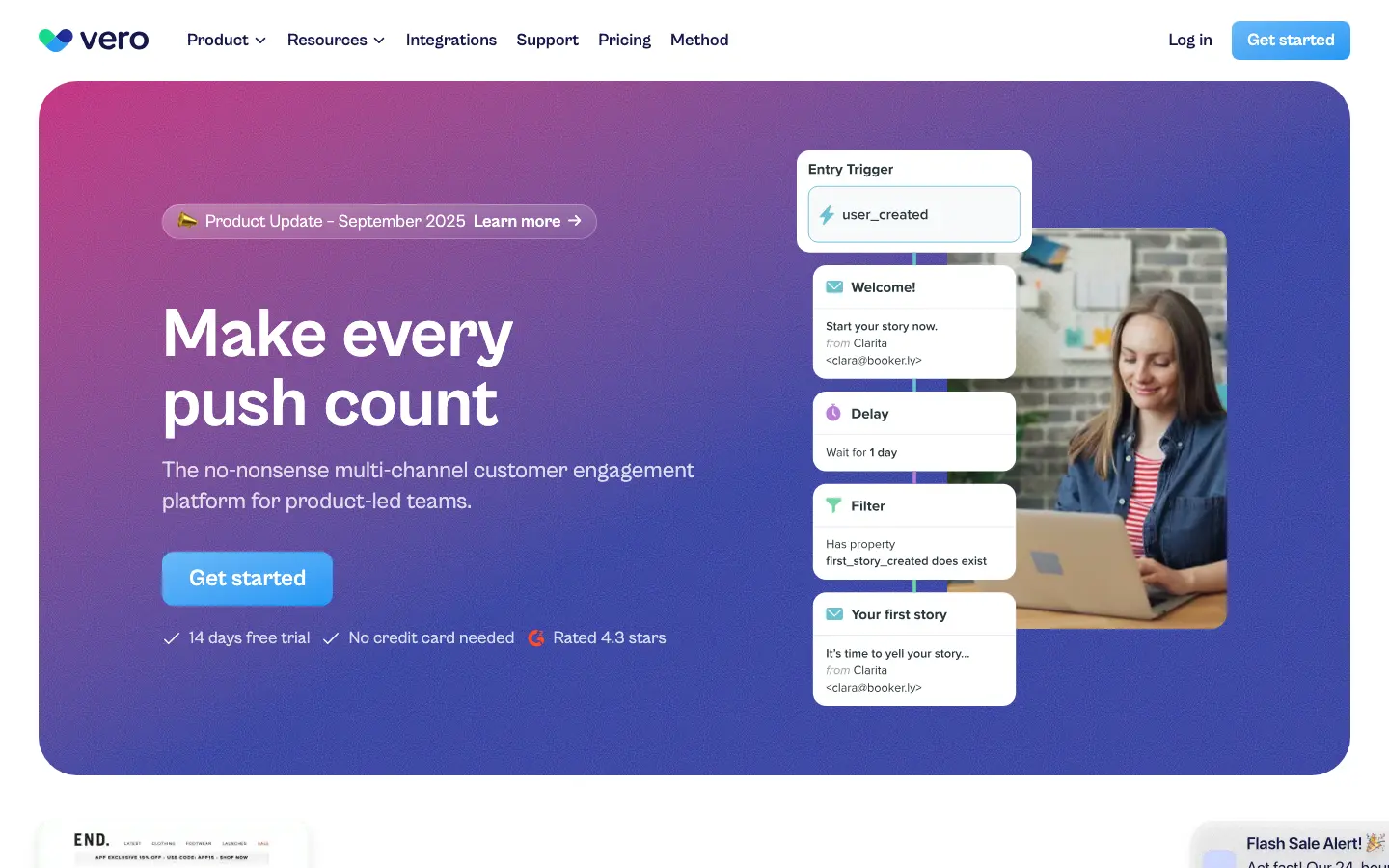
Vero supports SMS alongside Email, iOS/Android push, In-app messaging, and Webhooks from a single visual journey builder. You build one workflow; Vero routes each user through the right channels based on their behavior. There’s no separate SMS tool to manage alongside your email platform.
The data model is built for product-led and B2C teams. Connected Audiences connects directly to Snowflake, BigQuery, Redshift, and other warehouses via SQL — you trigger SMS from warehouse data without a separate ETL step. Active-profile pricing charges only for users active in the billing period, not your full subscriber database.
For teams where SMS spend scales with inactive users on other platforms, this matters. A B2C company with 200,000 total subscribers and 30,000 actives pays for 30,000 on Vero — not 200,000. Vero starts at $49/mo (annual) with a 14-day free trial and no sales call required.
"We needed something that scales with our send volumes, not our user counts."
— Lawrence Scotland, Sr. Director, Dribbble
SMS marketing use cases by business type
E-commerce
Cart abandonment is the highest-ROI SMS use case in e-commerce. The sequence is simple: send an SMS 1–3 hours after abandonment, include the product name and a direct link, and offer a time-sensitive incentive if the first message doesn’t convert. Automated flows like this consistently outperform broadcast campaigns by a factor of 3–4x.
Other strong e-commerce use cases: back-in-stock alerts for wishlisted products, loyalty milestone notifications, flash sale announcements, and post-purchase review requests.
SaaS and product-led growth
For SaaS companies, SMS works best as a high-urgency nudge for moments that matter. Trial expiry reminders, failed payment alerts, and re-engagement triggers for users who’ve gone dark all perform well. These are low-volume, high-stakes sends — not broad campaigns.
The key is behavioral triggering. An SMS sent 24 hours before a trial expires, personalized with the user’s name and the specific feature they used most, converts at multiples of a generic "your trial ends tomorrow" broadcast.
B2B
B2B SMS is narrower and more valuable per message. Demo confirmations, onboarding check-ins for key accounts, and contract renewal reminders are the primary use cases. The list sizes are smaller, but the ACV per subscriber is often orders of magnitude higher than e-commerce or B2C SaaS.
B2B SMS requires more careful frequency management. Sending more than 2–4 messages per month to a business buyer is a fast path to opt-out. Every message needs a clear reason to exist.
Frequently asked questions
What is SMS marketing?
SMS marketing is the practice of sending promotional or transactional text messages to subscribers who have opted in. It’s used for sales announcements, abandoned cart recovery, product updates, and time-sensitive alerts. It consistently produces the highest open and response rates of any digital marketing channel.
Is SMS marketing still effective in 2026?
Yes. SMS open rates remain at 98% and response rates average 45%. 66% of businesses increased their SMS marketing budgets in 2025. The channel continues to outperform email and push on reach and immediate engagement.
How do I stay compliant with SMS marketing laws?
In the US, obtain prior express written consent before sending, register your campaigns via 10DLC, and send only between 8 AM and 9 PM local time. Honor opt-outs immediately and store consent records for at least five years. In the EU, GDPR requires explicit, specific consent and a clear opt-out mechanism in every message.
How often should I send SMS messages?
For promotional messages, 1–4 per month is the standard recommendation. Transactional messages — order updates, reminders, alerts — can be sent whenever triggered by a real event. Exceeding promotional frequency without strong value in each message is the fastest way to spike opt-out rates.
What is 10DLC and do I need it?
10DLC (10-Digit Long Code) is the US carrier framework for business SMS. All business text messaging campaigns must be registered through The Campaign Registry. Unregistered campaigns face significant filtering that can cut delivery rates to 60–70%. Plan 4–8 weeks for registration before your first campaign.
What’s the ideal length for an SMS message?
160 characters or fewer. Messages over 160 characters are split into multiple segments — increasing cost and sometimes creating delivery issues across carriers. Include your brand name, a single clear CTA, and an opt-out instruction. Cut everything else.
How do I build an SMS subscriber list?
Start with consent at checkout for e-commerce, or keyword opt-in for in-person and offline channels. Incentivize sign-ups with a discount or exclusive access. Use double opt-in to confirm consent and reduce bots. Set clear frequency expectations at the point of opt-in — subscribers who know what they’re signing up for retain better.
How is SMS different from email for marketing?
SMS has a 98% open rate vs email’s ~28%. SMS response rates average 45% vs email’s 6%. SMS is better for urgency, time-sensitive alerts, and reaching users who don’t open email regularly. Email is better for long-form content, detailed product announcements, and nurture sequences that need rich formatting. The two channels work best in combination.
Conclusion
SMS marketing in 2026 is not a shortcut — it’s a high-trust channel that rewards teams who use it carefully. The open rates are real. So are the compliance risks, the opt-out costs, and the damage that irrelevant messages do to subscriber lists built over years.
The teams that win with SMS treat it as part of a coordinated strategy. Every send has a behavioral trigger, a clear reason to exist, and a connection to what the subscriber actually did. That requires good data, good tooling, and a platform that coordinates SMS alongside the rest of your marketing channels.
Ready to add SMS to your existing multi-channel workflow? Start a free trial with Vero — no credit card required, no sales call needed.