- All Posts
- /
- Top Courier Alternatives for Notification Infrastructure
Top Courier Alternatives for Notification Infrastructure
Alternatives-
 Chris Hexton
-
Updated:Posted:
On this page
Courier built its reputation as a developer-first notification platform. It handles email, SMS, push, Slack, Teams, and in-app notifications through a single API. Per-send pricing and a visual Design Studio made it a natural first choice for product teams.
But it’s not the right tool for every team. Some need warehouse-native behavioral messaging on top of notification routing. Others want open-source infrastructure, a lower entry cost, or a specialized in-app notification center.
This post covers the top Courier alternatives for notification infrastructure in 2026. Each option suits a different stage, technical requirement, and channel mix.
What are the best Courier alternatives for notification infrastructure?
The best Courier alternatives include Vero, Novu, Resend, SuprSend, and MagicBell. Each platform approaches notification delivery differently. The right choice depends on your team’s scale, stack, and control requirements.
| Platform | Starting Price | Best For | Key Channels | Free Tier |
|---|---|---|---|---|
| Vero | $54/mo | Product-led and B2C software teams | Email, Push, In-App, SMS | 14-day trial |
| Novu | $30/mo (self-host free) | Open-source notification infrastructure | Email, SMS, Push, Chat, In-App | ✅ Yes |
| Resend | $20/mo | Transactional email for developers | ✅ Yes (3K/mo) | |
| SuprSend | $250/mo | Multi-channel workflow notification infra | Email, SMS, Push, Slack, WhatsApp, In-App | ❌ No |
| MagicBell | $99/mo | In-app notification centers | In-App, Email, Push, Slack | ✅ Yes (100 users) |
1. Vero: Best for Product-Led and B2C Software Teams
Disclosure: Vero is our own product. We’ve included it because we genuinely believe it belongs on this list — but you should know we’re not a neutral party.
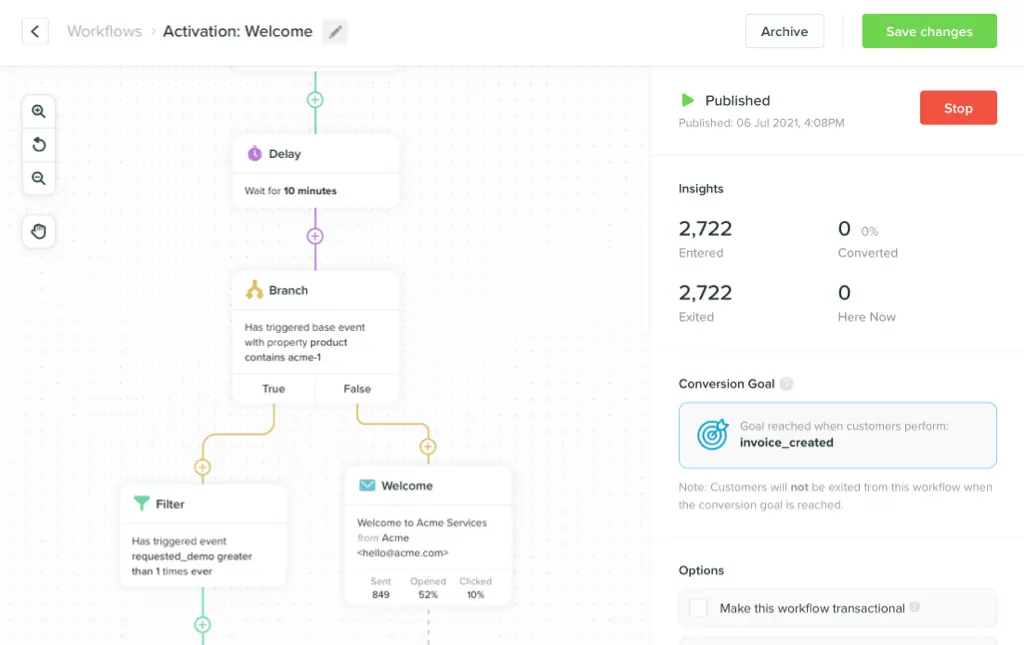
Vero is a multi-channel customer engagement platform built for product-first software teams. It covers the full behavioral messaging stack — event-triggered campaigns, visual journey automation, and direct data warehouse integration.
That’s the key difference from Courier. Courier routes messages to delivery providers. Vero adds segmentation, journey orchestration, behavioral logic, and active-profile pricing on top of multi-channel delivery.
If your team needs more than a routing layer, Vero is worth evaluating alongside pure infrastructure tools.
Key features
- Event-triggered messaging based on real user product behavior
- Visual journey builder with drag-and-drop branching, A/B splits, and delays
- Connected Audiences: direct SQL connections to Snowflake, BigQuery, Redshift, PostgreSQL, MySQL, and SQL Server
- Behavioral segmentation using event history, profile attributes, and warehouse data
- Multi-channel delivery: email, iOS/Android push, in-app messaging, SMS, and webhooks
- Full API and integrations with Segment, RudderStack, Hightouch, and Census
- A/B testing across subject lines, content, timing, and channel combinations
Pricing
- Starter: $54/month ($49/month billed annually) — 5,000 profiles, 10,000 emails/month, 20,000 push/month, 160,000 events/month, unlimited team members
- Professional: Custom — scales all dimensions; includes SMS; fair use overage policy with notifications
14-day free trial, no credit card required.
Pros & cons
Pros:
- Active-profile pricing charges only for engaged users — a structural cost advantage for B2C and PLG businesses with large inactive lists
- Native warehouse integration via Connected Audiences means no duplicate data storage required
- 5B+ messages delivered annually at 99.99% uptime — proven infrastructure at scale
- Built for engineering and marketing teams to operate the same platform independently
Cons:
- Not a pure notification routing layer — broader scope than some teams need
- SMS and WhatsApp channels are still expanding; email and push are the most mature
- Smaller review base than some category leaders on G2
Customers
Vero is trusted by Dribbble, Unsplash, Pipedrive, and Stockpile, among 50+ companies globally. It holds a 4.3-star rating on G2. One customer noted: "Vero has one of the best support teams I’ve encountered."
2. Novu: Best Open-Source Notification Infrastructure
Novu is the leading open-source notification infrastructure platform. It provides a unified API for email, SMS, push, chat, and in-app notifications. The platform includes a visual workflow editor and embeddable UI components.
With 38,000+ GitHub stars, Novu has built a developer community that few proprietary platforms can match. Teams that need full stack ownership — including self-hosting on their own infrastructure — consistently choose it.
The open-core model means zero licensing cost when self-hosting. You only pay for managed cloud hosting if you prefer not to operate the infrastructure yourself.
Key features
- Unified API for all notification channels: email, SMS, push, in-app, and chat
- Visual drag-and-drop workflow editor for building notification flows without code
- Embeddable in-app notification center with real-time delivery
- Subscriber preference management built into the platform
- Delivery observability with real-time logs and analytics
- Multi-language and multi-region support
- Self-hosted (MIT license) or managed cloud options
Pricing
- Free: Self-hosted at no licensing cost; infrastructure runs approximately $5–15/month on Railway
- Managed Cloud: From $30/month for 30,000 notification runs
- Enterprise: Custom pricing for high-volume or compliance-sensitive deployments
Pros & cons
Pros:
- Open-source under MIT license — full code transparency, no vendor lock-in
- 38K+ GitHub stars signals strong developer trust and active community maintenance
- Unified API simplifies integration across all major notification channels
- Embeddable notification center UI components save weeks of custom development time
Cons:
- Self-hosting requires infrastructure management and DevOps overhead
- Message retention has been flagged as limited in some user reviews
- Managed cloud pricing scales quickly at higher notification volumes
- Less mature marketing automation layer compared to full customer engagement platforms
Customers
Novu is used by engineering and product teams at startups and scaling companies globally. Its open-source community includes over 3,000 contributors. Developer reviews highlight fast integration, responsive support, and reliable handling of 100,000–200,000 notification events per month at sustained volume.
3. Resend: Best for Transactional Email Infrastructure
Resend is a developer-first transactional email API. It’s built around React Email — an open-source component system that lets engineers write email templates as React components.
It doesn’t compete with full notification platforms. Resend handles transactional email at the infrastructure layer. Clean SDKs, fast delivery, and a strong developer experience earn it the category’s highest G2 scores.
If your primary need is reliable transactional email — password resets, receipts, alerts — Resend is the cleanest option.
Key features
- React Email: open-source component-based email template system
- REST API with SDKs for Node.js, Python, Ruby, PHP, Go, Rust, and Elixir
- Domains, audiences, broadcasts, and batch sending
- Webhook support for real-time delivery events
- Multi-region sending with dedicated IPs on Scale and Enterprise plans
- Real-time logs and email previews in the dashboard
- Team workspaces and API key management
Pricing
- Free: 3,000 emails/month, 1 domain, 1 API key
- Pro: $20/month for 50,000 emails; $35/month for 100,000 emails
- Scale: $90–$1,150/month for 100,000–2.5M emails; includes dedicated IPs and Slack support
- Enterprise: Custom pricing with SLA and dedicated IPs
Marketing email (broadcasts and audience campaigns) runs on a separate billing track from $40/month.
Pros & cons
Pros:
- Best-in-class developer experience — React Email plus a clean, well-documented REST API
- 4.8 stars on G2 — one of the highest ratings in the notification infrastructure category
- Very low entry cost with a functional free tier for evaluation and low-volume usage
- Trusted by engineering teams at Vercel, Linear, Raycast, Cal.com, and Loom
Cons:
- Email-only — no push notifications, SMS, in-app messaging, or behavioral automation
- Not a marketing platform — no journey builder, segmentation, or lifecycle campaigns
- Marketing email is priced separately, adding cost for teams that need both
- Basic analytics limited to delivery metrics; no engagement analytics
Customers
Resend is used by some of the most developer-credible startups in the ecosystem. Notable customers include Vercel, Linear, Raycast, and Cal.com. Resend co-created React Email with Vercel. That open-source project is now a standard for how engineering teams build and maintain email templates.
4. SuprSend: Best for Multi-Channel Workflow Notification Infrastructure
SuprSend is a notification infrastructure platform built for engineering and product teams that need to manage multi-channel notifications at scale. Every major channel is supported from a single API: SMS, Slack, WhatsApp, Email, Push, and In-App Inbox.
The platform goes beyond routing. It adds workflow orchestration, notification batching, user preference management, and template version control. These are features teams usually build themselves when using a basic routing layer.
SuprSend sits between a lightweight routing tool and a full marketing automation platform. It’s infrastructure-grade — but accessible to product managers, not just engineers.
Key features
- Unified API across SMS, Slack, WhatsApp, Email, Push, and In-App Inbox
- Dynamic template management with version control
- Notification batching and digest support to reduce alert fatigue
- User preference management built into the platform
- Channel and vendor fallback mechanisms for improved delivery reliability
- Brand management for multi-brand or multi-tenant deployments
- Real-time visibility with webhooks and full audit logs
- Workflow orchestration with event-triggered sends and branching logic
Pricing
- Business: $250/month for 50,000 notifications/month — includes batching, digest, and user preferences
- Enterprise: Custom pricing based on volume, infrastructure requirements, and compliance needs
Pros & cons
Pros:
- All major notification channels — including WhatsApp and Slack — from a single API
- Batching and digest features reduce notification fatigue without custom development
- Vendor fallback mechanisms improve reliability across channels automatically
- Infrastructure-grade observability with real-time webhooks and audit logs
Cons:
- No free tier — minimum entry cost is $250/month
- Higher starting price than most alternatives on this list
- Less suited for teams that need full marketing automation or lifecycle campaigns
- Smaller brand recognition than established customer engagement platforms
Customers
SuprSend serves B2B, B2B2C, and B2C teams at startups and enterprises. It’s popular with product teams building notification-heavy SaaS products and marketplaces. The platform holds a strong rating on Gartner Peer Insights from product and engineering reviewers.
5. MagicBell: Best for In-App Notification Centers
MagicBell specializes in one primary use case: real-time in-app notification centers. Teams use it to build notification feeds, activity streams, and alert centers. No custom infrastructure required.
It supports multi-channel delivery — in-app, email, push, and Slack — but the in-app notification center is its core strength. Cross-device synchronization ensures users don’t receive the same notification twice across web and mobile.
MagicBell is the fastest path to a polished notification inbox. Teams ship to production without months of custom engineering work.
Key features
- Embeddable in-app notification center with real-time delivery
- Multi-channel delivery: in-app, email, push, and Slack
- Cross-device notification synchronization — no duplicate alerts
- Rich notifications with images, buttons, and links
- User-level delivery preference management
- A/B testing and audience segmentation
- Analytics to track notification open rates and engagement
Pricing
- Free: Up to 100 monthly active users
- Growth: $99/month for up to 2,000 monthly active users
- Scale: $599/month for up to 15,000 monthly active users
- Enterprise: Custom pricing for larger volumes
Pros & cons
Pros:
- Fastest path to a polished in-app notification center — deployable within a day
- Cross-device synchronization prevents duplicate notifications across platforms
- Rich notification support (images, buttons, links) goes beyond plain-text alerts
- Free tier up to 100 users makes it accessible for early-stage evaluation
Cons:
- Per-MAU pricing can increase significantly as your user base grows
- In-app focus means limited support for complex multi-channel orchestration
- Less suited for behavioral email campaigns or lifecycle messaging use cases
- Smaller platform footprint than full notification infrastructure tools
Customers
MagicBell is used by product teams building SaaS applications, developer tools, and B2B platforms that need embedded notification center functionality. The platform handles high read/unread state management and preference controls for apps with active, engaged user bases.
Frequently asked questions
What should I look for in a Courier alternative?
The right alternative depends on what Courier doesn’t give you. If you need a behavioral marketing layer on top of notification routing, choose a full customer engagement platform like Vero. If you want open-source infrastructure with self-hosting control, Novu is the natural fit.
For teams that only need transactional email, Resend offers the cleanest developer experience in the category.
Is Courier a full marketing automation platform?
No. Courier is a notification routing and orchestration tool. It handles multi-channel delivery, AI agent integrations, and user preference management. But it does not include behavioral lifecycle campaigns, advanced segmentation, or warehouse-native data connections. Teams that outgrow pure routing typically move to a full customer engagement platform.
What’s the difference between notification infrastructure and a customer engagement platform?
Notification infrastructure focuses on delivery reliability, channel routing, and developer tooling. Customer engagement platforms add behavioral segmentation, journey orchestration, and lifecycle automation on top.
Courier, Resend, Novu, SuprSend, and MagicBell are infrastructure tools. Vero operates as a full customer engagement platform with infrastructure-grade delivery underneath.
Which Courier alternative has the best developer experience?
Resend leads on developer experience for transactional email, with React Email and a well-documented REST API. Novu leads for open-source infrastructure, with its MIT license and extensive SDK coverage.
SuprSend and Courier are comparable for multi-channel routing. Vero offers the strongest combination of developer control and marketing usability in a single platform.
Can I self-host any of these platforms?
Yes — Novu is fully open-source under the MIT license and can be self-hosted. Infrastructure costs approximately $5–15/month on Railway for low-traffic deployments.
None of the other platforms on this list offer a self-hosted option. Teams with strict data residency or compliance requirements should evaluate Novu’s self-hosting capabilities.
How does Courier’s per-send pricing compare to alternatives?
Courier’s Business plan charges $0.005 per send. At 50,000 messages per month, that’s $250/month. SuprSend’s Business plan covers 50,000 notifications for the same $250/month.
Resend’s Pro plan handles 50,000 emails for $20/month — but email only. Vero’s Starter covers 10,000 emails and 20,000 push for up to 5,000 active profiles at $54/month. The right model depends on your channel mix and volume.
Conclusion: Match the Infrastructure to Your Team’s Real Needs
Courier is a strong tool for developer teams that need multi-channel routing, AI agent integration, and a visual Design Studio. But the best Courier alternative is whichever platform solves the problem Courier doesn’t.
Choose Vero for a full behavioral messaging platform with warehouse-native segmentation and active-profile pricing. It’s built for B2C and PLG teams where engineering and marketing share one platform.
Choose Novu if open-source infrastructure and self-hosting are priorities. Its unified API, MIT license, and visual workflow editor make it the default for developer teams who own the stack.
Choose Resend if transactional email is your primary channel. React Email and a clean REST API make it the fastest path for engineering teams that need reliable email delivery.
Choose SuprSend for multi-channel orchestration with batching, digesting, and vendor fallback built in. It covers WhatsApp and Slack without requiring you to manage delivery infrastructure.
Choose MagicBell if your goal is shipping a polished in-app notification center quickly. It’s the most focused tool on this list for that single use case.
Ready to see how Vero fits your notification stack? Start a free trial — no credit card required.