- All Posts
- /
- What Is Event-Based Marketing (And Best Tools in 2026)
What Is Event-Based Marketing (And Best Tools in 2026)
Alternatives-
 Chris Hexton
-
Updated:Posted:
On this page
Most marketing still runs on a schedule. You build a list, pick a send date, and blast the same message to everyone. It worked when the alternatives were worse.
Event-based marketing is different. It fires messages based on what individual users actually do — or stop doing — inside your product. The trigger is the moment, not the calendar.
This guide covers what event-based marketing is, why it outperforms batch campaigns, and which tools give you the most leverage in 2026.
What is event-based marketing?
Event-based marketing (also called behavioral marketing or trigger-based marketing) fires messages when a specific user action occurs. An "event" is any trackable product moment — a signup, a feature used, a checkout abandoned, or seven days of silence.
When the event fires, a message fires with it. The trigger provides context. That context is what makes the message feel relevant instead of random.
Traditional email marketing assumes everyone on your list needs the same thing at the same time. Event-based marketing assumes the opposite — what a user needs depends on where they are and what they just did.
How events work in practice
Every product interaction can be captured as a named event.
Common examples: user_signed_up,
first_feature_used,
checkout_abandoned,
subscription_upgraded,
account_inactive_7_days.
Each event carries properties — metadata about the moment. A
checkout_abandoned event might include the product
name, cart value, and the user’s current plan tier. Those
properties let you personalize the message that follows.
The platform listens for events in real time. When
checkout_abandoned fires with a cart value over
$200, the recovery email sends automatically. No manual
triggers, no batch scheduling required.
Event-based vs. batch marketing
Batch campaigns go to a segment at a fixed time. Event-based campaigns go to a specific user the moment a trigger fires. That distinction shapes everything — timing, relevance, and what users actually do next.
A welcome email sent the moment someone signs up converts better than one sent 24 hours later. An upgrade nudge that fires when a user hits their usage limit lands at exactly the right window. Batch campaigns can’t replicate that precision.
Event-based messaging also scales automatically. Once the trigger is live, it runs for every user who hits that event — 10 users or 100,000. You build the logic once and it compounds.
Why event-based marketing outperforms batch campaigns
The core reason is timing. Messages that arrive in the wake of a relevant action get noticed. Messages that arrive because "it’s Tuesday and we haven’t emailed this segment" get ignored.
There’s a personalization benefit too. Events carry properties, so you can reference the actual details of the moment in the message. Mentioning the feature a user just tried is more compelling than "you signed up recently." Specificity builds trust.
Finally, event-based campaigns generate cleaner data. Each trigger measures conversion against a defined moment of user intent. You learn what messages work at each stage of the journey — not just which campaign drove the most opens last month.
What event-based marketing is used for
The use cases map to every stage of the customer lifecycle.
Onboarding: Trigger a welcome sequence the moment a user signs up. Follow up when they reach a meaningful setup milestone. Send a nudge if they stall before completing the flow.
Activation: When a user runs their first report, sends their first message, or invites their first teammate — fire a message that reinforces the value and points to the next step.
Retention: If a user goes quiet for five days, fire a re-engagement message personalized with the last feature they used. Make it feel like the product noticed they were gone.
Expansion: When a user approaches a plan limit, trigger an upgrade prompt. When they connect an integration, trigger a message showing what’s now possible. Every expansion moment is a revenue opportunity.
Transactional: Password resets, invoice receipts, usage alerts, and delivery confirmations are all events. A well-timed transactional message builds trust. A delayed or generic one erodes it.
What makes a good event-based marketing platform?
Not every messaging tool can run event-based marketing properly. A few capabilities separate serious platforms from tools that bolt on behavioral triggers as an afterthought.
Real-time event tracking. The platform must ingest events from your product instantly and use them as triggers. Support for event properties — not just event names — is essential for any real personalization.
Behavioral segmentation. You need to filter users based on event history, not just profile fields. "Users who completed onboarding but haven’t invited a teammate in 7 days" is a behavioral segment. Basic email tools can’t build it.
Multi-channel coordination. Event-triggered messages work best when they can reach users across channels — email, push, in-app, SMS. A single platform coordinating all channels beats running four separate tools.
Data warehouse integration. Product and data teams often have richer behavioral data in a warehouse than in any single messaging tool. Native SQL connections to Snowflake, BigQuery, or Redshift let you use that data directly — no duplication needed.
Developer and marketing balance. Engineering teams need to trust the platform enough to instrument it. Product and marketing teams need to own workflows without depending on an engineer for every change.
What are the best event-based marketing tools in 2026?
Five platforms stand out for event-based marketing in 2026. Vero leads for mid-market PLG and B2C software teams that need warehouse-native behavioral messaging. CustomerIO suits teams that want a built-in CDP alongside event-triggered campaigns. Braze is the dominant enterprise choice — AI-powered and deeply multi-channel.
Iterable serves mid-market and enterprise brands focused on cross-channel lifecycle journeys. OneSignal is the strongest option for push-first mobile apps that need event-triggered notification infrastructure.
| Platform | Starting Price | Best For | Key Differentiator | Free Trial |
|---|---|---|---|---|
| Vero | $54/mo | PLG SaaS, B2C, mobile apps | Active-profile pricing + warehouse-native segmentation | 14 days, no credit card |
| CustomerIO | $100/mo | SaaS + enterprise | Built-in CDP, 9,000+ brands | 14 days |
| Braze | Custom | Enterprise brands | BrazeAI™, omnichannel at scale | Sales demo required |
| Iterable | Custom | Mid-market / enterprise | AI-powered lifecycle journeys | Sales demo required |
| OneSignal | Free–Custom | Mobile apps, push-first teams | Best-in-class push SDK, 2M+ businesses | Free plan available |
1. Vero: Best for PLG SaaS and B2C Software Teams
Disclosure: Vero is our own product. We’ve included it because we genuinely believe it belongs on this list — but you should know we’re not a neutral party.
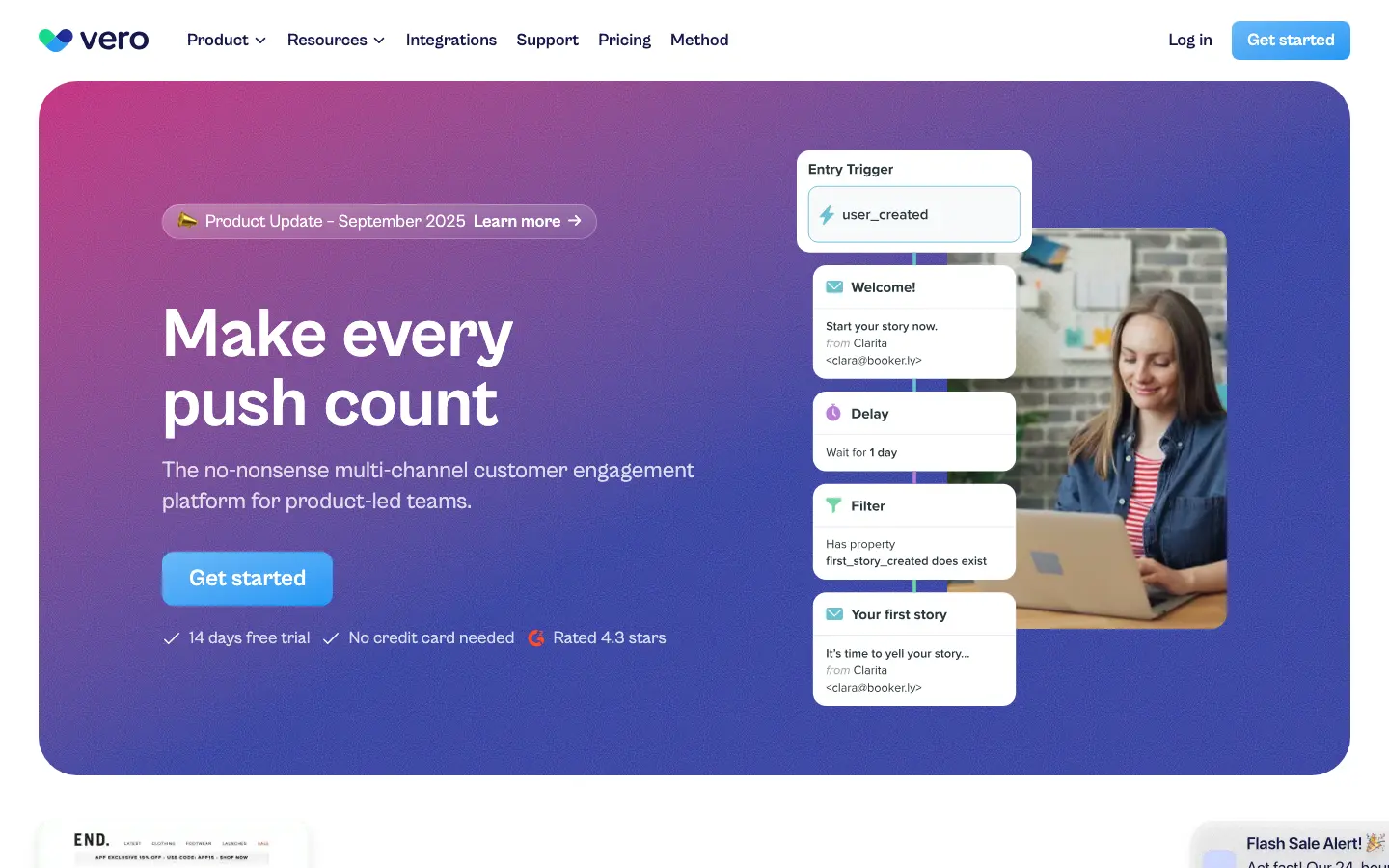
Vero is a multi-channel behavioral messaging platform built for product-led software companies. It fires event-triggered emails, push notifications, SMS, and in-app messages from live product data. Founded in 2012, Vero now delivers 5+ billion messages annually at 99.99% uptime.
What sets Vero apart is event-driven architecture combined with a pricing model built for PLG businesses. Competitors charge per total subscriber — Vero charges only for active profiles. A B2C company with 500K users but 50K active ones pays for 50K, not 500K.
Vero also connects directly to data warehouses. Connected Audiences lets teams query Snowflake, BigQuery, Redshift, and others via SQL — without duplicating data into the platform. Every behavioral segment can draw on the richest data your company already has.
Key features
- Event-triggered messaging: Fire messages from any product event — onboarding, activation, abandoned flows, win-back, or custom triggers you define.
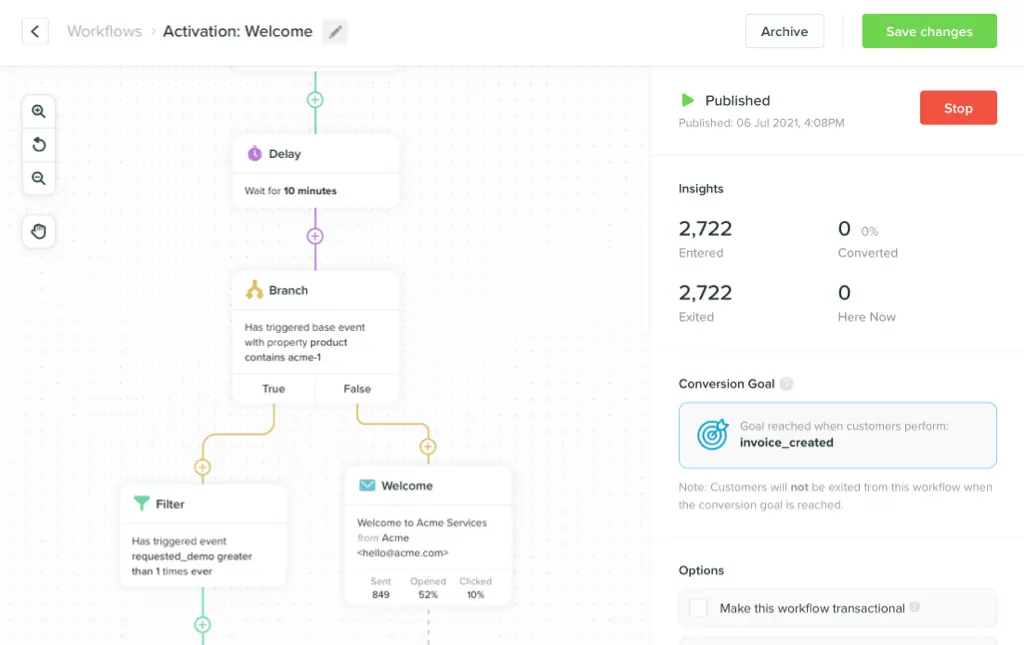
- Visual journey builder: Build multi-channel workflows with branching logic, delays, A/B splits, and no code required.
- Connected Audiences: Direct SQL integration with Snowflake, BigQuery, Redshift, PostgreSQL, MySQL, and SQL Server.
- Behavioral segmentation: Segment users by event history, profile attributes, and live warehouse data.
- Multi-channel delivery: Email, iOS/Android push, in-app messaging, SMS, and webhooks — coordinated in a single workflow.
- API and developer tools: Full API with integrations for Segment, RudderStack, Hightouch, and Census.
Pricing
- Starter: $54/month ($49/month billed annually) — 5,000 active profiles, 10,000 emails/month, 20,000 push/month, unlimited team members
- Professional: Custom — scales profiles, email, push, SMS, and events; fair-use overage policy
14-day free trial, no credit card required.
Pros & cons
Pros:
- Active-profile pricing is a genuine structural advantage for B2C and PLG businesses with large inactive lists.
- Connected Audiences brings warehouse-native segmentation to a price point no enterprise tool comes close to.
- Balanced developer-marketing access — engineering teams can trust it, product and marketing teams can run it independently.
- 12+ years of organic growth and 99.99% uptime; proven infrastructure without VC-fueled bloat.
Cons:
- Smaller brand footprint than CustomerIO, Braze, or Iterable — less likely to surface in early vendor shortlists.
- SMS and WhatsApp support are still maturing compared to Vero’s email and push capabilities.
- No built-in CDP — a strength for composable-stack buyers, a gap for teams wanting everything in one place.
Customers
Vero is trusted by Dribbble, Unsplash, Pipedrive, Stockpile, and 50+ companies globally. It holds a 4.3-star rating on G2. One customer put it directly: "Vero has one of the best support teams I’ve encountered."
2. CustomerIO: Best for SaaS Teams That Want a Built-in CDP
CustomerIO is a customer engagement platform used by 9,000+ brands across SaaS, EdTech, FinTech, and Healthcare. It combines event-triggered behavioral messaging with a built-in CDP — no separate data layer needed. Founded in 2012, it processes billions of messages and webhooks daily.
The built-in CDP is the key differentiator. CustomerIO lets teams store and activate customer data inside the platform without connecting to Segment or RudderStack separately. For teams that want a single vendor covering both data and messaging, that’s a real advantage.
The tradeoff is pricing structure. CustomerIO charges per profile regardless of activity, which becomes expensive for B2C businesses with large inactive lists. Teams already running a CDP will pay for capabilities they already own.
Key features
- Visual workflow builder with omnichannel orchestration
- Built-in CDP with custom objects for enhanced personalization
- A/B testing and cohort analysis
- Design Studio for message creation across channels
- Data pipelines via APIs, webhooks, and reverse ETL
- Ad audience synchronization
Pricing
- Essentials: $100/month — 5,000 profiles, 1M emails/month
- Premium: $1,000/month (billed annually) — custom volume, HIPAA compliance, dedicated support, 90-day onboarding
- Enterprise: Custom
- Startup program: Free for 12 months for startups raising under $10M
Pros & cons
Pros:
- Built-in CDP removes the need for a separate data tool if you’re starting from scratch.
- 9,000+ brands and a strong enterprise track record.
- Startup program makes it free for early-stage teams.
Cons:
- Per-profile pricing penalizes B2C and PLG businesses with large inactive user bases.
- Duplicative cost for teams already running Segment or RudderStack.
- Entry price at $100/month is higher than Vero’s Starter plan.
Customers
CustomerIO is used by Notion, Pipedrive, StuDocu, Kraft Heinz, and Schneider Electric. It holds 4.4 stars on G2 from 709 reviews.
3. Braze: Best for Enterprise Brands at Scale
Braze is the category leader for enterprise customer engagement. Public since 2021, it generates $593M ARR and serves 2,300+ customers across 195 countries. It’s the platform of choice for brands that need AI-powered personalization coordinated across every channel simultaneously.
BrazeAI™ is the headline capability — a suite of predictive, generative, and agentic intelligence tools built into journey orchestration. BrazeAI Decisioning Studio™ enables 1:1 personalization across millions of users. That level of capability requires significant budget and a dedicated team to operate it effectively.
For mid-market PLG companies, Braze is typically overkill. The pricing is enterprise-only, onboarding is substantial, and the full feature set assumes a large team. But for brands that have outgrown mid-market platforms, it’s the clear upgrade path.
Key features
- BrazeAI™ — predictive, generative, and agentic intelligence across journeys
- BrazeAI Decisioning Studio™ — 1:1 personalization at enterprise scale
- Braze Data Platform — data unification and activation
- Currents — real-time data streaming to data warehouses
- Channel support: email, SMS/RCS, WhatsApp, mobile push, web push, in-app, LINE
- Full reporting and attribution suite
Pricing
Custom. Usage-based on Monthly Active Users (MAUs) and message volume. Enterprise annual contracts are standard. A sales demo is required to begin evaluation.
Pros & cons
Pros:
- Most recognized enterprise CEP globally — 2,300+ customers and $593M ARR.
- Deepest AI personalization feature set available in any behavioral messaging platform.
- Real-time data streaming via Currents for data warehouse integration.
Cons:
- Enterprise pricing puts it out of reach for most mid-market and growth-stage teams.
- Complexity and onboarding overhead requires a dedicated platform operations team.
- Sales-led evaluation process adds significant time before you can test anything.
Customers
Braze works with Burger King, Grubhub, the NBA, HBO Max, Paramount, and KFC. It holds 4.5 stars on G2 from 1,412 reviews.
4. Iterable: Best for Experience-Focused Mid-Market and Enterprise Teams
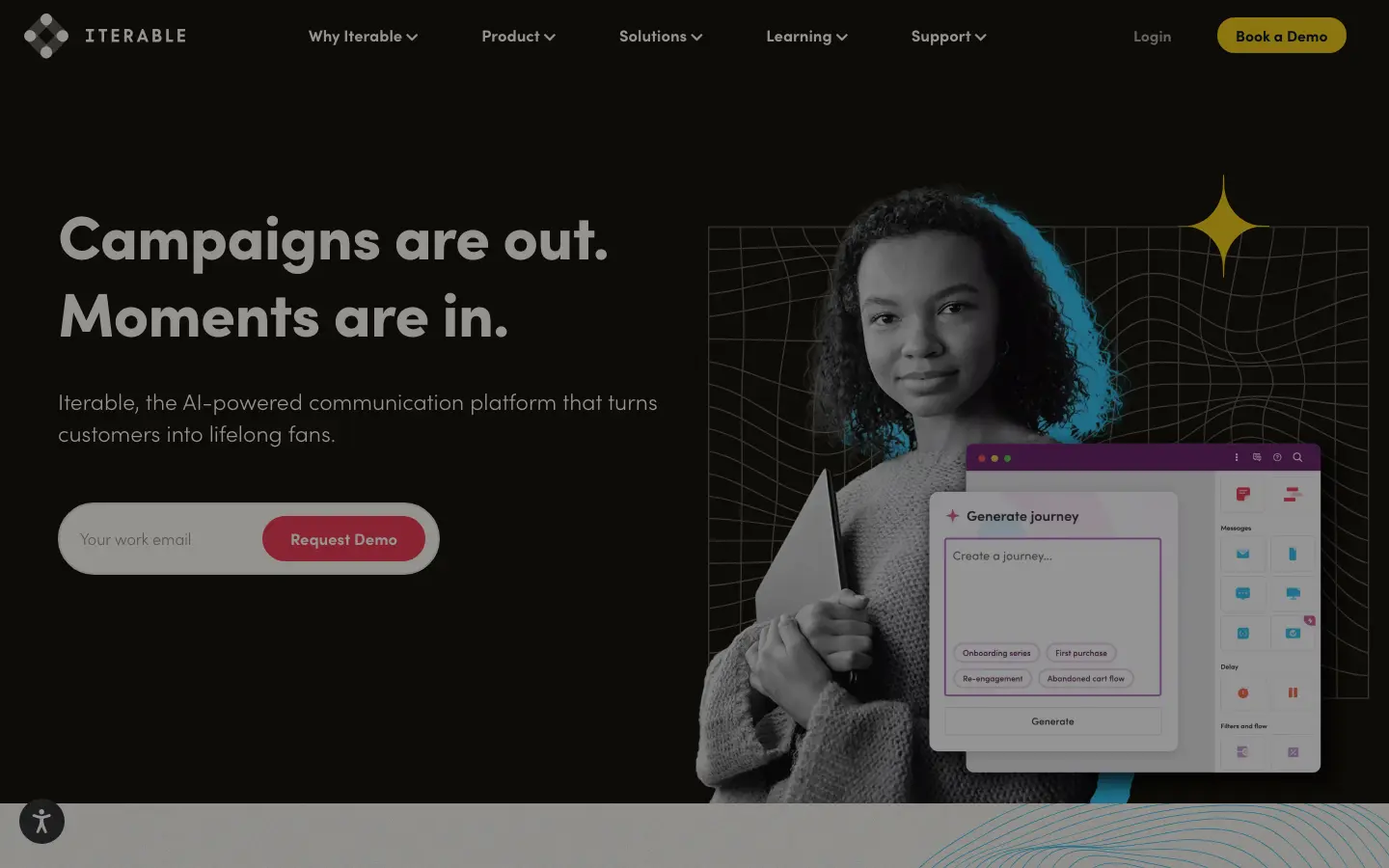
Iterable is a cross-channel engagement platform that raised $343M and serves mid-market and enterprise brands. Its strength is orchestrated lifecycle journeys — coordinated sequences across email, push, in-app, and SMS tied to behavioral events. The Iterable Nova AI suite adds send-time optimization, predictive goals, and brand affinity scoring on top of that journey logic.
The experience-led positioning makes Iterable a strong fit for consumer brands where loyalty and long-term retention are the primary metrics. E-commerce, media, marketplace, and fintech teams are well-represented in the customer base.
The gaps are pricing transparency and reporting maturity. Iterable requires a sales demo before any pricing is shared, and G2 reviewers consistently flag reporting as a weakness. Teams needing self-serve evaluation or deep analytics will want to probe those areas before committing.
Key features
- Iterable Nova AI suite — brand affinity, predictive goals, and send-time optimization
- Orchestrate Channels — cross-channel journey management
- Activate Data — data activation across the tech stack
- A/B testing and analytics
- Channel support: email, mobile push, web push, in-app, SMS
Pricing
Enterprise custom. Annual contracts standard. No public pricing tiers — a sales demo is required.
Pros & cons
Pros:
- $343M raised signals significant R&D investment and product runway.
- Strong brand recognition across mid-market and enterprise buying teams.
- Iterable Nova AI suite is a serious capability investment in behavioral intelligence.
Cons:
- No transparent pricing — evaluation requires full sales engagement.
- Reporting features flagged as needing improvement across multiple G2 reviews.
- No active-profile pricing — charges per subscriber regardless of whether they’re active.
Customers
Iterable works with Asana, Square, Redfin, Priceline, Fabletics, Morning Brew, and the NHL. It holds 4.5 stars on G2 from 691 reviews.
5. OneSignal: Best for Push-First Mobile Apps
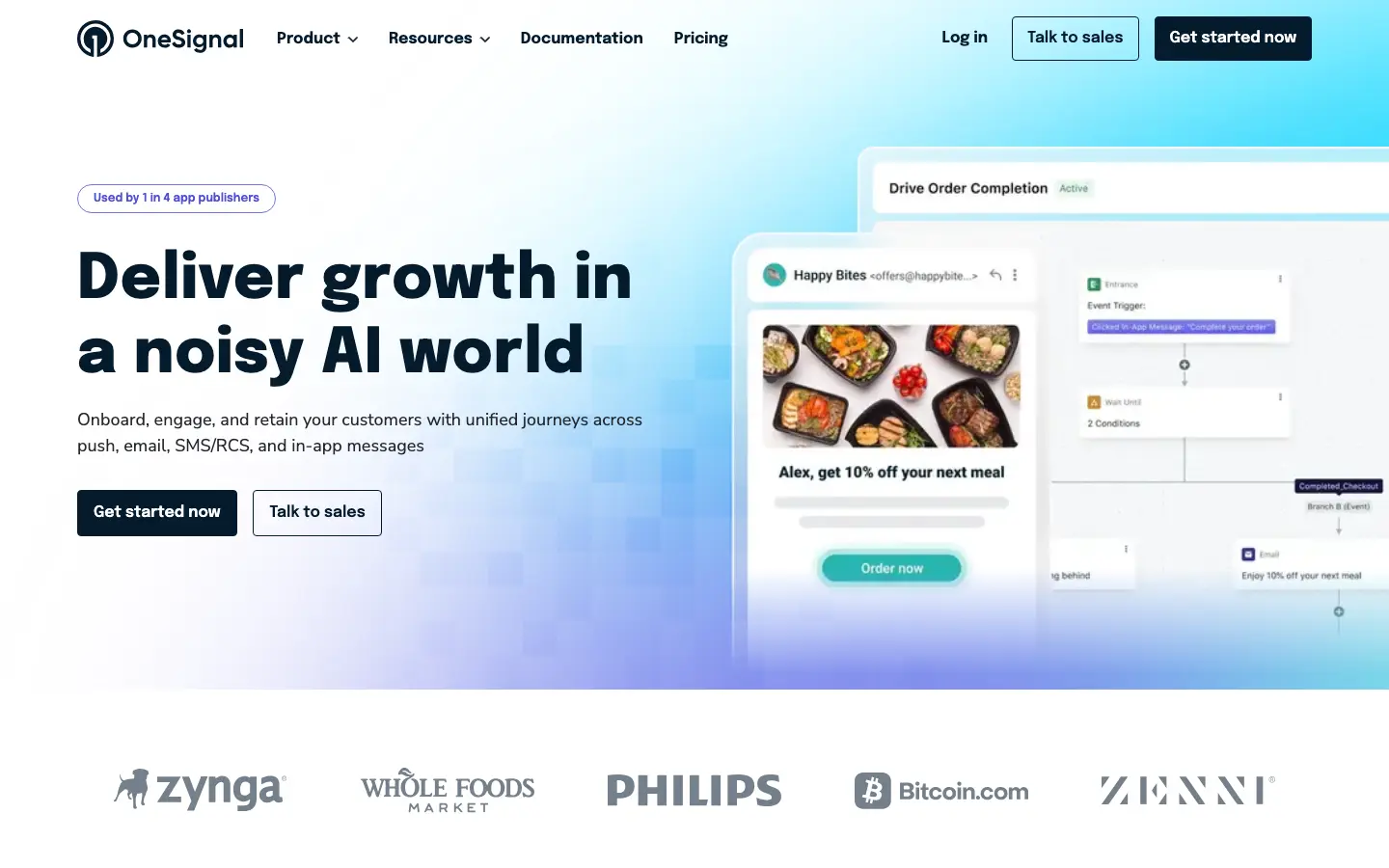
OneSignal is the dominant platform for push notification infrastructure. Over 2 million businesses use it — roughly 1 in 4 app publishers. It delivers 12 billion messages per day and holds a 4.7-star rating on G2 from 1,155 reviews — the highest in the category.
The core strength is SDK depth. OneSignal supports every major mobile framework: Android, iOS, Flutter, React Native, Expo, and Unity. Live Activities for iOS are supported. The developer experience prioritizes speed of integration over workflow complexity.
For teams that need event-triggered push notifications more than lifecycle email campaigns, OneSignal is the most practical entry point. The free plan is genuinely useful, and Growth plan pricing is fully transparent. The tradeoff: email and SMS are secondary channels, and the journey builder is less mature than dedicated CEP platforms.
Key features
- Mobile push notifications with best-in-class SDK coverage (Android, iOS, Flutter, React Native, Unity)
- Web push notifications
- Live Activities for iOS
- Journey orchestration and personalization
- Email, SMS/RCS, and in-app messaging
- REST APIs, webhooks, and event streams
Pricing
- Free: $0 — 10,000 emails/month, unlimited mobile push, 1 journey, 6 segments
- Growth: From $19/month — mobile push at $0.012/MAU, web push at $0.004/subscriber
- Professional: Custom — 20 journeys, advanced analytics, CSV exports
- Enterprise: Custom — frequency capping, dedicated success manager, SLA
Pros & cons
Pros:
- Highest G2 rating in the category (4.7 stars, 1,155 reviews).
- Best-in-class push SDK coverage — deepest framework support available anywhere.
- Freemium entry point with transparent public pricing at every tier.
Cons:
- Push-first heritage — email and SMS are not core strengths.
- Journey builder less mature than CustomerIO, Vero, or Iterable.
- Growth plan per-MAU pricing for push can become expensive at significant scale.
Customers
OneSignal is used by Zenni Optical, Zynga, Whole Foods, Philips, DHL, Royal Caribbean, and Porsche.
Frequently asked questions
What is the difference between event-based marketing and triggered email?
Triggered email is one channel within event-based marketing. Event-based marketing refers to any message — email, push, in-app, SMS — fired by a specific user action. Triggered emails are the most common implementation, but modern event-based marketing coordinates all those channels within a single behavioral workflow.
What events should I track first?
Start with three categories: activation events, drop-off events, and expansion events. Activation covers moments like first login or first key feature used. Drop-off tracks where users stall; expansion flags when they’re ready to grow. Pick the moments that most directly affect your retention or revenue curve, and track those before adding anything else.
Do I need a data warehouse to do event-based marketing?
No — but having one improves it substantially. Event-based marketing works with behavioral data sent directly from your product via an SDK. A warehouse adds depth: historical context, richer segmentation, and the ability to blend product data with customer data you’ve already collected.
How does event-based marketing differ from marketing automation?
Marketing automation typically means rule-based sequences tied to a schedule or form submission. Event-based marketing fires from real-time product behavior. Many modern platforms do both, but true event-based marketing requires real-time event ingestion and behavioral segmentation that basic automation tools can’t match.
Which platform is best for a small SaaS team just getting started?
Vero’s Starter plan at $54/month is the most practical entry point for multi-channel behavioral messaging. CustomerIO’s startup program offers 12 free months for teams raising under $10M. OneSignal’s free plan works for push-only needs. The right choice depends on which channels you need and whether you already have a CDP.
When should I move from a basic email tool to a proper event-based platform?
When the same email is going to users at completely different stages — that’s the signal. Other tells: send logic living in product code instead of a messaging platform, automatable campaigns still running manually. Or users churning at the same predictable stage with no behavioral message in place.
Conclusion: Match the message to the moment
Event-based marketing works because it aligns messaging with intent. Batch campaigns approximate when to reach someone. Behavioral triggers act on what that person actually just did.
That difference compounds — in open rates, in conversions, in retention. It’s the core reason behavioral programs consistently outperform batch campaigns over time.
The right platform depends on where your team sits. Mid-market PLG and B2C teams get the most from Vero — active-profile pricing, warehouse-native segmentation, and a platform engineering and marketing can both own. Enterprise teams running large-scale personalization belong on Braze or Iterable. Mobile-first apps with heavy push needs will find OneSignal the fastest path to event-triggered notifications.
Start with two or three triggers that cover your highest-stakes moments — activation, retention risk, or an upgrade prompt. Build those, measure the impact, and expand from there. Vero’s free trial requires no credit card — it’s the fastest way to see behavioral messaging in action.