- All Posts
- /
- Best Messaging Platforms for Product-Led Growth
Best Messaging Platforms for Product-Led Growth
Messaging and Automation-
 Chris Hexton
-
Updated:Posted:
On this page
Product-led growth lives or dies on user activation. Free trials convert when users hit their "aha moment" fast enough. Messaging is the mechanism — the right nudge keeps users moving toward value.
Most platforms weren’t built for this. They were designed for marketers running email blasts, not product teams triggering workflows from behavioral data. Pick the wrong one and you’ll fight the tool rather than ship campaigns.
This guide covers the six best messaging platforms for product-led growth in 2026. We’ve compared features, pricing, data capabilities, and PLG fit for each option. By the end, you’ll know exactly which platform fits your stage and stack.
What are the best messaging platforms for product-led growth?
Vero is the top pick for mid-market PLG teams needing behavioral messaging tied to warehouse data. CustomerIO suits SaaS teams that want a built-in CDP alongside their messaging tools. Braze dominates enterprise PLG with deep AI personalization at scale.
OneSignal leads for push-heavy mobile apps with a generous free tier and massive developer trust. Knock is built for engineering teams embedding notification infrastructure directly into their product. Loops serves early-stage SaaS startups that need clean, simple email automation without the overhead.
| Platform | Starting Price | Best For | Key Differentiator | Free Trial |
|---|---|---|---|---|
| Vero | $54/mo | PLG SaaS, B2C, mobile apps | Active-profile pricing + warehouse-native segmentation | 14 days, no credit card |
| CustomerIO | $100/mo | SaaS teams + enterprise | Built-in CDP, 9,000+ brands | 14 days |
| Braze | Custom | Enterprise PLG brands | BrazeAI™, omnichannel at scale | Sales demo required |
| OneSignal | Free–custom | Push-heavy mobile PLG apps | 2M+ businesses, best-in-class push infrastructure | Free plan available |
| Knock | $0–$250/mo | Developer-built notification infra | Version control + CLI for notifications | Free developer tier |
| Loops | Free–$49/mo | Early-stage SaaS startups | SaaS-specific templates, all features on every plan | Free up to 1,000 contacts |
1. Vero: Best for Mid-Market PLG Teams
Disclosure: Vero is our own product. We’ve included it because we genuinely believe it belongs on this list — but you should know we’re not a neutral party.
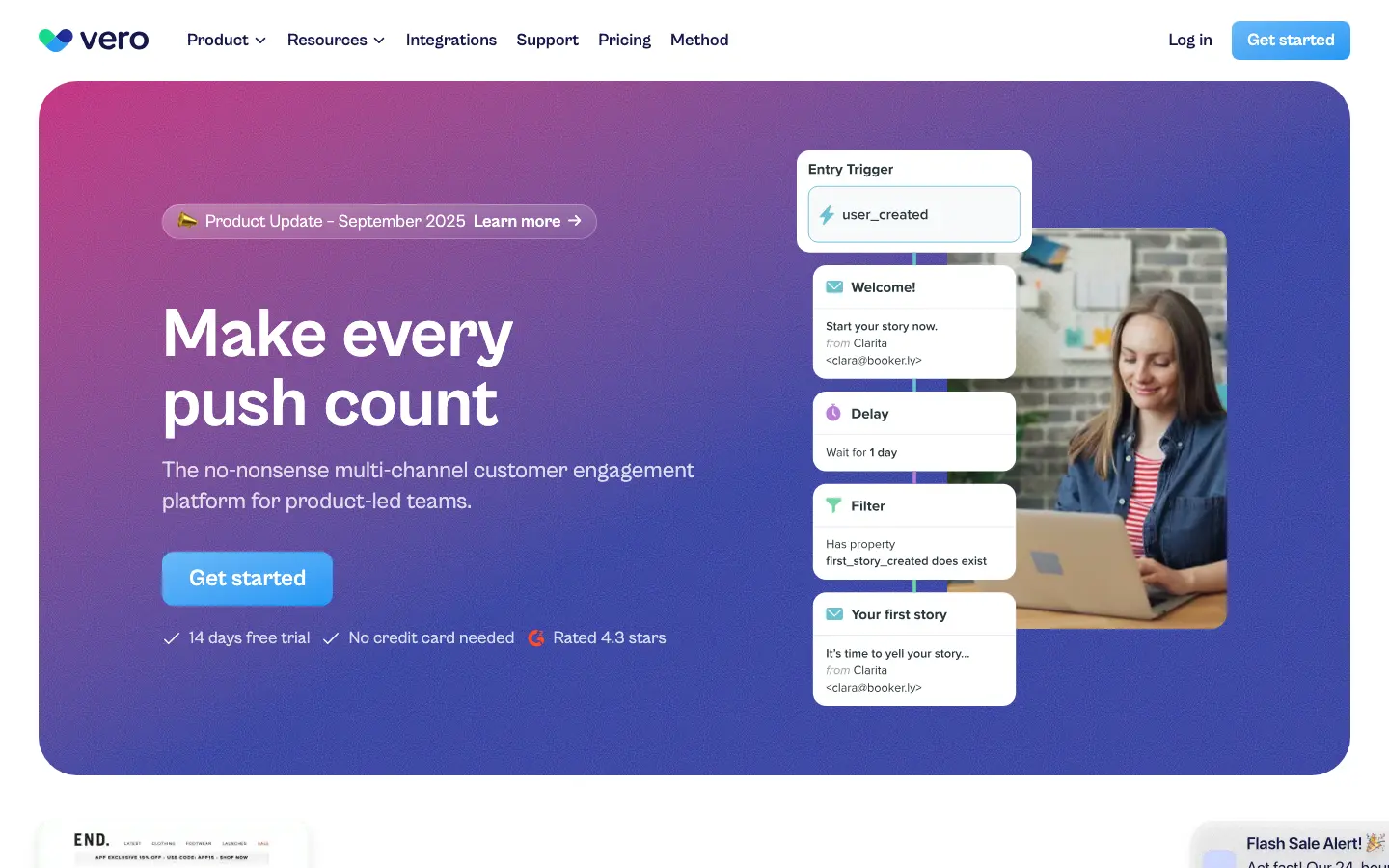
Vero is a multi-channel customer engagement platform built specifically for product-led software companies. It sends event-triggered emails, push notifications, SMS, and in-app messages — all powered by live product and warehouse data. Founded in 2012, it now delivers 5+ billion messages annually at 99.99% uptime.
What makes Vero exceptional for PLG is its pricing model. Most platforms charge per total subscriber — punishing B2C and PLG companies with large inactive user bases. Vero charges only for active profiles, a structural cost advantage for freemium and free-trial businesses.
Vero also connects directly to your data warehouse. Its Connected Audiences feature queries Snowflake, BigQuery, Redshift, and others without duplicating data into the platform. That’s rare in a category where most tools insist you route everything through their own CDP.
Key features
- Event-triggered messaging: Send messages based on real user behavior — onboarding, activation, abandoned flows, win-back campaigns, and more.
- Visual journey builder: Build automated workflows without code, including A/B splits, delays, and multi-channel coordination.
- Connected Audiences: Direct SQL integration with Snowflake, BigQuery, Redshift, PostgreSQL, MySQL, and SQL Server.
- Behavioral segmentation: Segment users by event history, profile attributes, and live warehouse data.
- Multi-channel delivery: Email, iOS/Android push, in-app messaging, SMS, and webhooks — coordinated in a single workflow.
- Developer tools: Full API, Segment and RudderStack integration, and a developer guide built for product infrastructure.
Pricing
- Starter: $54/month (or $49/month billed annually) — 5,000 active profiles, 10,000 emails/month, 20,000 push/month, unlimited team members
- Professional: Custom pricing — scales profiles, emails, push, SMS, and events with a fair-use overage policy
14-day free trial, no credit card required.
Pros & cons
Pros:
- Active-profile pricing is a genuine cost advantage for PLG companies with large inactive user bases.
- Connected Audiences brings warehouse-native segmentation to a price point no enterprise tool matches.
- Developer-credible platform that product and marketing teams can operate without an engineer on every change.
- 12+ years of organic growth and 99.99% uptime — proven infrastructure without VC-fueled complexity.
Cons:
- Smaller brand footprint than CustomerIO and Braze — may not surface in early vendor evaluations.
- SMS and WhatsApp capabilities are still maturing relative to email and push.
- No built-in CDP — a feature for composable-stack buyers, but a gap for teams that want everything in one place.
Customers
Vero is trusted by Dribbble, Unsplash, Pipedrive, Stockpile, and 50+ companies globally. It holds a 4.3-star rating on G2. One customer noted: "Vero has one of the best support teams I’ve encountered."
2. CustomerIO: Best for SaaS Teams That Want a Built-in CDP
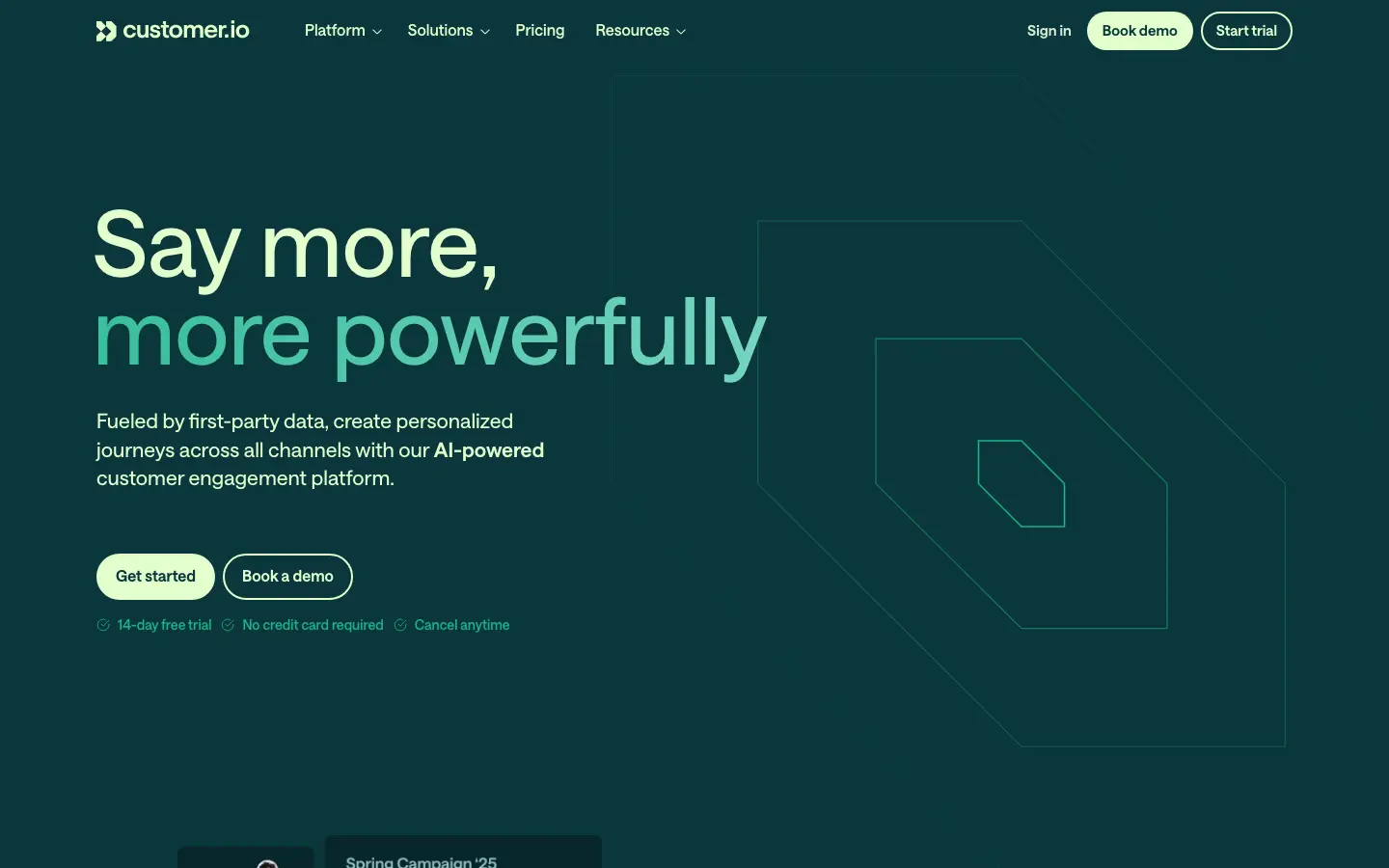
CustomerIO is a customer engagement platform for SaaS and B2C teams that want messaging and data management in one place. It powers omnichannel campaigns across email, push, in-app, SMS, and WhatsApp. Over 9,000 brands globally use the platform.
The key differentiator is CustomerIO’s built-in CDP layer. Teams without a separate CDP like Segment can consolidate data and messaging in one tool. That’s genuinely useful — but creates duplicative spend for teams that already have a CDP.
For PLG teams, CustomerIO’s visual workflow builder and cohort analysis are strong. The Essentials plan starts at $100/month for 5,000 profiles — nearly double Vero’s Starter price. That gap widens fast at scale if you’re paying per profile on an inactive-heavy list.
Key features
- Visual workflow builder: Automate customer journeys with a drag-and-drop interface.
- Omnichannel messaging: Email, push, in-app, SMS, and WhatsApp — all from one platform.
- Built-in CDP: Data pipeline with APIs, webhooks, and reverse ETL — no separate CDP needed.
- Design Studio: Message creation tools for non-technical marketers.
- A/B testing and cohort analysis: Test and learn across campaigns.
- Custom objects: Enhanced personalization using structured product data.
Pricing
- Essentials: $100/month — 5,000 profiles, 1M emails/month
- Premium: $1,000/month (billed annually) — custom volume, HIPAA, dedicated support, 90-day onboarding
- Enterprise: Custom — priority support, dedicated CSM, dedicated hardware
- Startup program: Free 12 months for startups raising under $10M
Pros & cons
Pros:
- Built-in CDP is a genuine value-add for teams that don’t have Segment or RudderStack.
- Strong brand recognition among SaaS buyers — 9,000+ brands signals proven product-market fit.
- WhatsApp channel support is ahead of Vero’s current roadmap.
- Startup program offers real value for early-stage teams.
Cons:
- Per-profile pricing model disadvantages PLG companies with large inactive user bases.
- Built-in CDP creates duplicative spend for teams already using a best-of-breed data stack.
- Essentials plan starts at $100/month — roughly double Vero’s entry point.
- Teams committed to Segment or RudderStack are paying for a CDP they don’t need.
Customers
CustomerIO serves Notion, Pipedrive, StuDocu, Kraft Heinz, and 9,000+ brands globally. It holds a 4.4-star rating on G2, with 709 reviews.
3. Braze: Best for Enterprise PLG at Scale
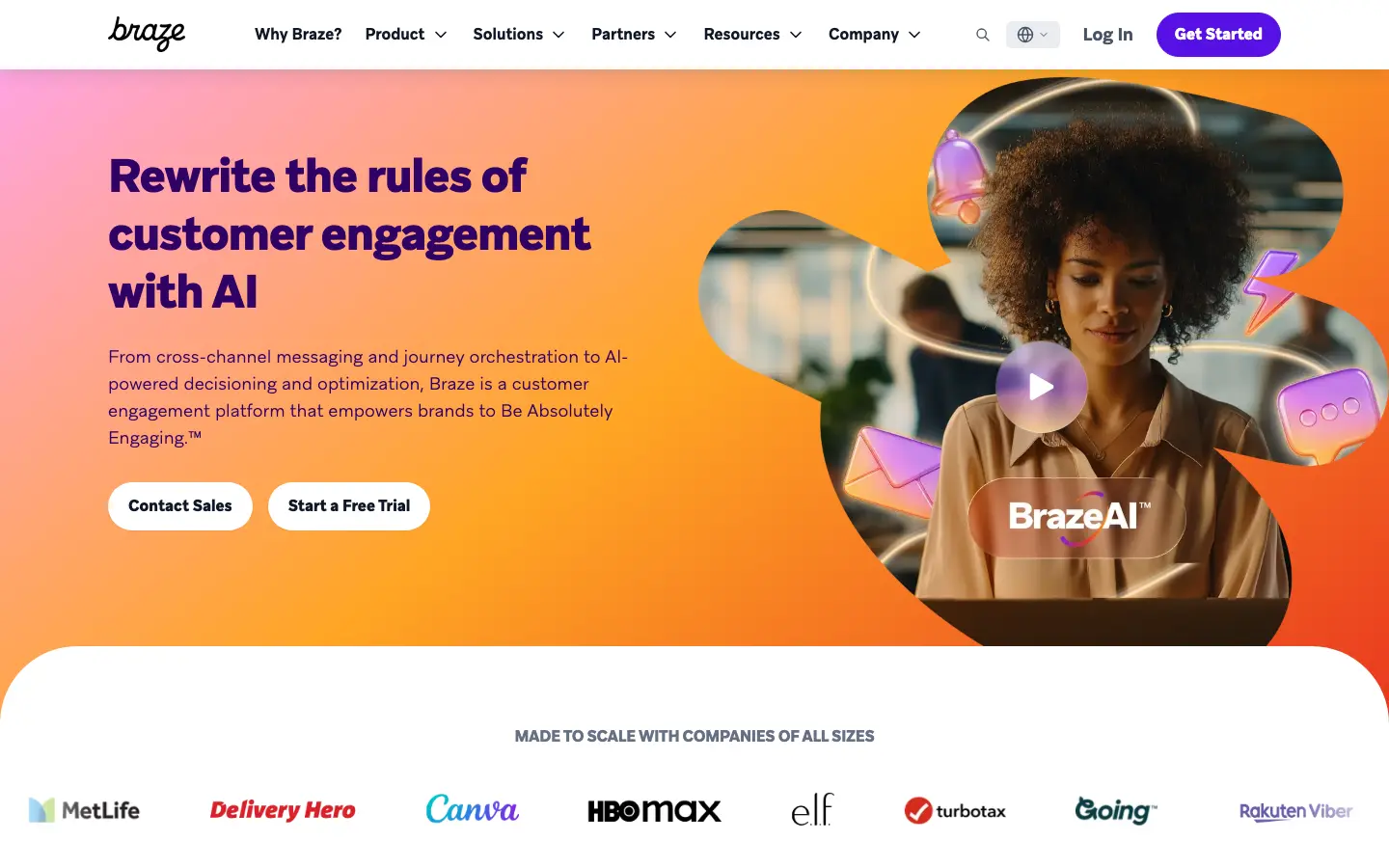
Braze is the dominant enterprise customer engagement platform — 2,300+ brands, $593M ARR, and a Nasdaq listing. It was built for large consumer brands running sophisticated personalization at scale. PLG companies that have grown past mid-market and need enterprise-grade infrastructure turn to Braze.
BrazeAI™ is the flagship differentiator. It includes predictive, generative, and agentic intelligence baked into journey orchestration. For PLG companies with millions of users and complex activation flows, that depth matters.
The tradeoff is cost and complexity. Pricing is fully custom, enterprise-first, and requires a sales process before evaluation. That’s the wrong fit for lean PLG teams — but right when you’ve outgrown mid-market tools.
Key features
- BrazeAI™: Predictive, generative, and agentic intelligence across campaigns.
- Journey orchestration: Multi-channel workflows with real-time 1:1 personalization.
- Braze Data Platform: Unified data activation across the customer lifecycle.
- Currents: Real-time data streaming to your data warehouse.
- Channel breadth: Email, SMS/RCS, WhatsApp, mobile push, web push, in-app, and LINE.
- Full analytics suite: Reporting, attribution, and campaign performance measurement.
Pricing
Custom enterprise pricing — usage-based on Monthly Active Users and message volume. Annual contracts are standard, and a sales demo is required before evaluation.
Pros & cons
Pros:
- The most recognized enterprise CEP globally — trusted by 2,300+ brands across 195 countries.
- BrazeAI™ personalization depth is unmatched in the category for large-scale PLG use cases.
- Real-time data streaming via Currents connects Braze to your data warehouse.
- Broadest channel coverage in this roundup, including RCS and LINE.
Cons:
- Enterprise pricing puts Braze out of reach for most PLG companies below $20M ARR.
- Full sales engagement required before evaluation — no self-serve trial.
- Onboarding complexity suits large teams, not lean product squads.
- Significant overkill for teams that don’t need AI personalization at enterprise scale.
Customers
Braze serves Burger King, Grubhub, NBA, HBO Max, Paramount, and Skyscanner across 195 countries. It holds a 4.5-star rating on G2, with 1,412 reviews.
4. OneSignal: Best for Push-Heavy Mobile PLG Apps
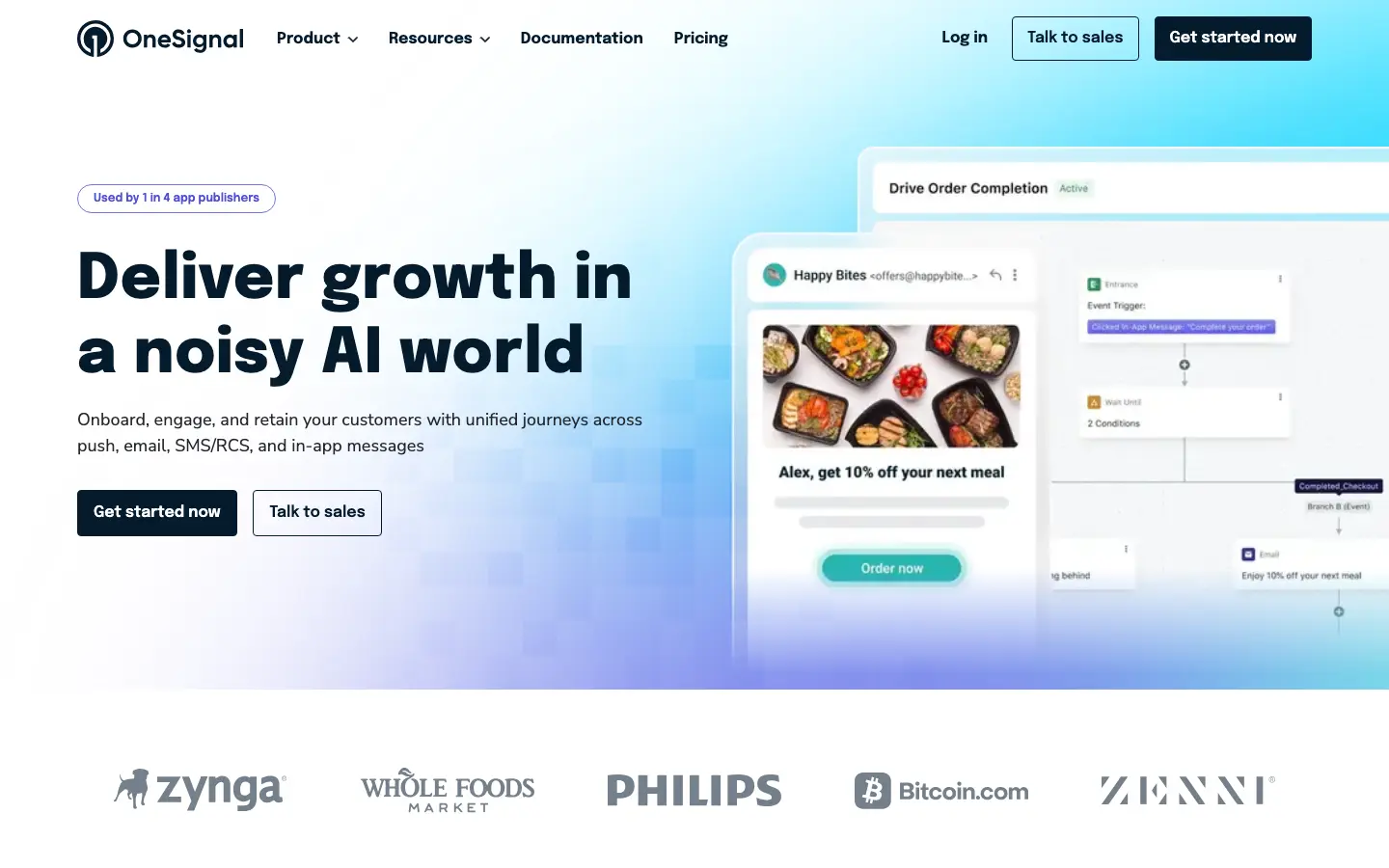
OneSignal started as a push notification infrastructure layer — and it still leads the category. One in four app publishers uses OneSignal — its 2M+ businesses and 12B+ daily messages signal real infrastructure maturity. For PLG mobile apps where push is the primary activation channel, it’s the default starting point.
The platform has expanded well beyond push. Journey orchestration, email, SMS, and in-app messaging round out the multi-channel offering. Push remains the core, but the freemium entry point makes it easy to validate before committing to paid tiers.
Pricing is transparent and accessible. The free plan covers unlimited mobile push and 10K emails per month. The Growth plan starts at $19/month, making it the lowest-cost entry point on this list for real PLG use.
Key features
- Mobile and web push: Best-in-class push infrastructure — iOS, Android, web, and Live Activities.
- SDK coverage: Android, iOS, Flutter, React Native, Expo, Unity, and more.
- Journey orchestration: Personalized lifecycle flows across push, email, and SMS.
- In-app messaging: Contextual in-product messages triggered by user behavior.
- REST APIs and webhooks: Full developer access for custom integrations.
- Analytics: Lifecycle measurement and campaign performance tracking.
Pricing
- Free: $0 — 10K emails/month, unlimited mobile push, 1 journey, 6 segments
- Growth: From $19/month — 20K emails included, mobile push at $0.012/MAU
- Professional: Custom — 20 journeys, advanced analytics, CSV exports
- Enterprise: Custom — frequency capping, dedicated success manager, SLA
Pros & cons
Pros:
- Highest G2 rating in the category at 4.7 stars with 1,155 reviews.
- Best-in-class push notification infrastructure with the deepest SDK and API coverage.
- Freemium entry point with genuine utility for early-stage PLG apps.
- 2M+ businesses using the platform — massive distribution and ecosystem trust.
Cons:
- Push-first heritage means email and SMS are secondary capabilities, not core strengths.
- Journey builder is less mature than dedicated customer engagement platforms.
- Growth plan per-MAU pricing can become expensive for rapidly growing apps.
- Less suited for warehouse-native or data-heavy PLG teams.
Customers
OneSignal is used by Zenni Optical, Zynga, Whole Foods, Philips, DHL, Royal Caribbean, and Porsche. It holds a 4.7-star rating on G2, with 1,155 reviews — the highest in this roundup.
5. Knock: Best for Developer-Built Notification Infrastructure
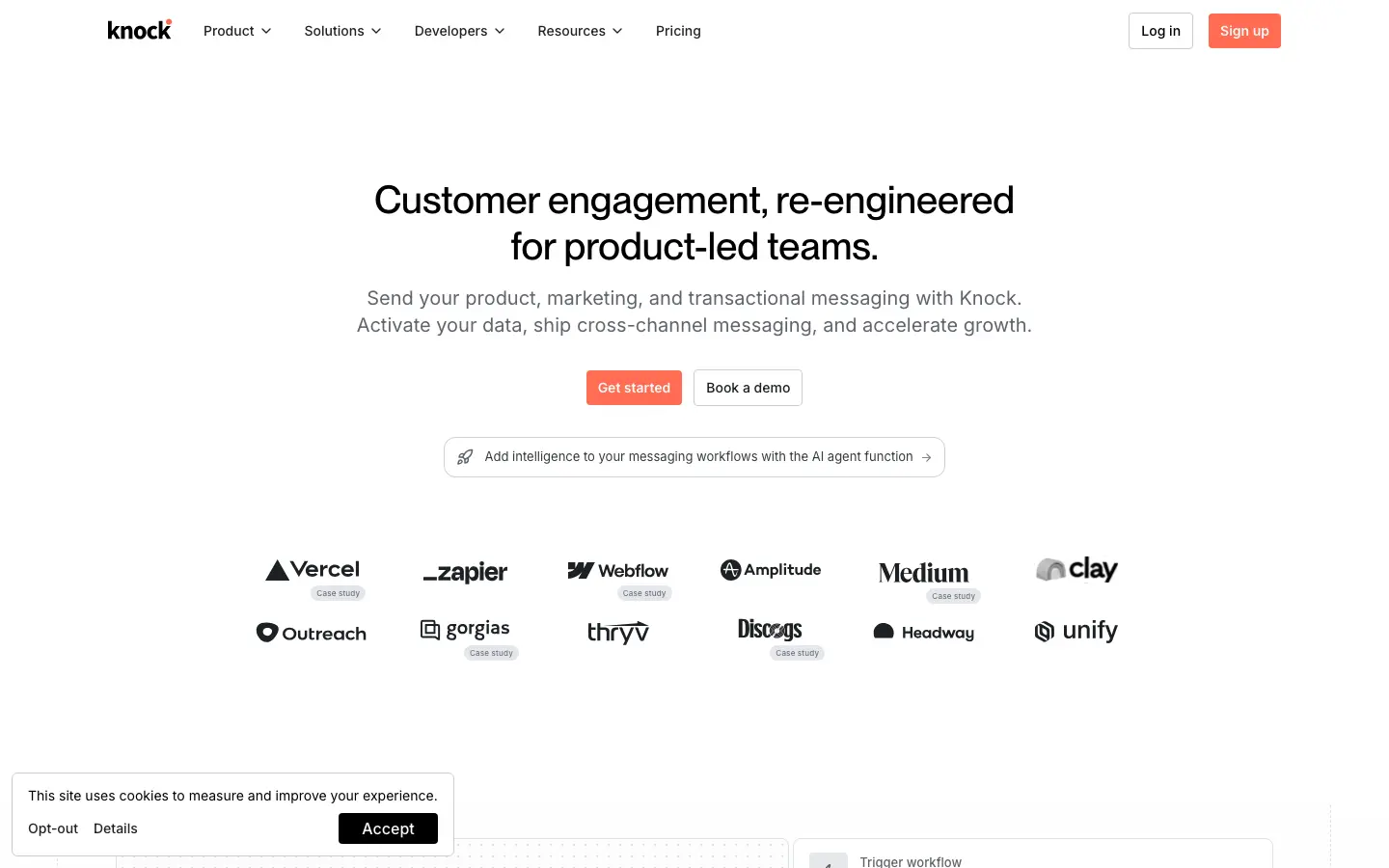
Knock is not a marketing automation platform. It’s developer-first notification infrastructure — version control, CLI, and CI/CD for the notification layer of your product. For PLG engineering teams building notification systems the same way they deploy code, Knock is purpose-built.
The differentiators are architectural. Notification templates live in version control; engineers deploy changes through CI/CD and integrate with Cursor or Copilot. That’s a fundamentally different category from any other platform on this list.
The tradeoff is scope — Knock is infrastructure, not automation. It doesn’t do lifecycle campaigns, behavioral analytics, or A/B testing. Teams often pair Knock with a marketing automation platform for campaign-layer messaging.
Key features
- Version control for notifications: Templates managed like code — git-compatible workflows.
- CLI and AI IDE integration: Build notification workflows from Cursor, Copilot, and the terminal.
- CI/CD integration: Deploy notification changes through your existing engineering pipeline.
- Multi-channel support: Email, SMS, push, in-app, Slack, and MS Teams.
- User preference centers: Let users control their own notification settings.
- Observability: Built-in logging and delivery tracking for every notification.
Pricing
- Developer: $0 — 10K messages/month, 500 guide active users
- Starter: $250/month — 50K messages, 2.5K guide active users
- Enterprise: Custom — flexible volume, SAML, HIPAA, Datadog observability
Pros & cons
Pros:
- Developer-first architecture is genuinely differentiated — notifications as code is a real paradigm shift.
- Version control and CI/CD integration fits naturally into PLG engineering workflows.
- Slack and MS Teams channels cover B2B PLG use cases most platforms miss.
- Free developer tier with real utility for early-stage product teams.
Cons:
- Not a marketing platform — no lifecycle campaigns, behavioral analytics, or A/B testing.
- Product and marketing teams cannot operate it without engineering involvement.
- Small team limits support resources and roadmap velocity at scale.
- No warehouse-native segmentation comparable to Vero’s Connected Audiences.
Customers
Knock is trusted by Vercel, Webflow, Medium, Clay, Amplitude, Gorgias, and Outreach. It holds a 4.6-star rating on G2, with 107 reviews.
6. Loops: Best for Early-Stage SaaS Startups
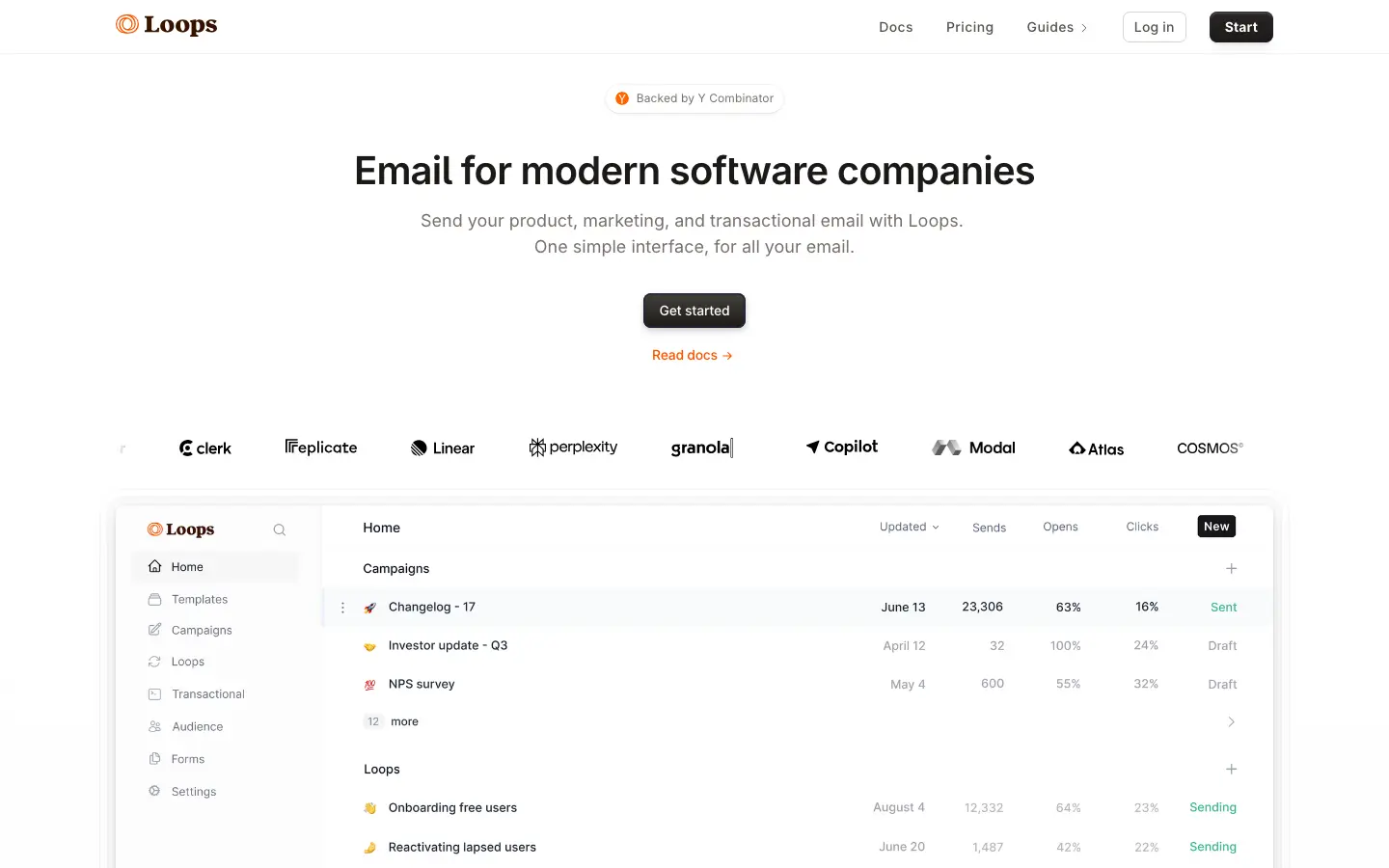
Loops is email-only, SaaS-specific, and built for founders. It handles transactional and marketing email from one tool — no full CEP overhead required. If you’re pre-product-market fit or building your first onboarding sequence, it’s the fastest path to shipping.
The differentiator is simplicity. No channels other than email, no complex data pipelines, and SaaS-specific templates that reduce setup time. Non-technical founders can navigate the interface without a tutorial.
Pricing is as accessible as the product. The free plan covers 1,000 contacts with no credit card required. Paid plans start at $49/month for 5,000 contacts, with unlimited sends and all features included.
Key features
- Transactional + marketing email: Both from one platform — no need for separate sending services.
- Event-triggered automation: Send messages based on user actions in your product.
- SaaS email templates: Pre-built templates designed for SaaS onboarding and lifecycle flows.
- Simple segmentation: Audience filtering by contact properties and events.
- Clean interface: Built for founders and small teams, not enterprise marketing operations.
Pricing
- Free: Up to 1,000 contacts — all features included, no credit card required
- Paid plans: From $49/month for 5,000 contacts — unlimited sends, all features, one plan
No feature gating — every tier gets full access.
Pros & cons
Pros:
- Extreme simplicity makes it the fastest platform to get live for SaaS email.
- SaaS-specific templates reduce setup time for common lifecycle flows.
- All features on every plan — no frustrating tier-gating on core capabilities.
- Free tier with no credit card makes it genuinely risk-free to evaluate.
Cons:
- Email-only — no push, in-app messaging, SMS, or webhooks.
- No data warehouse integration or Connected Audiences functionality.
- Limited segmentation and behavioral logic for teams with complex product data.
- Not a long-term solution for PLG companies that need multi-channel orchestration.
Customers
Loops targets SaaS startups and growth-stage companies. Pricing starts free for up to 1,000 contacts, making it accessible at the earliest stages of growth.
Frequently asked questions
What makes a messaging platform good for product-led growth?
PLG companies need platforms that trigger messages from real user behavior. That means event-based workflows, behavioral segmentation, and the ability to connect to your product data. Platforms built for email blasts or traditional CRM marketing rarely fit PLG needs well.
Do PLG companies need multi-channel messaging?
It depends on your product and user base. B2C PLG apps often need push, in-app, and email working together. B2B PLG SaaS teams typically start with email and in-app, then expand to SMS or push at scale.
How does pricing affect PLG teams specifically?
PLG companies often have large user bases with varying activity levels — many inactive users, a smaller active core. Per-subscriber pricing (like CustomerIO or HubSpot) charges for the full database. Active-profile pricing (like Vero) charges only for active users — and for PLG, that difference is significant.
When should I choose Vero over CustomerIO?
Choose Vero if you have a CDP or data warehouse and want warehouse-native segmentation without redundant costs. Choose CustomerIO if you want data management and messaging consolidated in one platform without a separate CDP.
Is Braze worth the cost for an early-stage PLG startup?
Almost certainly not. Braze is enterprise software built for large teams and large budgets — misaligned with most PLG startups. Start with Vero, CustomerIO, or OneSignal — and revisit Braze when you’re operating at enterprise scale.
What’s the difference between Knock and a full messaging platform?
Knock is notification infrastructure — it handles the developer layer of building and deploying notifications as code. A full messaging platform like Vero or CustomerIO handles the marketing layer — segmentation, campaign creation, analytics, and A/B testing. Many teams use both — Knock for transactional product notifications, a CEP for lifecycle campaigns.
Conclusion: Choose the Right Platform for Your PLG Stage
The right messaging platform for PLG depends on where you are — not where you hope to be.
Early-stage startups should start with Loops for simplicity or OneSignal for push-first mobile apps. Both have free tiers and low switching costs.
Growing mid-market PLG teams should evaluate Vero first. Active-profile pricing, warehouse-native segmentation, and balanced developer-marketing usability make it the clearest fit for product-first software companies at this stage.
SaaS teams that want CDP consolidation should consider CustomerIO. If you don’t have Segment or RudderStack, the built-in CDP reduces your stack complexity.
Engineering teams building notification systems into their product should look at Knock. It solves a fundamentally different problem than any marketing platform on this list.
Enterprise PLG companies with the budget and team to support it should evaluate Braze. The AI personalization depth and channel breadth are unmatched — but only relevant at scale.
Start your Vero free trial today at getvero.com. No credit card required. See whether active-profile pricing and warehouse-native segmentation fits your PLG stack.