- All Posts
- /
- Vero vs Customer.io: Which is Better for Product Teams
Vero vs Customer.io: Which is Better for Product Teams
Alternatives-
 Chris Hexton
-
Updated:Posted:
On this page
Vero and Customer.io are two of the most common platforms product teams compare. Both were founded in 2012. Both are headquartered in Beaverton, Oregon.
But they’ve grown in different directions. Customer.io has expanded into a broader platform serving 9,000+ brands from startups to enterprise.
Vero has stayed focused on mid-market product-led software companies. It targets teams that need behavioral messaging tied to real product and warehouse data.
The right choice depends on how your team works, how your data is structured, and how fast you’re growing. This guide breaks down every meaningful difference so you can make the call confidently.
How do Vero and Customer.io compare?
Both platforms handle event-triggered messaging, multi-channel delivery, and visual workflow automation. At a high level, they’re solving the same problem. The differences appear when you look at pricing model, data architecture, and who each platform is actually designed for.
Vero is built for product teams that want developer reliability and marketing usability in one platform. It charges only for active profiles — a structural advantage for PLG and B2C companies with large inactive user bases. Connected Audiences connects directly to data warehouses. Teams can use any warehouse data for segmentation without duplicating it.
Customer.io is a broader platform with a built-in CDP and WhatsApp support. It also runs a startup program offering qualifying teams 12 months free. It suits teams that want everything in one place — engagement tooling, data management, and multi-channel delivery under a single roof.
| Vero | Customer.io | |
|---|---|---|
| Starting price | $54/month | $100/month |
| Pricing model | Active profiles | Per profile (total) |
| Channels | Email, push, in-app, SMS, webhooks | Email, push, in-app, SMS, WhatsApp |
| Warehouse integration | Native (Connected Audiences) | Via APIs / reverse ETL |
| Built-in CDP | No | Yes |
| G2 rating | 4.3 stars | 4.4 stars |
| Free trial | 14 days, no credit card | 14 days (startup program: 12 months) |
| Best for | Mid-market PLG, B2C SaaS, mobile apps | SaaS startups to enterprise |
1. Vero: Best for Product-Led Teams with Data Maturity
Disclosure: Vero is our own product. We’ve included it because we genuinely believe it belongs on this list — but you should know we’re not a neutral party.
Vero is a multi-channel customer engagement platform built for product-first software companies. It sends event-triggered emails, push notifications, SMS, and in-app messages driven by real-time product and warehouse data. Founded in 2012, Vero now delivers 5+ billion messages annually at 99.99% uptime.
The pricing model is the sharpest differentiator. Vero charges only for active profiles — not your total database. A PLG company with 500K total users but 50K actives pays for 50K.
That structural advantage compounds fast at scale.
The second major differentiator is warehouse-native segmentation. Vero’s Connected Audiences feature connects directly to Snowflake, BigQuery, Redshift, PostgreSQL, MySQL, and SQL Server. Teams can run any warehouse data through Vero for segmentation and personalization without storing a copy inside the platform.
Key features
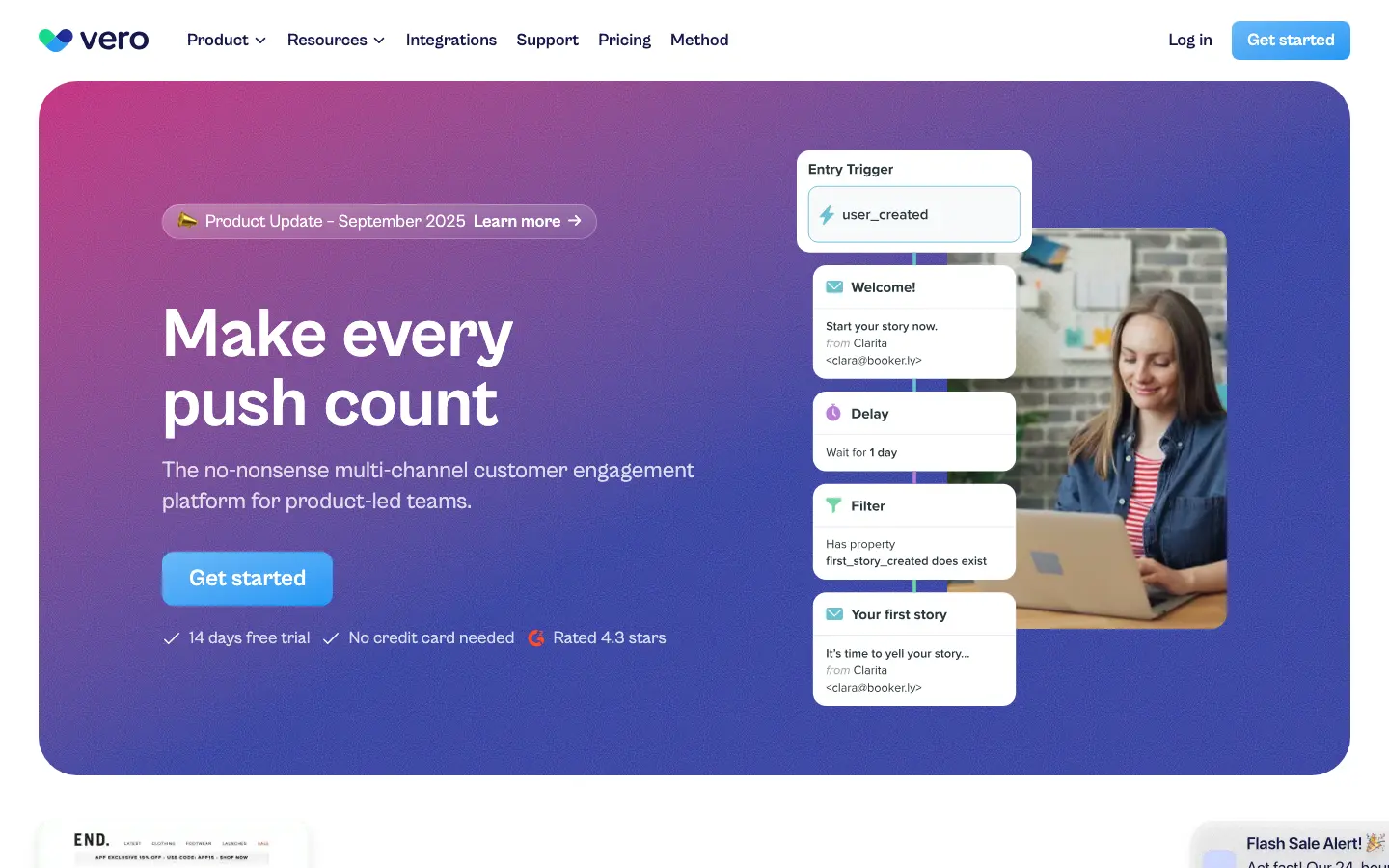
- Event-triggered messaging: Onboarding sequences, activation nudges, abandoned flows, and lifecycle campaigns — all driven by actual user behavior.
- Visual journey builder: Drag-and-drop automation with branching logic, delays, A/B splits, and multi-channel coordination.
- Connected Audiences: Direct SQL integration with all major data warehouses. Use any warehouse data for segmentation without duplication.
- Behavioral segmentation: Target users by event history, profile attributes, and live warehouse data.
- Multi-channel delivery: Email, iOS/Android push, in-app messaging, SMS, and webhooks — coordinated in one workflow.
- Developer tools: Full API, Segment and RudderStack integration, and a dedicated developer guide.
- A/B testing: Test subject lines, content, timing, and channel combinations across campaigns.
Pricing
- Starter: $54/month (or $49/month billed annually) — 5,000 active profiles, 10,000 emails/month, 20,000 push messages/month, 160,000 events/month, unlimited team members
- Professional: Custom pricing — scales profiles, emails, push, SMS, and events with a fair-use overage policy and notifications
14-day free trial. No credit card required.
Pros & cons
Pros:
- Active-profile pricing is a genuine cost advantage for B2C and PLG teams with large inactive user bases.
- Connected Audiences gives mid-market teams warehouse-native segmentation — typically only available at enterprise price points.
- Developer-credible platform that product and marketing teams can operate without engineering involvement on every change.
- 12+ years of organic growth and 99.99% uptime — proven infrastructure without VC-fueled bloat or acquisition risk.
- Best-of-breed stack fit — pairs cleanly with Segment, RudderStack, Hightouch, or Census without duplicative CDP spend.
Cons:
- Smaller brand footprint than Customer.io — less likely to surface early in vendor evaluations.
- No WhatsApp channel yet (in development); SMS is newer and less mature than email and push.
- No built-in CDP — a feature for best-of-breed buyers, but a gap for teams that want everything in one platform.
- Smaller review base on G2 (fewer reviews than Customer.io) means less third-party social proof at the shortlist stage.
Customers
Vero is trusted by Dribbble, Unsplash, Pipedrive, Stockpile, and 50+ companies globally. It holds a 4.3-star rating on G2.
One customer put it simply: "Vero has one of the best support teams I’ve encountered."
The platform ships 24/5 email support with a dedicated team.
2. Customer.io: Best for Teams Wanting a Built-In CDP
Customer.io is a customer engagement platform with an "AI-powered" positioning. It serves SaaS, EdTech, FinTech, Healthcare, and Marketplace companies. With 9,000+ brands and 4.4 stars on G2, it’s one of the most recognized platforms in the mid-market CEP category.
The key structural decision Customer.io made is building a CDP layer directly into the platform. Teams that don’t already have Segment or RudderStack get a unified data layer alongside their messaging tooling. That’s a meaningful value proposition for earlier-stage teams or those wanting to consolidate tools.
Customer.io also supports WhatsApp — a channel Vero hasn’t launched yet. For teams operating in markets where WhatsApp is a primary communication channel, that’s a hard requirement that tips the decision.
Key features
- Visual workflow builder: Automation for complex, multi-step customer journeys across all channels.
- Design Studio: Visual message creation for emails, in-app messages, and push notifications.
- Built-in CDP: Data pipelines, custom objects, and reverse ETL — a data layer built into the platform.
- Omnichannel messaging: Email, push, in-app, SMS, and WhatsApp — five channels in one platform.
- A/B testing and cohort analysis: Test and measure campaign performance across segments.
- Ad audience sync: Synchronize engagement data with ad platforms for retargeting.
- Startup program: 12 months free for startups raising under $10M — a strong early-stage acquisition motion.
Pricing
- Essentials: $100/month — 5,000 profiles, 1 million emails/month, 2 custom object types
- Premium: $1,000/month (billed annually) — custom volume, 10 object types, HIPAA compliance, dedicated support, 90-day onboarding
- Enterprise: Custom — priority support, dedicated CSM, dedicated hardware
- Startup program: Free for 12 months (for startups raising under $10M)
Pros & cons
Pros:
- Built-in CDP removes the need for a separate data platform for teams at an earlier stage of data maturity.
- WhatsApp support is a hard requirement for many international and consumer-facing teams.
- 9,000+ brands and 4.4 stars on G2 signal strong market validation and robust third-party social proof.
- Startup program provides 12 months free — a compelling acquisition motion for early-stage teams.
- Broader channel coverage including WhatsApp compared to Vero’s current lineup.
Cons:
- Charges per total profile — a significant cost penalty for B2C or PLG companies with large inactive user bases.
- Entry price at $100/month is nearly double Vero’s Starter at $54/month for a comparable profile count.
- Built-in CDP creates duplicative spend for teams already using Segment, RudderStack, Hightouch, or Census.
- Less suited to best-of-breed stack buyers who don’t want a CDP bundled into their messaging tool.
Customers
Customer.io counts Notion, Pipedrive, StuDocu, Kraft Heinz, Zara USA, and Schneider Electric among its notable customers. That customer base spans from fast-growing SaaS companies to global enterprise brands. G2 reviews frequently cite the platform’s workflow flexibility and breadth of integrations as standout strengths.
Head-to-Head: The Key Decision Dimensions
Pricing — and Who It Actually Favors
This is the most important structural difference between the two platforms. Vero charges only for active profiles. Customer.io charges for all profiles — active or not.
For a B2C SaaS company with 200K total users and 30K actives, that gap is enormous. Vero charges for 30K. Customer.io charges for 200K.
The cost difference at scale isn’t marginal — it can be 5–10x.
Large inactive user bases are common in PLG, B2C SaaS, and mobile apps. For those businesses, Vero’s pricing model is structurally better aligned to actual costs. If your user base is mostly active — common in B2B SaaS — the gap narrows.
Data Architecture — Warehouse-Native vs. Built-In CDP
Vero and Customer.io take opposite bets on where data should live. Vero says: keep data in your warehouse. Customer.io says: bring it into the platform.
Vero’s Connected Audiences gives teams direct SQL connections to their warehouse. No duplication. No extra storage costs inside the messaging tool. Teams with Snowflake, BigQuery, or Redshift already in place get immediate value from this.
Customer.io’s built-in CDP is the right call for teams without an existing warehouse or CDP. It centralizes data alongside messaging in one platform.
But for teams already running Segment, RudderStack, or a warehouse, it creates redundancy. You end up paying to store data you already store elsewhere.
Developer Experience
Both platforms offer a full API, Segment integration, and webhook support. Both are credible with engineering teams.
Vero has a slight edge for teams with high data maturity. The warehouse-native approach appeals to data and engineering teams that want to keep their stack clean. Vero’s deliberate decision not to build a CDP signals a philosophy that engineering teams tend to trust.
Customer.io has better brand awareness in the developer and startup community, partly driven by the startup program and early-stage acquisition. Engineering teams at seed and Series A companies are more likely to have already evaluated or used Customer.io.
Channels
Both platforms cover email, push, in-app messaging, SMS, and webhooks. Customer.io adds WhatsApp. That’s a critical channel for teams serving users in Southeast Asia, India, MENA, and Latin America.
Vero has WhatsApp in development. For teams where WhatsApp is a current requirement, that’s a gap that ends the conversation. For teams where WhatsApp is a future consideration, it’s worth factoring into the roadmap conversation.
Support and Reliability
Vero ships 24/5 email support, a Help Center, full API documentation, and a dedicated support team. Customer reviews specifically call out the quality of Vero’s support team. The platform’s 99.99% uptime SLA and 5B+ messages annually signal mature, reliable infrastructure.
Customer.io’s Premium and Enterprise plans include dedicated support and 90-day onboarding. The startup program includes standard support. At the Essentials tier, support depth is less than what Vero provides at the equivalent price point.
Frequently Asked Questions
Which is cheaper — Vero or Customer.io? Vero’s Starter plan is $54/month. Customer.io’s Essentials plan is $100/month. But the more important variable is the pricing model. Vero charges only for active profiles. Customer.io charges for all profiles. For businesses with large inactive user bases, Vero can be significantly cheaper at scale — even if Customer.io’s nominal tier looks close.
Does Customer.io have better integrations than Vero? Both platforms integrate with Segment, RudderStack, and common data tools. Customer.io’s built-in CDP gives it an edge for teams that don’t have an existing data stack. Vero’s Connected Audiences are better for teams that already have a warehouse and don’t want to duplicate data into a messaging platform.
Which platform is better for B2C SaaS? Vero. Active-profile pricing is purpose-built for the B2C model — large user bases with a significant portion inactive at any given time. Customer.io’s per-profile pricing charges for every user regardless of activity, which gets expensive fast in B2C and PLG contexts.
Does Vero support WhatsApp? Not yet. WhatsApp is in development at Vero. Customer.io currently supports WhatsApp. If WhatsApp is a required channel today, Customer.io is the stronger choice.
Can I use my own data warehouse with these platforms? Vero offers native Connected Audiences — direct SQL connections to Snowflake, BigQuery, Redshift, PostgreSQL, MySQL, and SQL Server. No data duplication required. Customer.io connects to data warehouses via APIs and reverse ETL tools, but doesn’t offer the same native SQL integration that Vero provides.
Which platform is better for product-led growth companies? Vero. The combination of active-profile pricing, event-triggered behavioral messaging, warehouse-native segmentation, and a developer-credible architecture makes Vero a more natural fit for PLG companies. Customer.io works well for PLG teams too — particularly earlier-stage ones using the startup program — but Vero’s pricing model and data architecture align more closely with PLG unit economics at scale.
Does Customer.io have a free trial? Yes — a 14-day free trial, plus a startup program that gives qualifying startups (raising under $10M) 12 months free. Vero offers a 14-day free trial with no credit card required.
Conclusion: Which Is Better for Product Teams?
The honest answer: it depends on where your team is today and where your data stack is going.
Choose Vero if you’re a mid-market product-led or B2C SaaS company with a large user base, meaningful inactive user percentage, and a data warehouse already in place (or on the roadmap). Active-profile pricing will save you real money at scale. Connected Audiences will let you build powerful segmentation without duplicating your data. And the platform’s developer-credible architecture will keep engineering happy while product and marketing teams move independently.
Choose Customer.io if you’re an earlier-stage SaaS team without an existing CDP or data warehouse, you want everything in one platform, or you need WhatsApp today. The startup program is genuinely compelling for seed-to-Series A teams. The built-in CDP makes sense if you’re not yet running a separate Segment or RudderStack instance.
Product-led teams at mid-market scale take their data architecture seriously. For those teams, Vero’s warehouse-native segmentation and active-profile pricing is the right long-term fit.
It gives engineering teams the reliability they need. It gives product and marketing the independence they want.
Start a free trial of Vero — no credit card required.